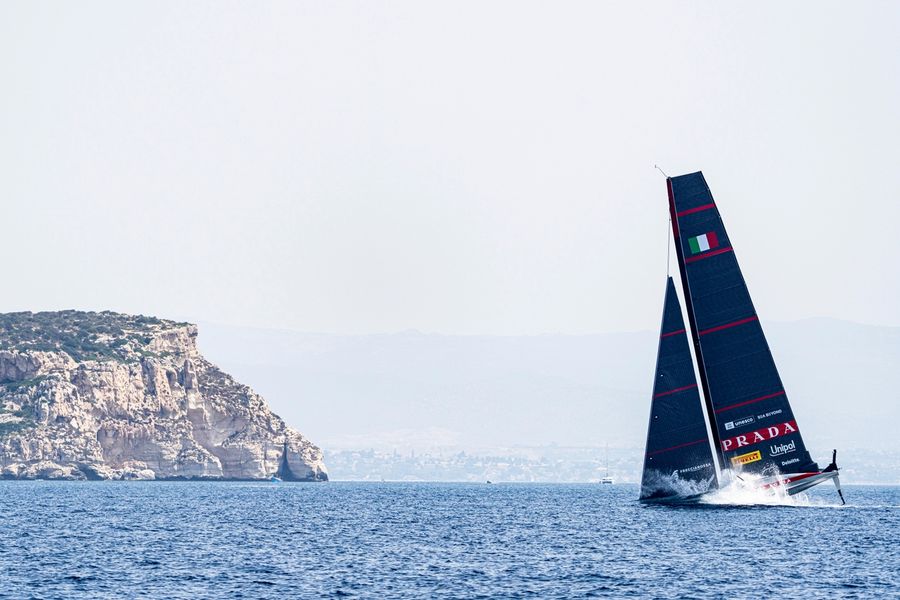
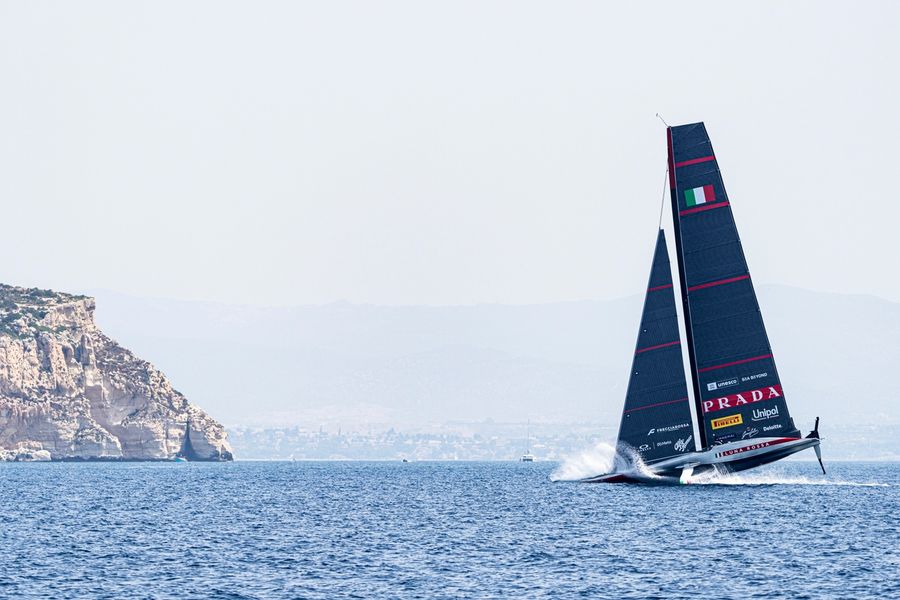
Luna Rossa had a testing day on the water in Cagliari on 15 July as the team found the limits of their recently introduced rudder configuration before a hydraulic issue cut the session short.
The Italian team rolled out at 9:10 with additional GoPros removed from the starboard wing, while the newest mast-mounted cameras remained in place. With a dying offshore Maestrale still blowing, the squad postponed dock-out to 11:15 to wait for the first sea-breeze. The newest mainsail, designated M2-1, was hoisted at 11:30 and paired with the newest J1-1 before leaving the harbour.
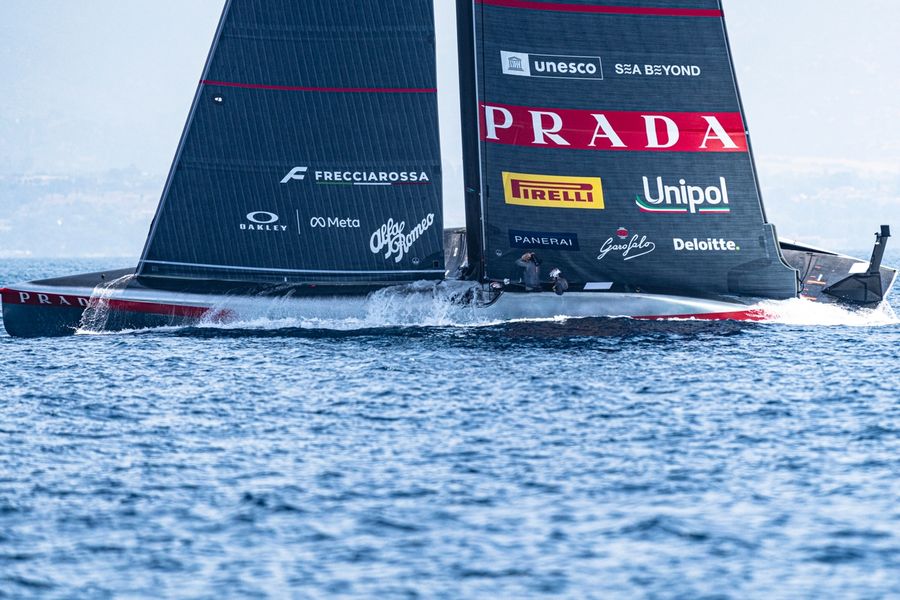
The starting crew had Marco Gradoni on helm, Gigi Ugolini on trim, and Maria Giubilei as fifth on port, with Peter Burling on helm, Vittorio Bissaro on trim, and structural engineer William Brooks as sixth on starboard.
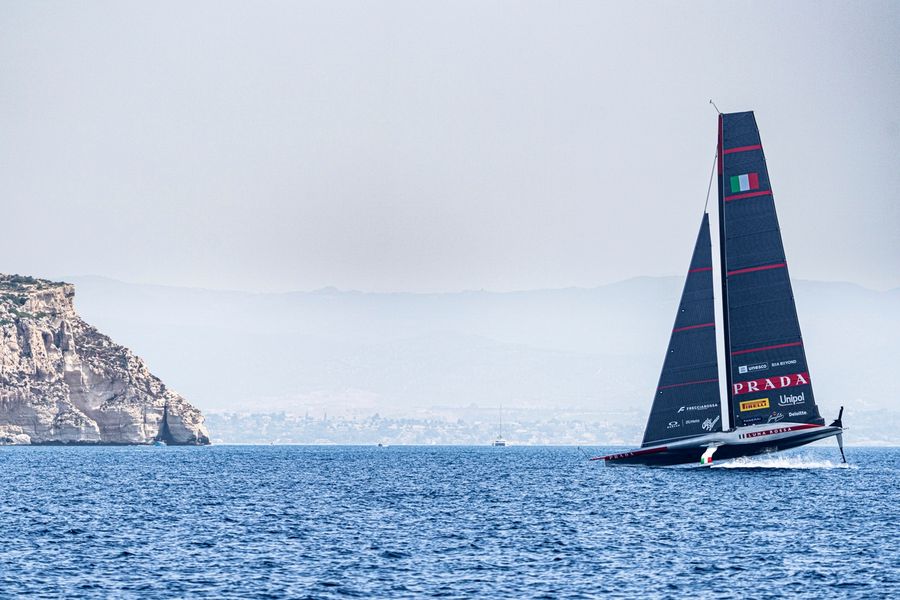
The first session got underway at 11:55 following a tow-to-foil from the chase boat. The yacht sailed in the lightest conditions recorded so far, with 4 to 6 knots from 145 degrees over a minor residual swell of 0.3 metres. Manoeuvring looked consistent, with predominantly dry tacks and gybes even in the minimal breeze.
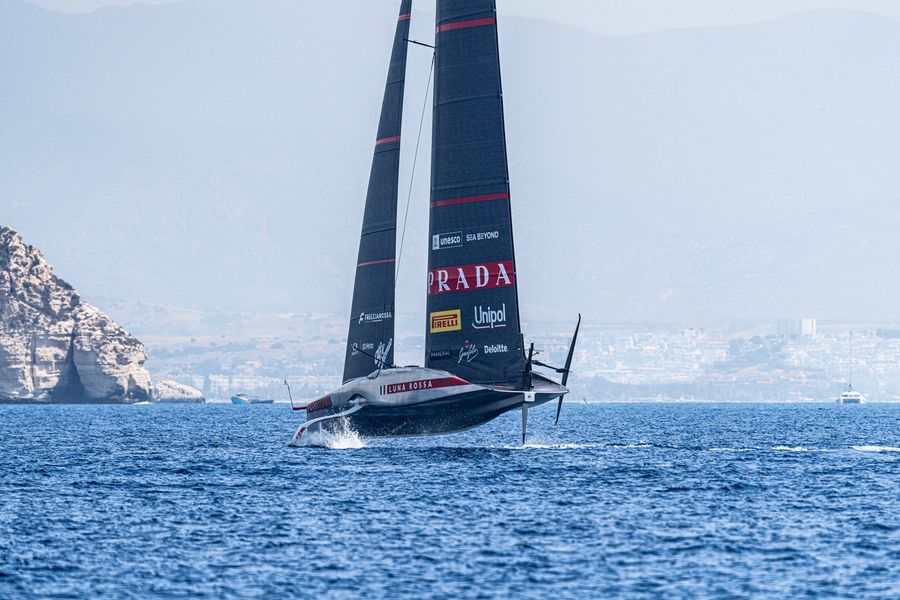
The trouble started after the first roundup. The on-water recon team described what followed: "After the first roundup, the yacht appeared with significant windward heel and cant, almost immersing the inboard half of the starboard wing while still in sailing mode. As the yacht bore away, the boat entered the first gybe from stbd to port in a very bow-down trim, and the rudder pierced, resulting in an impressive nosedive. The Rudder Elevator was out of the water before the bow touched the water. Besides a broken wand and several fairings that had to be taped together, there was no major damage to the boat."
Luna Rossa introduced the new rudder form earlier in July and has been working through the nuances of the design and its smaller elevator, the horizontal hydrofoil that provides pitch stability and lift, ever since. The nosedive marked the point where the team found the limit of that configuration.
Just as sailing appeared to resume, technicians gathered around the main track, pointing to a possible hydraulic issue. A second session eventually got underway at 13:35 after a tow-to-fly, but the yacht stopped again shortly after, suggesting the problem had not been fully resolved. Jib car, main car, and mast trims were tested, with trim vibration producing an unusually loud oscillating noise during this period.
The boat managed a self-take-off at 13:48 with the breeze building to 7 to 9 knots. Several bear-aways to roundups were practised before heading downwind for gybes, though board drops appeared inconsistent on a couple of tacks, with the board not dropping gradually. On the final gybe, the port board appeared very canted and was also not dropping gradually.
Sails were dropped and the team called it a day at 14:30 due to the hydraulic issue, having completed approximately 33 minutes of foiling time, 15 tacks, and 12 gybes. As the day ended up short, foil designer Francisco Azevedo was the only personnel change, taking the sixth position. Luna Rossa towed back to their base at Molo Ichnusa in the Port of Cagliari.