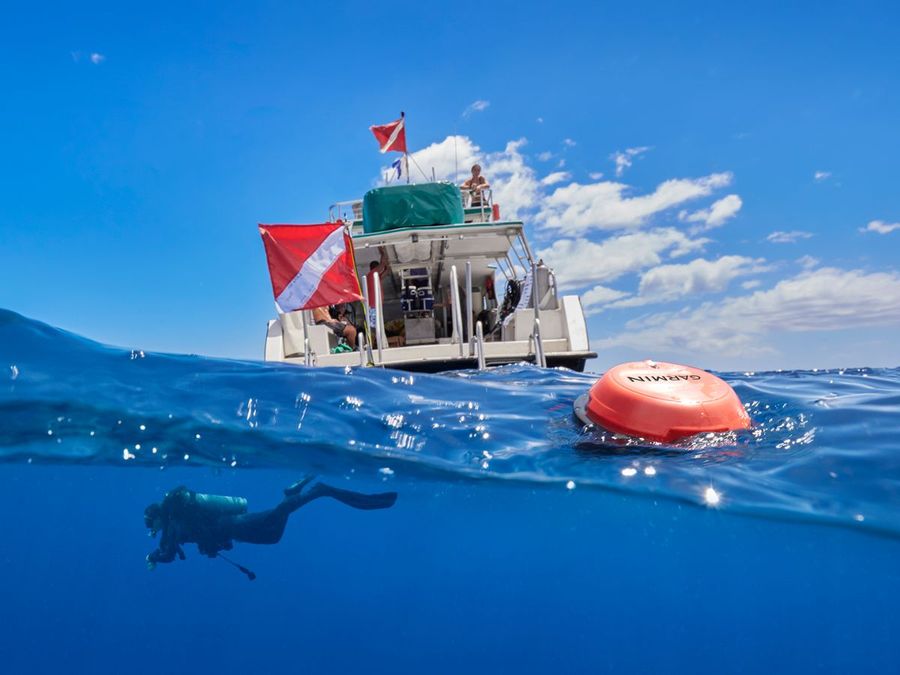
Garmin has added a genuinely new piece of equipment to its dive range, one that tackles a problem as old as the sport itself: keeping divers and surface crews connected. The Descent S1 Smart Buoy uses Garmin's SubWave™ sonar networking to track, monitor, and exchange messages with up to eight divers simultaneously, all linked through compatible Garmin Descent dive computers.
The S1 is not a revision of something that already existed. Although it draws on SubWave™ technology and the Descent T2 transceiver familiar to users of existing Descent computers, the buoy itself represents the first time Garmin has brought those capabilities together in a surface-deployed device built specifically as a communication and tracking hub between divers and the team above.
Susan Lyman, Garmin's Vice President of Consumer Sales and Marketing, describes it as a significant step forward for the sport. The buoy, she says, "adds game-changing communication, navigation, and safety capabilities between divers and their surface crew, making it the next must-have piece of kit for dive teams, charter operations, instructors and more."
One of the more practical features for anyone diving in moving water is the navigation information the S1 gives to connected divers. Whether the buoy is fixed to an anchor line, drifting on a tag line, or sitting in a set position, divers can see both the distance and the direction back to it at any time. That kind of consistent reference point can make the difference between a controlled ascent and a stressful one when currents are running.
The S1 also extends the communication range between Descent units themselves, pushing diver-to-diver messaging out to 100 metres. A set of pre-configured messages lets divers share information on their position, what they intend to do next, how much decompression time remains, or whether they need to surface ahead of schedule.
For the crew on the surface, the S1 pairs with the Garmin Dive™ app to deliver real-time tracking of everyone in the water. When divers are using a Descent computer fitted with a T2 transceiver, topside teams can follow depth, location, and tank pressure from above. The system triggers automatic alerts if air supply drops to a critical level, and surface crews can push preset messages back down to divers, including an urgent recall if conditions deteriorate. After the dive, underwater heatmaps within the Garmin Dive app allow the whole team to review the session and see precisely where it unfolded.
The hardware itself is designed to handle daily use in a marine environment. Coming in at just under a kilogram and carrying an IPX8 rating to 10 metres, it is straightforward to deploy and not easily put out of action by salt water and rough handling. The rechargeable lithium battery delivers up to 15 hours of use, which is comfortably enough to cover a full weekend of diving on a single charge.
At a recommended retail price of $4,999 NZD at the time of writing, the Descent S1 Smart Buoy sits firmly in the professional and serious recreational category. For commercial dive operations, training schools, or committed dive teams where safety and communication are non-negotiable, it represents a compelling case for investment.
Garmin has built its reputation on producing technology that performs reliably in demanding conditions. With the Descent S1, the company has created something that did not previously exist in its lineup: a dedicated surface buoy that closes the communication gap between the underwater world and the crew waiting above.