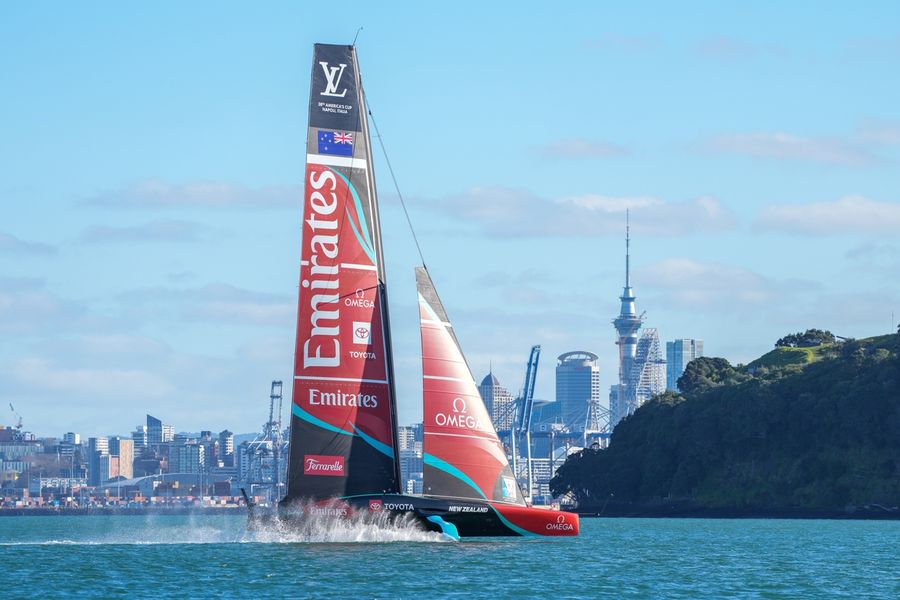
The phrase "systems controls" is one of the most frequently heard terms in the America's Cup right now, and it is where the meaningful gains are being made. Controlling sail shapes and pre-setting those shapes so they can be accurately reproduced across a wide range of conditions is the priority for every team at this stage of the campaign. Data flows back in real time to shore teams where designers and sailmakers are on hand, while out on the water telemetry is being captured and processed aboard the chase boats.
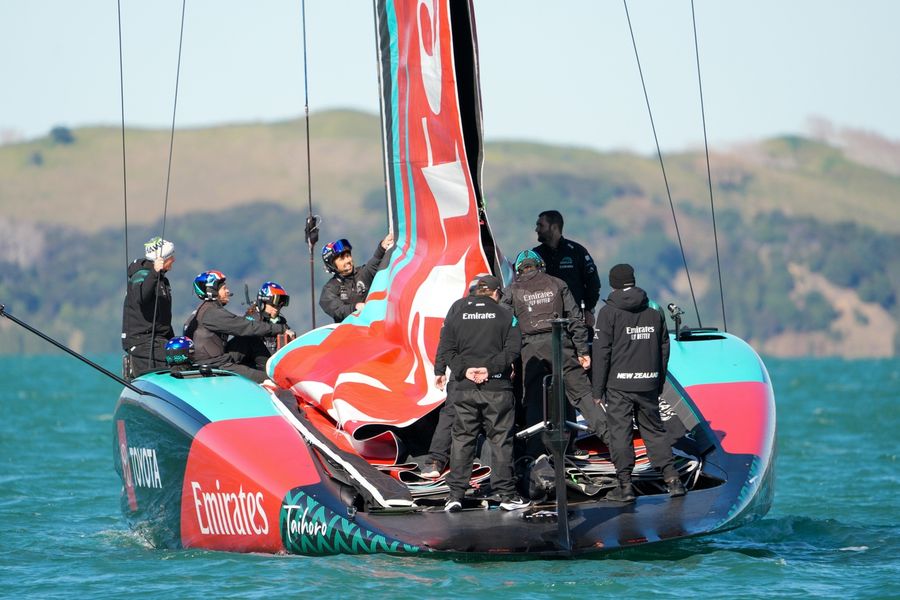
Emirates Team New Zealand had a long winter's day on the Waitemata on 5 August 2026, rolling out of the shed at 0815 and splashing at 0857. The standard crew of Outteridge, Maloney, Jensen and Aleh was on board, with Draper filling in on port helm for an absent Menzies.
The tow south to the far end of the paddock near Passage Rock covered around 30 kilometres. A strong 20-knot southerly was already easing by the time ETNZ hoisted their M2-0 and J4-2, with the breeze settling to 12 to 16 knots. ETNZ came off the tow at 1042 but it was not until 1118 before the mainsail was fully hoisted, having stuck near the bottom and paused several times on its way up. A crew member was sent up the mast to free it, and by 1129 the boat was finally underway and up on the foil.
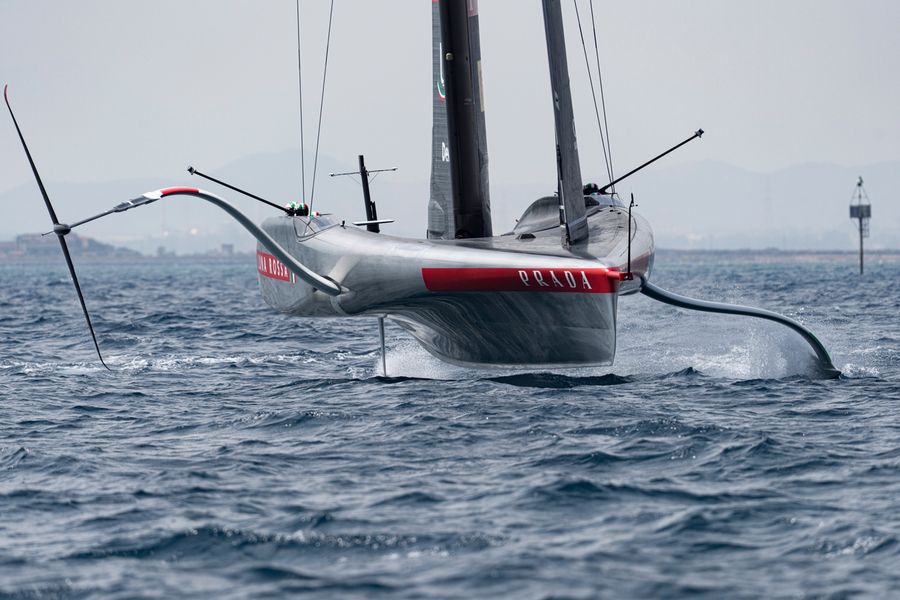
Lifting onto the foil at 17 knots, the acceleration from lift-off to racing speed appeared noticeably quicker than usual. ETNZ were very quickly up to maximum VMG, particularly impressive given the lighter winds and smaller jib. They then made their way back to Eastern Beach where conditions better suited the J4-2, completing speed runs at close to 50 knots boat speed before ending the first session at 1212 in the shelter of Motuihe Island.
ETNZ changed to their J3-3 and sailed in a light, patchy 8 to 10 knots behind Motuihe Island, heading downwind towards the Noises. At 1252 the boat fell off the foils in a gybe in 7 to 8 knots of breeze, below the usual operating range of the J3. The failed manoeuvre was still a small surprise: the boat had plenty of entry speed but appeared to suddenly stall the flow over the sails on exit, causing it to pop off the foil.
After a brief tow to steadier breeze on the other side of the Noises, the session ended at 1307 on the northern side of Rakino Island. A quick VIP crew swap followed before ETNZ sailed back onto the foils in a sheltered 8 to 10 knots and headed over to Whangaparoa where the breeze was much stronger. These later sessions involved much longer runs, with the boat eventually working its way back up the harbour via Rangitoto Island, finishing the day at 1515 in the shelter of Mechanics Bay and arriving back at the dock at 1545.
The on-water Recon Team noted far more ability to control the middle of the mainsail than had been seen in previous sessions. During the longer runs there were noticeably more rapid and greater adjustments to the depth of the mainsail, while the platform itself remained relatively stable throughout. Previous sessions had shown a lot of movement at the very top of the sail, but this was the most and quickest movement in the middle segment observed to date, suggesting considerable work during the recent break to develop these controls and the coordination of the trimming systems. Manoeuvres overall were minimal, pointing to a focus on straight-line speed development in the punchy, cool southerly.
The team also took an unusually long time to hoist the mainsail, which may indicate new technology inside the double skin. Some manoeuvres, particularly on exit, surprised the Recon Team for their lack of consistency, again suggesting the sailors were working on variables in trim. Foil development, so often a major focus of AC75 tuning, will come later in the programme. For now, it is all about the aero package.
La Roche-Posay Racing Team returned their boat B1 to the water at Lorient on 4 August 2026, their first sailing day since the D7 incident on 7 July. Team representative Antoine Rucard attributed the layoff to water ingress that led to a battery fire, with the systems stripped out of the boat for repairs. The mast rolled out around 09:55 and the boat came out of the shed at 10:07, with work on the spare mast continuing outside.
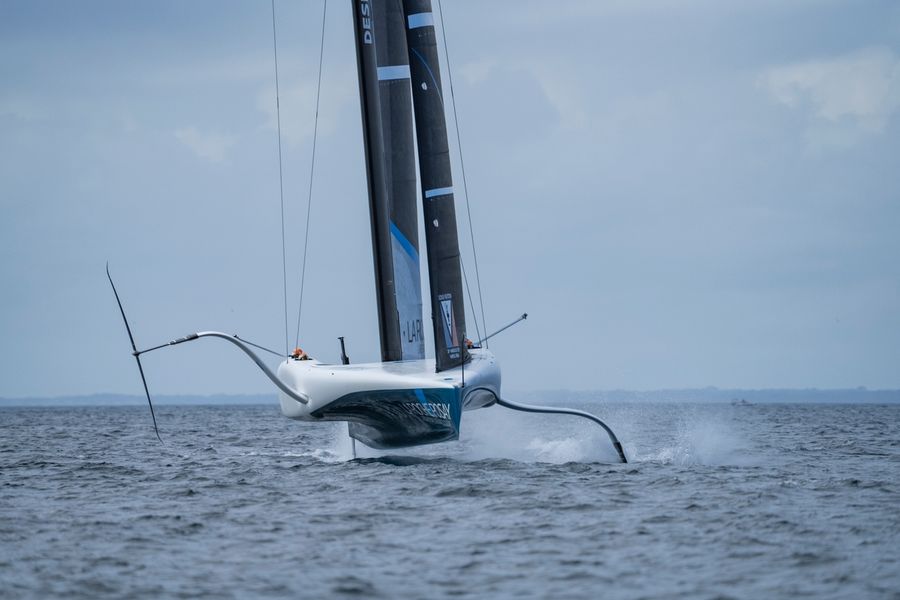
Two small white sensors had been added at the masthead, along with a masthead windex and anemometer unit. The foils, extension fences, wings, flaps and rudder shaft all appeared consistent with previous sailing days, though the port wing tip carried a slightly shinier silver area. On the aft face of the mast tube, the two upper openings appeared to have been covered over, possibly with a film.
During the commissioning phase on the dock, attention centred on the port central pod and the Cunningham system, which effectively de-powers the sails as the boat increases speed. The traveller system also drew attention, given it is considered the most likely location of the cause of the capsize a month earlier.
The boat was put in the water around 12:10 for further checks before docking out at 13:46, behind schedule. Sailing took place through the afternoon in a shifting WSW breeze, over a notably choppy, almost swelly sea. The mainsail and what appeared to be a J3-2 were hoisted, and the boat made its first brief self-start onto the foils at 15:07. A jib change to what appeared to be a J2-1 was made around 15:48, after which the sea flattened and the breeze became more constant. The boat looked more stable through this later part of the session.
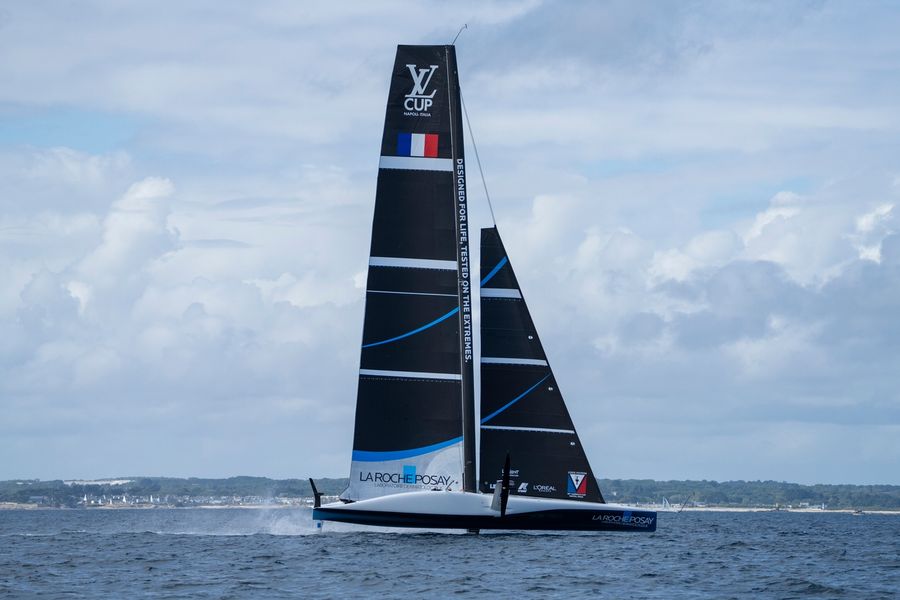
On one gybe exit the boat heeled significantly and came down in a heavy touchdown. On one or two occasions it also appeared slow to rebuild speed following a gybe. A battery change was carried out around 17:07 before the final run. Sailing finished at 17:30, with the boat towing back to the marina and docking in at 18:12 to visibly happy faces on board. The boat was back in the shed by 19:56.
Sailing team leaders Quentin Delapierre and Diego Botin looked comfortable and in control through most manoeuvres and take-offs, with a stable flight in a straight line. La Roche-Posay Racing Team will increase their training load to recover lost time in the coming days.
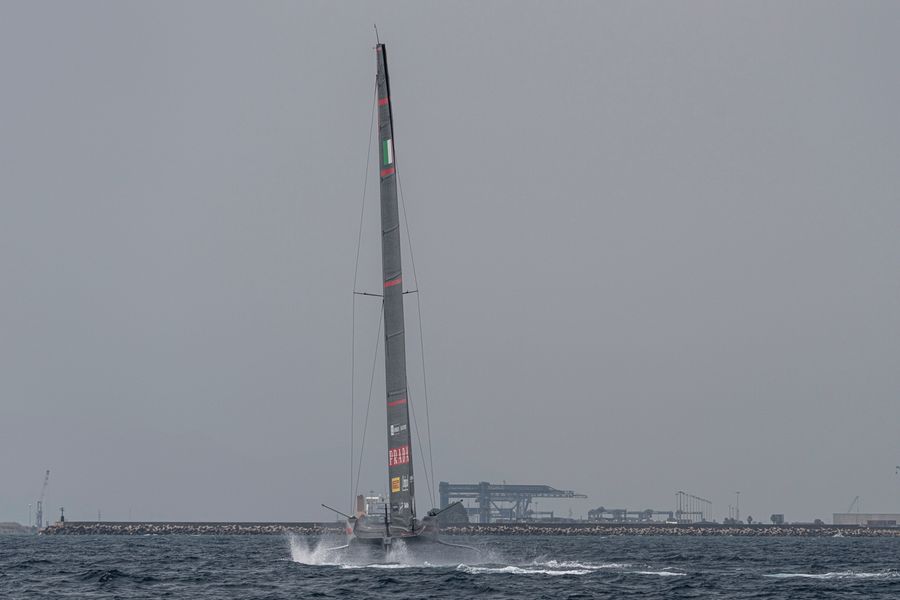
Luna Rossa were out on 4 August 2026 for their 14th sailing day in Cagliari, rolling out the boat at 10:00 with a refined bow paint job and the longer legacy rudder R06 mounted. The use of R06 may indicate that modifications are being carried out on the newer R05. The GoPros had been removed from the starboard wing, leaving only the standard slim camera housings on both wings.
Conditions outside the harbour were light, with 6 to 8 knots from 140 degrees and a short 0.4 metre chop. The starting crew included Marco Gradoni and Peter Burling on helms, with Umberto Molineris, Vittorio Bissaro, Maria Giubilei and Francisco Avezedo also aboard. Later in the day, Ruggero Tita replaced Marco Gradoni, Ugolini replaced Bissaro, and Pietro De Luca rotated in for both Avezedo and Giubilei.
By 12:00, J2-9 was hoisted and paired with mainsail M2-1, on which additional red camber stripes were noted on both skins near the head. Whether these represent a reinforcement added over the top two main batten skin portions was not confirmed.
The Recon Team noted that as on previous days, the mainsail head leech tended to remain quite open, leaving a visible gap between the two skins in some modes. When the boat came to a stop mid-session, technicians jumped on board to inspect the first batten hardware and the mainsail traveller, which is hidden beneath the fairings and has been an area of considerable focus for Peter Burling in recent sessions. Team members obscured the recon view, so it could not be determined whether the issue was hydraulic or something else.
The first session began with a tow-to-fly from the chase boat. The yacht started on starboard tack and completed its first tacks in patchy, light conditions before splashing hull-borne at 12:12 following a mistake while exiting the first gybe. Further offshore, the sea breeze had eased to approximately 5 knots, prompting the team to attempt a self-start, which was successful.