For the crews of World ARC 2025, arriving in Mackay carries a weight that no port before it quite has. Australia marks the halfway point of a circumnavigation measured in lived hours rather than neat statistics, a threshold where the Pacific finally lies astern and the world's remaining oceans stretch ahead. The miles already sailed number in the tens of thousands. The memories are beyond counting.
To understand the scale of what these sailors have accomplished, it helps to trace the route back to its beginning, months and thousands of nautical miles ago.
The rally launched from Saint Lucia in January, spinnakers and gennakers drawing full in the trade winds as the fleet shaped course south. The first leg to Colombia was not without incident. Mechanical troubles, heavy rain, and the occasional confused sea tested both gear and resolve, but what those early miles also revealed was the glue that holds a rally together: the bonds between crews who discover, quite quickly, that camaraderie matters as much as competition. This was always going to be a marathon.
The Panama Canal rewarded patience with spectacle. Locking through alongside ocean-going cargo vessels, rafting up with rally friends while the chambers filled and emptied, and then that extraordinary moment when the final gates swung open and the Pacific lay ahead. Beyond the canal, the San Blas Islands offered swaying palms and coconut-rich anchorages, Panama City provided contrast and provisioning, and then the ocean itself took over.
Few places stirred the fleet quite like the Galápagos. Sea lions commandeered jetties without apology, giant tortoises moved through highland mist as if time itself had slowed, and hammerhead sharks swept past divers with magnificent indifference. The islands' famous wildlife, so startlingly unafraid of people, delivered everything sailors had imagined. Strict biosecurity rules, hull inspections, and controlled landings tested patience, but few crews grumbled for long once ashore among creatures that have never learned to fear humans.
Then came the passage that defines the Pacific for any offshore sailor: roughly 3,000 nautical miles from the Galápagos to the Marquesas. Weeks at sea. Flying fish skipping across decks in the grey of predawn. Sunsets that saturated the ocean in shades of copper and red. The Southern Cross climbing higher each night as the fleet drove south and west. Tuna came aboard on some boats while others wrestled with broken gear or depleted freezers, but every crew found the same strange peace of passage-making, where the day's rhythm is set by watches and meals and the slow wheel of stars rather than any clock ashore.
Landfall at Hiva Oa, after nearly three weeks at sea, brought volcanic peaks rising from morning haze. Cold Hinano beers, grilled steak, and the sound of friends laughing ashore confirmed what every arriving sailor feels: that to come into port under sail, from deep ocean, is one of the finest experiences the sea offers.
The Marquesas gave way to the Tuamotus, where turquoise lagoons and reef-fringed passes opened a different chapter entirely. Drift-snorkelling through coral gardens, watching manta rays bank silently below the surface, sharing food cooked in earth ovens, and absorbing the warmth of Polynesian welcome, these experiences accumulated alongside the miles. The Society Islands followed, their jagged peaks and black-sand beaches adding more pages to already full logbooks. From Bora Bora the fleet dispersed westward across a chain of stepping stones: Niue, Tonga, Fiji, Vanuatu. Rain-soaked hikes, wreck dives in clear water, kava ceremonies, and dolphin pods riding bow waves all became part of the shared story. And then the Coral Sea delivered the fleet to Australia.
The road ahead is no less ambitious. Bows will swing westward toward Indonesia, with Lombok a first taste of the Indian Ocean's complexity. Christmas Island and the Cocos Keeling Islands lie beyond, remote anchorages where self-sufficiency counts. Mauritius and Réunion will offer volcanic drama before the long southern run to Richards Bay, bringing the fleet to landfall on the African continent.
Come January the South Atlantic opens up, with Namibia, St Helena, and Brazil marking the arc north and west. By March, trade winds will once again fill canvas, driving the fleet back toward the Caribbean. The final return to Saint Lucia, parade of sail and prize-giving included, is pencilled in for April, fourteen months after departure and 26,000 miles after the last ties were cast off.
Describing World ARC 2025 purely as a 26,000-mile rally reduces something richer to a single measurement. There is also the particular quality of light over a Pacific dawn, the relief of a safe anchorage after a hard night, and the pleasure of a beach barbecue where the currency is coconuts. There is serious seamanship when squalls demand it, and absolute stillness when the wind drops and the stars multiply. There is the fatigue of consecutive watches and the discovery that people you met only months ago now feel like family.
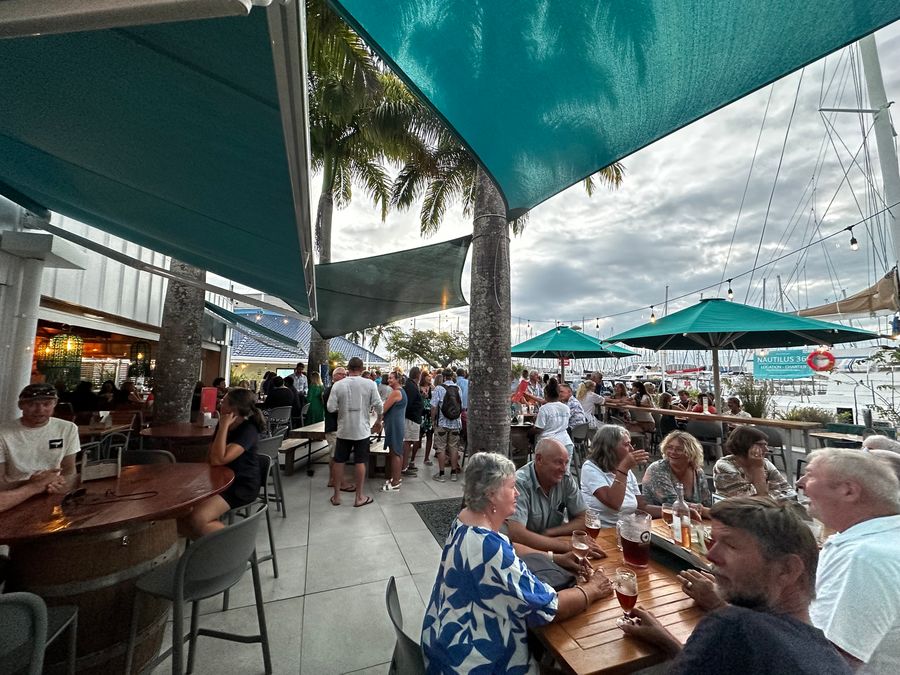
In the marinas at Mackay, among salt-stained hulls and sun-darkened faces, there is a mood that is equal parts satisfaction and restlessness. Half a world of ocean is already behind these crews. The other half, from the spice-island anchorages of the Indian Ocean to the wind-driven passages around Africa and the long Atlantic run home, waits just over the horizon.
For those who have ever pictured themselves on a boat with the whole world ahead, the 2027-28 edition of World ARC is now open for registration. The fleet can depart Saint Lucia in January 2027, or join from Darwin in September 2027, completing a full circuit of the globe on the trade-wind route before returning to Saint Lucia in April 2028, after 26,000 miles of discovery.