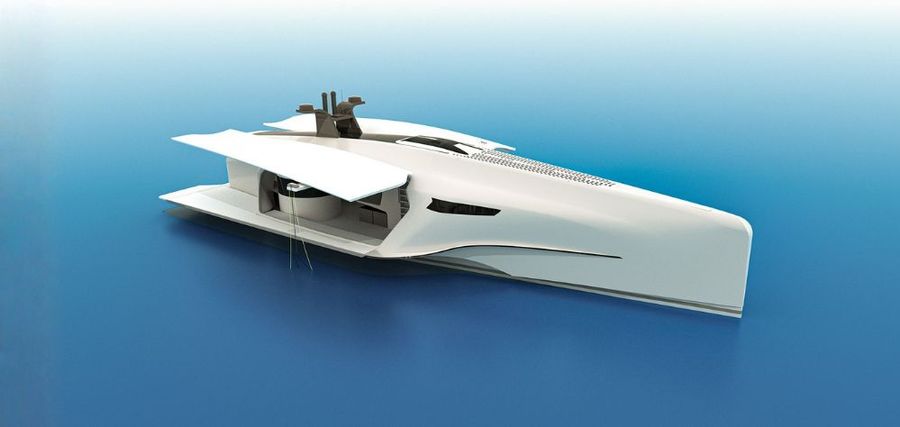
The brief was simple to state and hard to solve: design a research vessel around fleets of miniaturised underwater drones, rather than the divers and heavy gear that have defined ocean science for decades. That's the starting point for a new design just completed by French naval architecture studio Thomas Tison Yacht Design, working with Mines Paris, one of France's oldest engineering schools.
Underwater drones have become dramatically cheaper to build and run in recent years, and that shift is opening ocean research up to far more operators than the old model of costly crewed submersibles ever allowed. Seafloor mapping, ecosystem tracking and pollution monitoring all become more achievable once you're not relying on a handful of expensive deployments a year. Designing a vessel purpose-built for that reality, rather than adapting an existing research ship, was the whole point of the exercise.
That reasoning shaped two specific demands in the brief. First, the vessel needed to be genuinely welcoming to the public, somewhere people could engage directly with what's being discovered, rather than a closed platform bristling with equipment nobody outside the science team understands. Second, and far trickier from an engineering standpoint, it needed to sit completely still for 24 hours while drones worked below it, with zero environmental footprint. Anyone who's held a boat steady on a mooring through a full tide cycle will appreciate why that's no small ask.