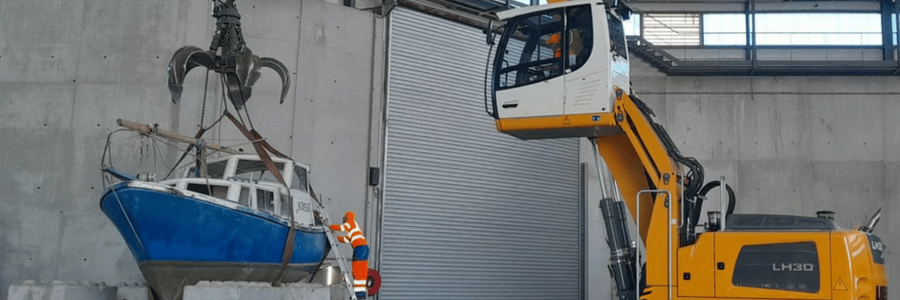
France and the United States are leading a push to remove and recycle abandoned boats at scale, with Europe moving toward a continent-wide approach to end-of-life vessel management.
In the US, the National Oceanic and Atmospheric Administration's Marine Debris Program provided a 10 million dollar grant in 2023 to fund a major clean-up of abandoned and derelict vessels from coastal waterways and the Great Lakes. BoatUS received the funds and has been building a national database of abandoned boat locations since then. Last year, the programme paid for the collection and retrieval of over 300 boats across five states, US territories and one tribal reservation, with removal now set to scale up nationwide through the current 2026 boating season.
Boaters are being asked to report any abandoned vessels they spot on the water. "With boating season around the corner, boaters have an opportunity to spot and report abandoned vessels that might otherwise go unnoticed," says BoatUS Foundation director of outreach, Alanna Keating. "Each report helps communities better address the issue of abandoned and derelict vessels by supporting both removal efforts and prevention." The cost of collecting, dismantling and recycling a single vessel can exceed 24,000 dollars.
France has taken a different approach, introducing a boat tax called Teamup in 2022 to fund ocean protection, infrastructure maintenance and end-of-life recycling. The tax is levied on boats from seven metres, calculated progressively by length and engine power, and generates an estimated 45 million euros annually. A 10-metre yacht with a 35-horsepower engine, for example, pays 254 euros per year.
The tax led to the creation of APER, the Association pour la Plaisance Eco-Responsable. By the end of 2024, APER had overseen the dismantling of 11,000 boats across 36 facilities, with three quarters of all reclaimed materials either recycled or burnt to generate electricity. Collection is free for the boat's last owner. The programme began as a four-year project in 2015 and has been extended to at least 2029, though the industry is heavily criticising planned changes to the tax scheduled for 2027.
The broader European picture is shaped by the European Boating Industry's roadmap, presented in March 2023, targeting a fully circular boating industry by 2030. A central idea is combining the recycling of fibreglass boats with decommissioned wind turbine blades, both composed of similar glass fibre and polyester resin composites, to achieve the volumes needed for cost-effective processing. The EBI estimates between 30,000 and 40,000 boats will reach end-of-life in the EU by 2030, representing at least 30,000 tonnes of composite material. End-of-life wind blades represented a similar figure in 2025 and are projected to reach 60,000 tonnes by 2030.
A Luxembourg and Bristol-based start-up, Uplift360, has been awarded a 7.4 million grant to establish a European composite collection system. Beyond the environmental case, the project carries a strategic dimension. The fossil-sourced materials used in composites are largely not produced in Europe, and recovering them domestically could reduce dependence on international supply chains.
Before composite hulls can be processed, boats must first be stripped of engines, fuel, oils, steel wiring, metal fittings, electronics, timber, foam and fabric. Much of that equipment has little resale value, and achieving genuine circularity across the full range of boat materials remains a hard task for the industry.