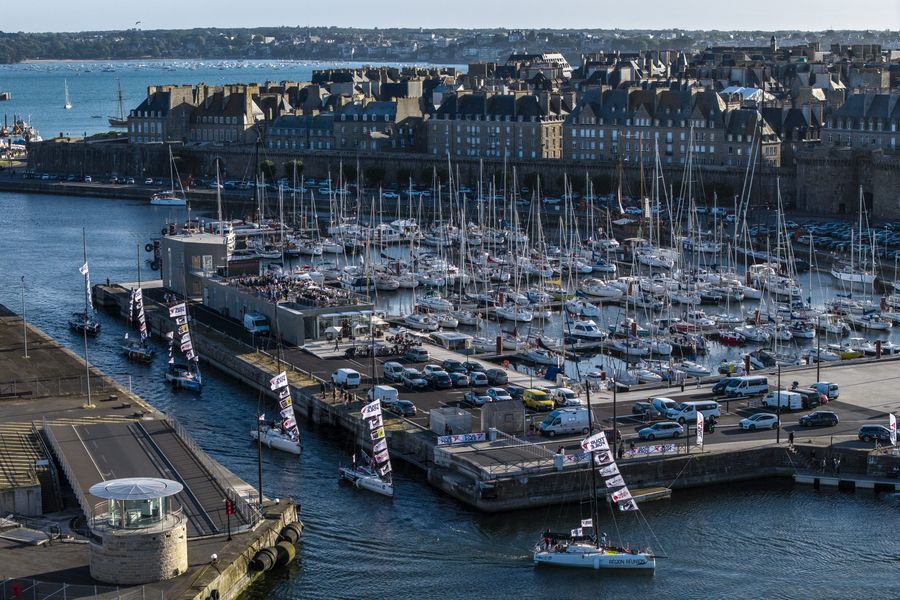
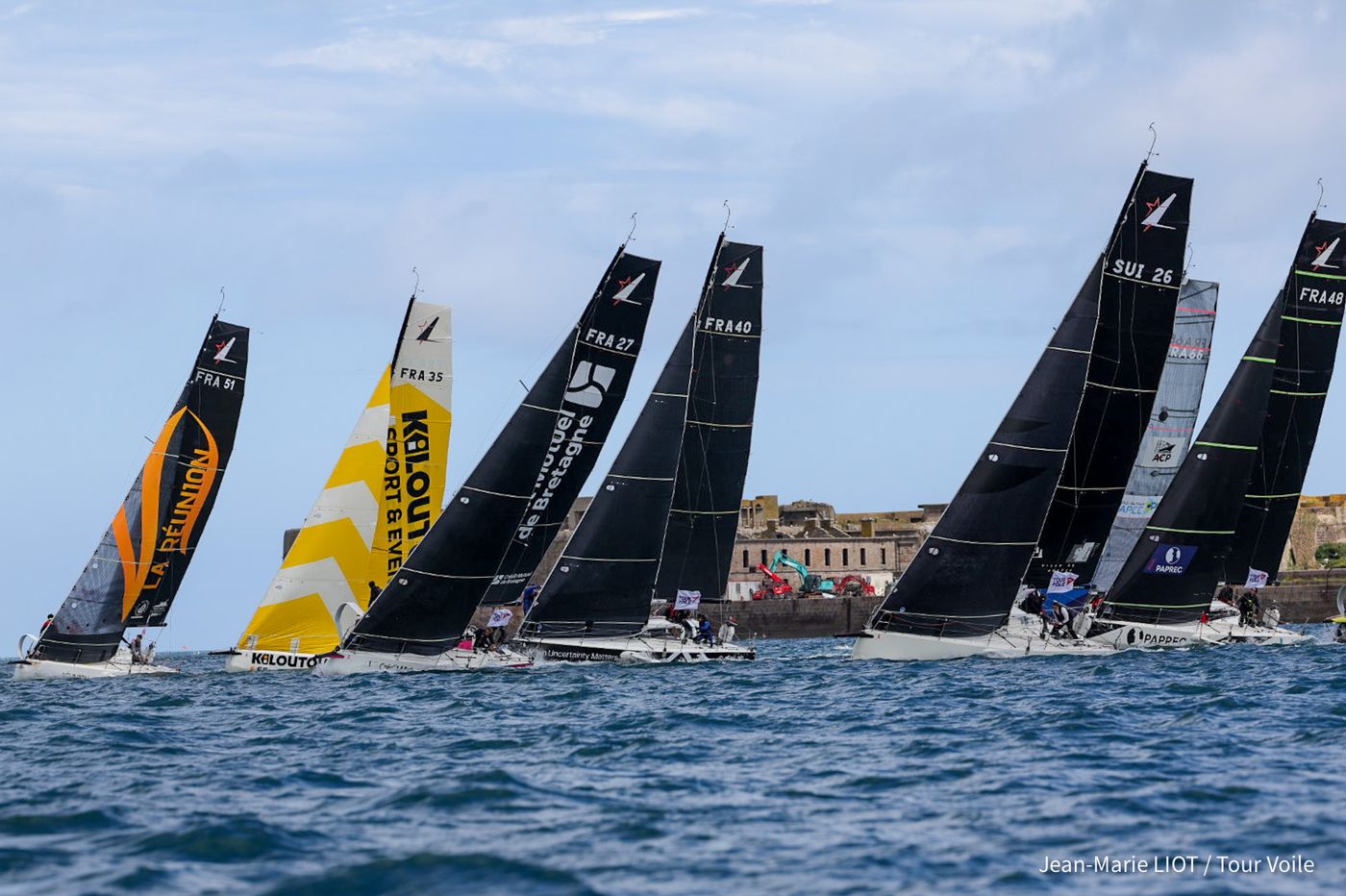
Nine Figaro Beneteau 3s cast off from Cherbourg-en-Cotentin at midday on Sunday, setting course for Saint-Malo on the first offshore leg of the Tour Voile's 47th edition. The route covered roughly 226 nautical miles, taking in a waypoint at Needles Fairway off England's Isle of Wight, which meant two Channel crossings, close to thirty hours of continuous sailing, strong tidal flows, gusts forecast to reach 30 knots near the English coast, and a navigational challenge of an entirely different order from anything the fleet had faced in the opening days.
That contrast was written clearly on the crews before they left the dock. The shorts and t-shirts of the inshore racing had disappeared under merino base layers, hats, and serious waterproofs. The wardrobe change told its own story.
The first two days had rewarded reaction speed, tactical instinct, and moment-to-moment aggression. Each sprint race arrived with its own blank slate. The offshore stage called for something else altogether: structured watch systems, carefully managed fatigue, and the mental capacity to plan across hours rather than minutes.
Paul Loiseau, helming Région Bretagne – CMB Espoir, welcomed the format change before the fleet departed. "This first stage marks a real shift in dimension," he said. "It's exactly the kind of racing that suits our team. Long passages are crucial in Tour Voile, and we're eager to show what we can do in this format."
For several crew members in this year's fleet, the offshore leg represented something beyond a change of format. The Tour Voile has long championed an educational dimension, and Oakley Marsh, racing aboard digiLab x RORC, described it in exactly those terms. "Tour Voile is fundamentally an educational adventure," he said. "Our goal is to enjoy ourselves, learn as much as possible, and give young sailors the experience they'll need for their future at sea."
Eve Durbant, from Réunion, arrived at the rally stage with no previous Tour Voile offshore experience to draw on. She was unfazed. "I've been looking forward to it," she said on Sunday morning. "We've prepared thoroughly. Now it's time to apply it all on the water."
The early miles were expected to be fast. Wind building toward 30 knots near the Isle of Wight would put a premium on raw boat speed through both Channel crossings. The Channel, though, rarely rewards those who assume the shortest route is the smartest. Cargo traffic, tidal reversals, and layered current patterns across the crossing would all demand careful thinking alongside outright pace. As Durbant observed: "In sailing, straight lines are never actually straight."
Alexandre Carlo, sailing LGC Sailing – Bretagne Plaisance, identified tidal management as the central challenge. "Finding the right balance between boat speed, angles, and tidal flows, being in the right place at the right moment, that's the puzzle here," he said.
The race's character was expected to shift considerably on the approach to Saint-Malo, where the breeze was forecast to ease. The speed game of the open Channel would give way to patient water-reading and precise boat-handling. A loop was planned off Saint-Malo, timed to bring the fleet to the harbour lock on Monday evening, with exact distances and scheduling remaining subject to adjustment depending on conditions and how the racing unfolded.
Margot Vennin, aboard PAPREC by Normandy Inshore Program, had the finishing stretch firmly in mind. "The beginning will be quite fast, but the final phase is shaping up to be much more technical," she said. "Those last miles will demand sharp thinking and clean tactical choices."
Loiseau offered a pointed warning about the psychological trap the approach can set. "If the loop stays in play, crews will have to re-engage their brains while Saint-Malo is right there, but everything's still undecided," he said. "That's where people get caught."
The arrival carried different meaning for different competitors. For Carlo's team it was a return to familiar ground. "It's a homecoming," he said. "We want to perform in our own backyard, though knowing the water doesn't guarantee anything. Sometimes familiarity is exactly what gets you into trouble."
Maïwenn Deffontaines, sailing for Dunkerque – Kiloutou, held a deeper personal connection to the destination. Saint-Malo was where she first discovered sailing, working her way through Optimist dinghies and windsurfing before moving on to offshore racing. "Coming back through the channel, past the Grand Jardin, seeing my family, that will be something special."
Two days of inshore racing had left the fleet sharp and quick. The Channel would now test something harder to develop on a training run: the capacity to let time and tide work in your favour.