For many Kiwi boaties, the tender barely gets a second thought until it refuses to cooperate on the one occasion it's actually needed. It's the workhorse of any boat: ferrying crew to shore, running kids to the beach, and serving as a last resort if things go seriously wrong offshore. The problem is that tenders earn that hardworking reputation by taking a constant beating. They get dragged over beaches, left out in all weather, and bumped around in marinas season after season.
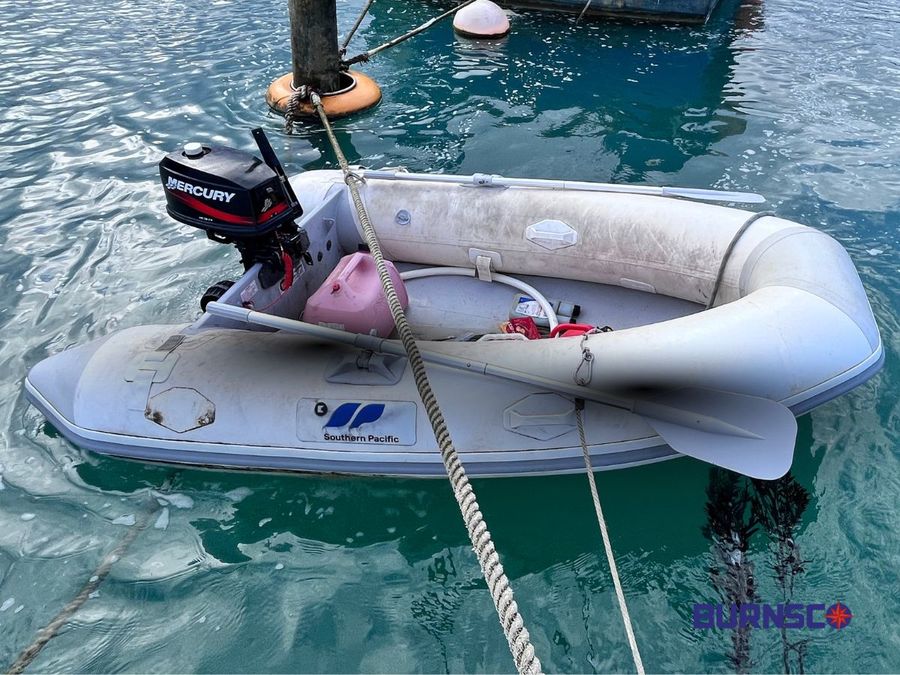
Our own Southern Pacific tender, which is similar to the Puffin RIB range, has had exactly that kind of winter. It's lightweight, tough, and practical by design, but the hard use has left its mark: saggy tubes, a scuffed alloy bottom, a missing oar, and a carry handle that's lifting away from the hull. With warmer months ahead, it's time to give it some proper attention. Burnsco has both the gear and the know-how to bring any tender back from that kind of state.
Inflation: the starting point
An under-inflated tender is a liability. Soft tubes make rowing harder work than it should be, reduce the boat's stability, and leave the hull far more vulnerable to punctures. Keeping the tubes properly pressurised starts with a decent hand pump.
Burnsco carries the Southern Pacific Double Action Hand Pump, which is straightforward and effective. Ours has run for multiple seasons without complaint. The Brunner Double Action Hand Pump is another solid option, using the same piston principle to push air on both the up and down strokes, which halves the effort involved. Both pumps pack down small enough to live on board, and it's worth keeping one as a spare.
Tip: Always check tube pressure before heading out. Firm tubes make for a drier ride, a tougher hull, and a safer boat overall.
Cleaning: aluminium and PVC
A tender is still a boat, and like any other hull it needs regular cleaning. Salt, dirt, and general scum all shorten its working life if left to accumulate. For aluminium or timber hulls, start with a thorough freshwater rinse, then work over the surface with a mild soap such as Burnsco Boat Wash and a soft brush or sponge. Harsh acids and abrasives are best avoided entirely, as they'll pit alloy or damage timber over time. For a polish on the aluminium, a product like 3M Marine Metal Restorer and Polish is purpose-made for the job, and finishing with soft cloths such as PAL Cotton Rags will keep the surface looking clean without scratching.
PVC tubes call for a different approach. Burnsco's Inflatable Boat Cleaner is formulated specifically for the job: spray it on, let it lift the black marks, and rinse off. It's safe for both PVC and Hypalon and won't attack the seams the way harsh scrubbing can.
The right tools take a lot of the effort out of cleaning. Burnsco's Deck Brush Kit, which includes a telescopic handle and a squeegee, works well whether you're running a hose or working from a bucket. Collapsible options like the Pack-Away 10L save precious storage space aboard; for those who prefer something more traditional, the 9L Black Plastic Bucket remains as practical as ever.
Rounding out the cleaning kit, the Sailor Jumbo Sponge from Burnsco is both ultra-absorbent and hard-wearing. A 1kg bag of PAL Cotton Rags handles washing, polishing, and general repair prep with equal usefulness.
Tip: A quick rinse after every outing is one of the best habits to get into. Salt and sand wash off easily when fresh, but bake on over time and become considerably harder to shift.
Small repairs that matter
A hard winter tends to reveal itself in loose fittings, worn patches, and the odd seam that's starting to lift. Burnsco's repair kits are well suited to tackling most of these jobs without professional help.
- Handles and seams: If a carry handle has peeled away, the PVC repair kit covers it. It includes two-part glue, PVC patches, and everything needed to form a strong bond. Thorough cleaning and drying of both surfaces before re-bonding is essential. - Aluminium rivets or seams: A dedicated aluminium repair kit handles leaks and pits effectively. With G/flex epoxy, fillers, syringes, and gloves included, it's built for DIY fixes and comes with clear instructions. - Small nicks: A basic kit containing glue and patches is ideal for emergency PVC fixes and worth keeping on board at all times. - Plastic repairs: A plastic repair kit works across HDPE, ABS, PVC, and similar materials, making it useful for small cracks or areas needing reinforcement.
Tip: A repair kit should always travel with the tender. A small seam leak ignored for a season can become a much larger problem.
Oars, rowlocks and fittings
Rowing any tender without properly sized oars is more effort than it needs to be. Getting the sizing right is straightforward if you follow a few basic steps:
- Measure the distance between oarlocks. - Divide that measurement by two, then add 50mm for loom length. - Multiply the result by 25, then divide by 7 to arrive at the total oar length. - Round to the nearest 150mm.
Correctly sized oars give the rower proper hand clearance and keep the blades at the right depth in the water. Spoon-blade oars suit tenders best, though they're not the only blade profile available.
Rowlocks matter as much as the oars themselves. Southern Pacific Rowlocks hold oars firmly in place during use. Bolts with exposed ends are a safety hazard and should be avoided; Burnsco's boat oar knob bolts, which are rounded and safe, are available by asking in-store. Burnsco carries oars in a range of lengths and materials, and the team in any branch can help match the right set to a particular tender.
To stop oars swinging loose against the tubes during transit, Velcro tape does the job simply and cheaply.
Tip: Oars should always be tethered before the boat gets underway. Never motor with oars swinging loose. An oar lost overboard in any kind of current or swell quickly becomes a hazard for everyone on the water.
Wheels, ropes and anchors
Hauling a tender up a beach without wheels is hard, slow work. A good set of dinghy wheels transforms the job. Burnsco's Heavy Duty Dinghy Wheels are wide, strong, and maintenance-free, rated to handle up to 200kg. Railblaza C-TUG Dinghy Wheels are another option: puncture-proof and easily removable, which matters if the tender is stowed beneath the genoa, where fixed wheels have a habit of catching on sail ropes.
A couple of marine-grade eye-splice ropes should always be on board. Short lengths, such as a 5m Wilco Dockline, handle tight tie-ups well, while longer lines are better suited to shore moorings. Burnsco's mooring ropes are both durable and UV-resistant. Adding a spring hook to the end of a rope and fitting a heavy-duty pad eye such as a Ronstan Round Pad Eye to the underside of the transom makes for quick and easy clip-on tie-ups. A tender that drifts away on the tide is a headache that's very easily avoided.
For anchoring, folding grapnel anchors are the right choice for a small tender. Burnsco's range folds flat for easy stowing and holds reliably in sand, mud, and rock alike.
Tip: Keep a short painter rigged for everyday use, and stow a longer spare line for shore work or unexpected situations.
Drainage and safety
Tenders take on water constantly, whether from rain, spray, or the chaos of people boarding and disembarking. A spare bung is a non-negotiable item, but for pumping out water while afloat you'll need a bilge pump. Burnsco's compact Hand Bilge Pumps float if they're dropped overboard, and they're lightweight, reliable, and genuinely useful after a tender has sat out in an overnight storm. The price for that kind of insurance is minimal.
Comfort and extras
Removable tender seats have a talent for disappearing, and when it comes to replacing one, careful measuring is essential since replacement seats come in a range of lengths. To take the edge off a hard seat, Burnsco's Tinnie Seat Cushion is pre-glued and water-resistant, which makes a real difference on longer runs ashore.
Small additions like these can seem trivial, but they make everyday use noticeably more pleasant. The same applies to a few spare bungs, a fresh supply of rags, or a compact folding grapnel anchor stowed under a seat.
Burnsco's product range is only part of the story. The practical knowledge the staff bring to it is equally valuable. They understand what works in New Zealand conditions and what doesn't, and can walk you through the finer points, whether that's the difference between various inflatable cleaners or why spoon-blade oars are better suited to tenders than flat-blade alternatives.
A few hours of attention, with the right gear to hand, is all it takes to bring a tired tender back to a state where it's safe and ready for another full season on the water.