The business case for making sustainability a central part of superyacht refits was examined at The Superyacht Forum's 2025 panel session, Justifying Sustainable Refits: ROI & The Value Beyond. Participants noted that while the numbers can stack up, the path to getting owners on board is rarely straightforward.
The scale of the challenge gives context to the opportunity. A 65-metre yacht can consume as much energy as a small town of 900 houses. Vessels built in the early 2000s represent a widely acknowledged peak of inefficiency, constructed at a time when hotel loads were climbing sharply and top speed was the headline performance measure. Generation and propulsion systems fitted to those yachts have frequently proven a poor match for how the vessels are actually operated.
Energy audits of in-service superyachts suggest the savings on offer are real. Basic changes, switching to efficient antifouling and fine-tuning onboard systems, can yield 5 to 10 per cent reductions in energy use. Major refits can deliver 25 to 35 per cent, and wholesale rebuild projects can push savings as high as 50 per cent.
Re-engining is among the more obvious targets. Modern engines offer genuine efficiency gains over those manufactured a decade or more ago, and studying actual usage data often reveals that a yacht's top speed has rarely been called on beyond sea trials. Specifying smaller modern engines better suited to typical cruising speeds can reduce fuel consumption, noise, and vibration, while also simplifying compliance with current IMO and EPA standards.
Hybrid systems are increasingly part of the conversation. Generation plant aboard some superyachts may be running at as low as 20 to 30 per cent efficiency. Modern hybrid installations can use energy storage to supplement or replace generators, extracting more value from every litre of diesel burned.
Air conditioning is another major target. The panel noted that savings of nearly two-thirds of typical HVAC energy consumption on older superyachts could be achieved if all available improvements were addressed, starting with settings adjustments and extending to chiller upgrades, duct modifications, and improved airflow design. Many yachts from around 2010 were designed to deliver high volumes of fresh air, which can lead to large energy losses.
Despite the numbers, sustainable refits remain relatively uncommon. The panel identified owner psychology as part of the reason. Capital expenditure on a yacht may be viewed as a justifiable investment in leisure or status, but expensive mid-life refits can feel like unwelcome operational cost. There is also some resistance to what owners may perceive as upselling or greenwashing. Yards, too, can be reluctant to suggest departures from a precise owner brief.
The panel's view was that sustainability often travels better as a secondary benefit attached to something an owner already wants. Better deck shading or upgraded glazing improves comfort and appearance first, with energy savings following. Transom extensions, increasingly popular for improving beach clubs or swim platforms, also deliver improved hull efficiency and seakeeping.
Independent tools such as the Water Revolution Foundation's YETI (Yacht Environmental Transparency Index) are gaining traction and can support the case, providing a basis for realistic estimates of what changes will mean in operational savings and reduced environmental impact. The panel also suggested that framing sustainability investment as a multi-year, multi-refit plan, with each step mapped toward a future-proof yacht, could make the proposition easier for owners to commit to.
Longer-term risk was raised as a compelling argument in its own right. A superyacht not progressively upgraded could find its operational freedom increasingly constrained by tightening emissions regulations and protected-area restrictions, regardless of how well maintained it is physically. A vessel upgraded through refits to be more sustainable, as the session framed it, is not just an old yacht on the market. It remains relevant, with the appeal of more compliant and efficient operation, and one that the next generation of owners will be more comfortable with as they consider their own environmental impacts.
The panel also recognised that yards need to play their part, investing in and proving the technologies of tomorrow alongside partners, to give owners the confidence to commit to solutions that may make a substantial difference in the future.
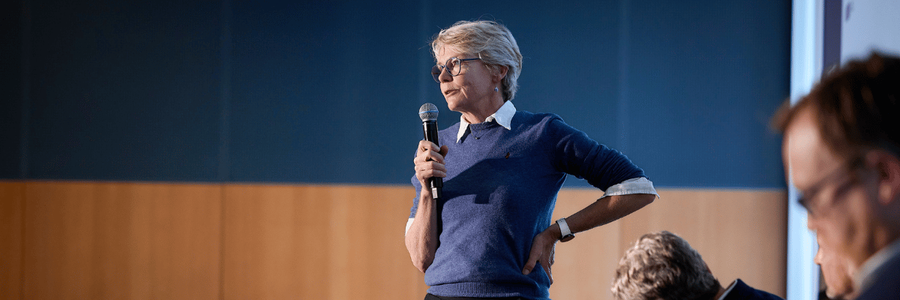
The 2025 panel comprised Hanneke Grijpma, Founder and CEO of xullux; Simon Brealey, Head of Consulting Services at Lateral; Rob Papworth, CEO of MB92 La Ciotat; Alberto Perrone Da Zara, Director Sales Yacht Refit at Lürssen; and Tobias Kohl, Vice President Application Engineering Marine at Rolls-Royce Solutions GmbH.
The Superyacht Forum returns to RAI Amsterdam on 16 to 17 November 2026.