Tucked into the berths at Olympic Marine beneath Cape Sounio, somewhere south of Athens, sits a 9.12-metre Dehler 30. The surrounding fleet runs to maxis, JPKs, Pogo 50s, and ocean racers from 21 nations. Flying the colours of both Greece and New Zealand, Aether is, by almost any measure, the smallest boat entered in one of the most demanding offshore challenges this fleet has ever faced.
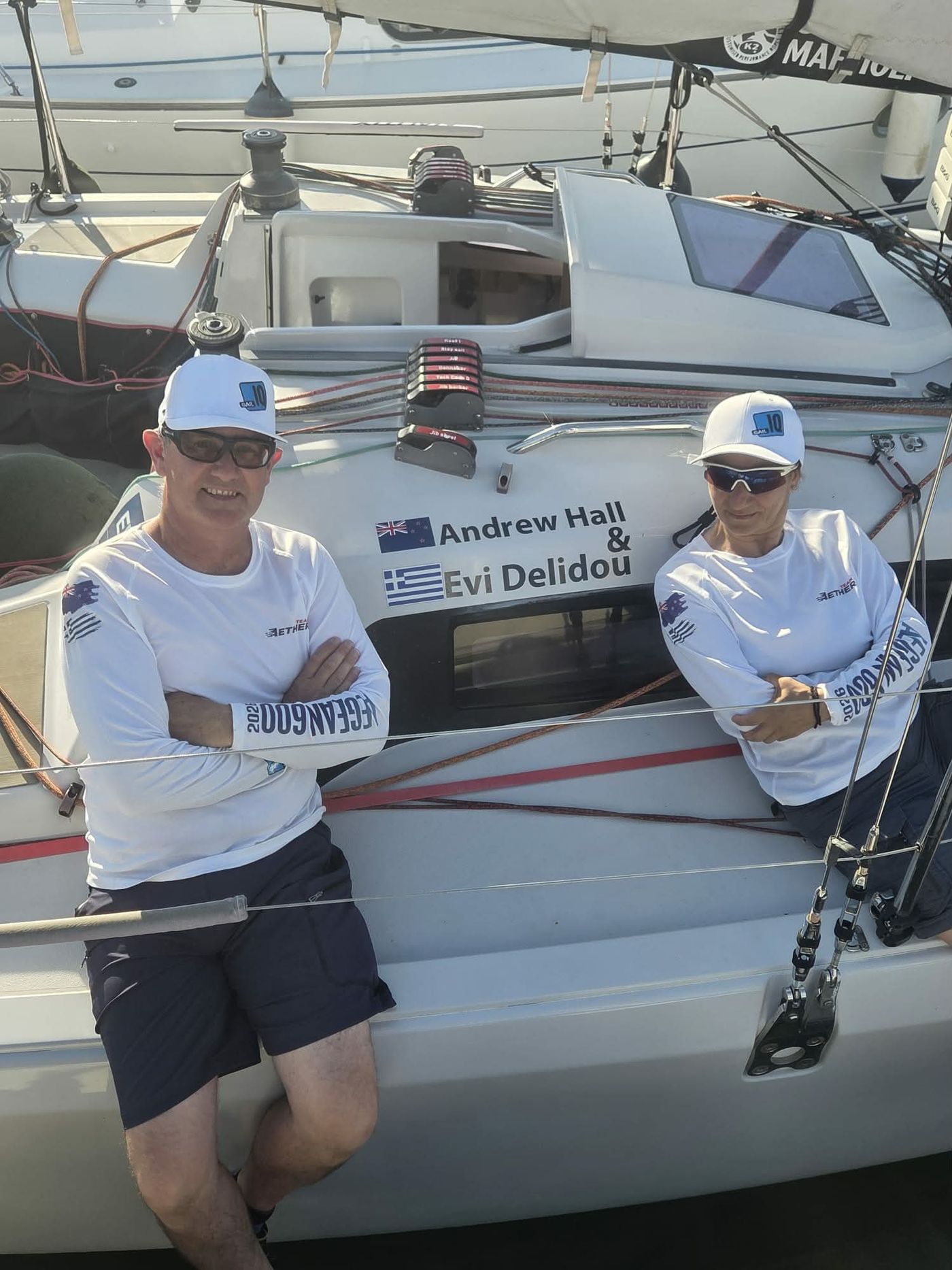
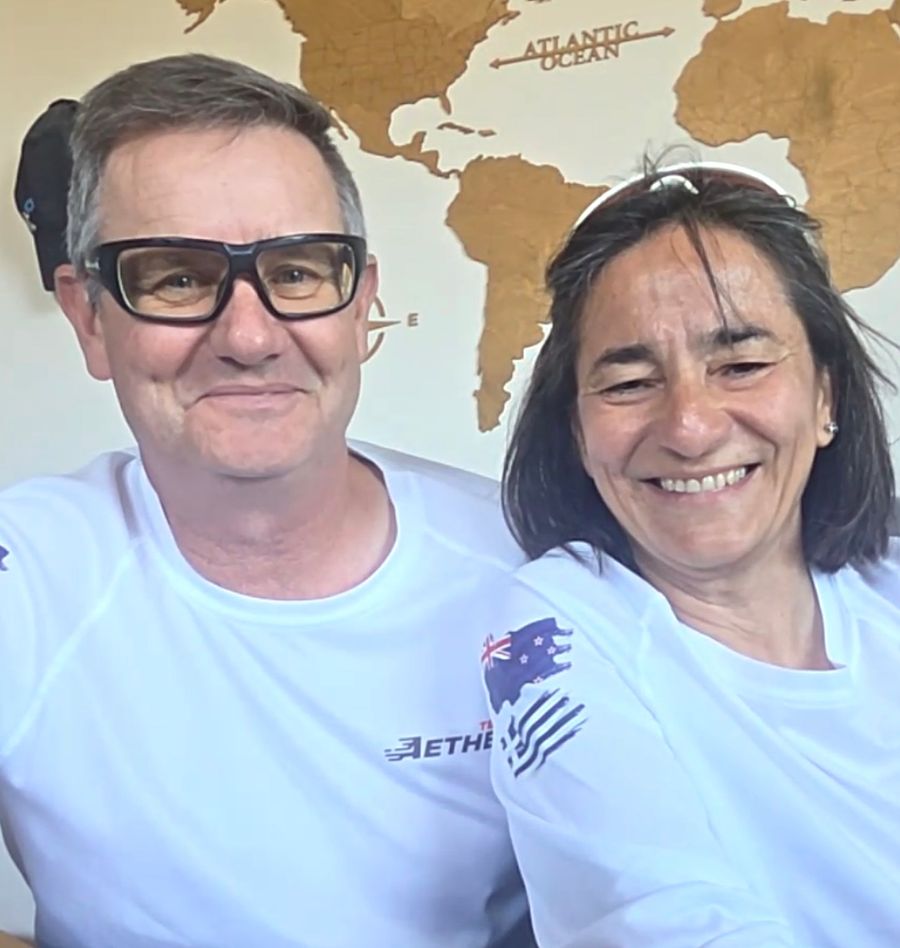
Aether belongs to Evi Delidou, a Greek architect and competitive offshore sailor who has lined up at the start of every edition of the Aegean 600 since the inaugural running. Joining her as co-skipper this year is New Zealander Andrew Hall, sailmaker, sail designer, and founder of SailIQ Ltd. He is the only Kiwi in the race. Together they represent the most modestly resourced campaign in a 74-boat fleet, in terms of both crew numbers and boat length.
The non-stop race starts Sunday, 5 July, from Cape Sounio at 2pm Greek local time.
Organised by the Hellenic Offshore Racing Club (HORC), the Aegean 600 is now in its sixth year and has secured its place among the world's elite 600-mile offshore events. The course covers 605 nautical miles through the Greek island archipelago, departing and returning to the ancient Temple of Poseidon at Cape Sounio. From the start the fleet swings southwest to Milos, the island home of the Venus de Milo, then drives through the caldera gate at Santorini, the still-active volcanic island whose whitewashed clifftop buildings rise directly above the racetrack from black lava. The course pushes south to Kassos and Karpathos, turns east to Rhodes, and winds back north through Kos, Kalymnos, the small islands of Pharmakonisi and Agathonisi, across the Icarian Sea to Patmos, on to Mykonos and Delos, past Giaros and Kea, and finally back to the finish at Sounio. More than 25 turns. Over 600 miles. Non-stop.
The race was born in 2021, when 37 teams set off from Sounio for the inaugural edition. Carlo Alessandro Puri Negri's Italian Farr 70 Atalanta II crossed the line in just under three days, setting the first course record. The race manager from that winning boat described it as one of the most beautiful tracks he had ever sailed in his life, a sentiment the fleet has echoed ever since. Multihulls joined the event in 2022, and that year Gregor Stimpfl's mono Scuderia 65 Hägar V took overall honours on corrected time, edging the German boat Rafale by just 15 minutes after more than two and a half days of racing, even as Rafale set a new monohull elapsed record of 63 hours and 2 minutes. By 2023 the fleet had grown to 45 boats and nearly 500 sailors from 16 countries, and Chris Sherlock's Farr 100 custom Leopard 3 from Monaco demolished the monohull record, crossing the line in 1 day, 21 hours, 5 minutes, and 25 seconds. That record still stands. The 2024 fleet stretched to 69 entries from 24 countries, and Erik Maris' Mod 70 Zoulou completed the course in under 37 and a half hours to set the multihull record.
For the sixth edition in 2026, 74 monohull and multihull teams from 21 nations have assembled at Olympic Marine, the largest fleet in the race's history. The event's organisers appear to have always believed it would reach this point.
The forecast for the start looks favourable. The Meltemi, the Aegean's signature seasonal wind, is expected to build to its usual 20-plus knots through Sunday and Monday, which should produce a fast and dramatic departure from the cliffs at Sounio.
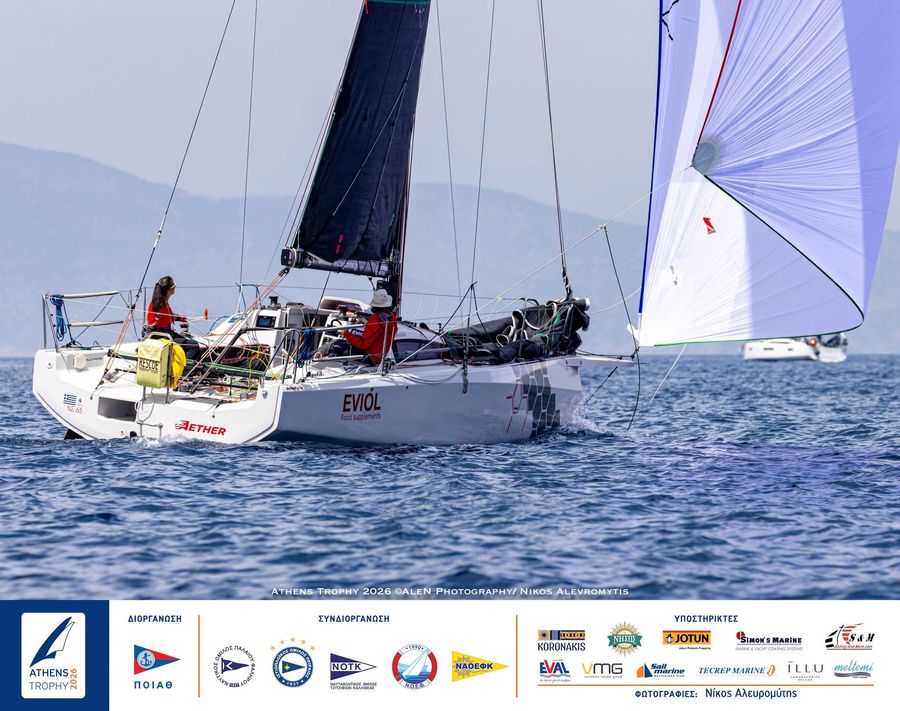
Aether (GRE016) is a Dehler 30 One Design, designed by Judel/Vrolijk. She measures 9.12 metres on the waterline, carries a 2.17-metre fin keel, twin rudders, and tiller steering, and weighs under 3,000 kilograms. Optimum 4, another Dehler 30 OD, also lines up in this year's fleet, but at 9.12 metres both boats sit at the shorter end of an entry list that stretches all the way to a Reichel/Pugh 90.
Evi Delidou was born in Thessaloniki in northern Greece, the birthplace of Alexander the Great, and moved to Athens a decade ago specifically to pursue sailing. By profession she is an architect; by record she is one of the more tenacious shorthanded racers in the Mediterranean. She came to the sport later than most competitors at her level, describing herself as a twelve-year sailor rather than someone who grew up near the water. Before sailing took over, she was a member of the Greek National Gymnastics Team, a background that translates well to the physical demands of a small offshore racing yacht. Before this campaign she sailed Aether from Greece to Barcelona, a passage of some 1,800 miles, to compete in the Mixed Crew Double-Handed World Championship, then turned around and sailed her home.
She has started all five previous editions of the Aegean 600. In every edition she finished, Aether was the smallest boat in the fleet to cross the finish line, a distinction claimed four times. In the shorthanded division she has stood on the podium in three editions, collecting two second places and one outright win. In 2023, when the Meltemi turned the fleet inside out, Aether was the only double-handed team to complete the course, winning the shorthanded category under both IRC and ORC. Her personal best over the 605-mile circuit is 112 hours. Her target for this edition, sailing alongside Andrew Hall, is to break the 100-hour mark.
"We want to go 100 hours," she said in the days before the start. "So whatever that means, I don't know, but we will try."
Andrew Hall and Evi Delidou were strangers until 2024. They met as rivals at the Mixed Crew Double-Handed World Championship in Lorient, France, Andrew representing New Zealand and Evi representing Greece. A conversation developed between them, and somewhere between Lorient and Athens it became a concrete plan: race Aether together in the Aegean 600.
Andrew's career has been built around understanding what makes boats go fast. As a professional sail designer and founder of SailIQ Ltd, he brings a technical perspective to offshore racing that pairs well with Evi's deep familiarity with this course and this boat. Readers who follow the New Zealand offshore scene will know him from the Round North Island Two-Handed Race, where he co-skippered the Sun Fast 3300 Indis, a boat designed specifically for shorthanded sailing. More recently he sailed as navigator aboard Nick Roberts' Dehler 41 Ākonga in the fully crewed 2026 Three Kings Offshore Yacht Race, a race that delivered its own offshore education: a roller furler failure just miles short of the turning mark, a J1 on the deck at the worst possible moment, and a night of repairs in 30 knots that included patching a gennaker while it was still flying.
He flew into Athens ahead of the fleet, deliberately early, to get on top of the jet lag before work began. Athens in early July sits at 33 degrees Celsius, dry and relentless, and after travelling from a New Zealand winter the contrast hits immediately.
"It's like getting the hairdryer out as soon as you get out of the air conditioning," Andrew said. "And that tends to, when you're not used to it, suck it out of you."
Preparation in the week before the start was methodical. Evi went up the mast for a thorough rig check. The pair had days on the water together before the gun. On the navigation side, Andrew is running Expedition with PredictWind data feeds, though even the most sophisticated routing tools struggle with an archipelago as complex as this one. Early routing software returned an estimated time of three days and sixteen hours for the course. Neither Andrew nor Evi believed a word of it.
Andrew also brought Starlink connectivity to the campaign. Reliable communications through a race of this length and complexity is close to essential, and it also means the team can send updates and images from the boat as the race progresses.
The Aegean 600 is not simply an offshore race that happens to be 600 miles long. It is a navigation and seamanship examination that uses those 600 miles as its test paper.
[video width="1280" height="720" mp4=" loop="true" autoplay="true"][/video]
More than 25 waypoints thread through islands that each generate their own local wind patterns. Conditions shift every two or three hours. The Meltemi accelerates through gaps between islands, so a boat sailing in apparent calm in the lee of a headland can find itself in 40 knots within minutes of clearing it. The reverse happens just as readily: strong breeze vanishes behind a large island and boats slow to a crawl in the flat water of its shadow. Sailors refer to these stretches as parking lots, and the Aegean 600 course has plenty of them.
Rhodes, in the southern section, throws a particularly significant wind shadow. The island is large and high, and its lee extends well across the race track. Managing that stretch efficiently on two people requires careful sail handling at precisely the stage of the race when fatigue is already taking hold.
The course falls into roughly three phases. The opening third, running south from Sounio past Santorini toward the southern islands, is predominantly downwind in strong Meltemi and can be fast and exhilarating. The middle section, working through the islands near Rhodes and along the Turkish coast, is where the parking lots cluster thickest and where races are usually decided. The final third, heading back north and west toward Sounio, can deliver another burst of Meltemi or can turn light and unpredictable depending on the weather system.
Past editions have shown both extremes. In 2023, record-breaking speeds under a powerful Meltemi. In 2025, light and difficult conditions stretched the winning time past four and a half days. Andrew offered a straightforward assessment: "It's gonna be challenging."
Traffic is a further consideration. Tankers working close to the Turkish coast and day-charter boats near the island ports demand continuous vigilance through every watch. The one advantage is that the racing fleet largely has the Aegean to itself at this time of year. The Meltemi keeps most cruising yachts safely in harbour. As Evi noted with some affection, only the crazy ones are out there.
Shorthanded offshore racing has a long tradition in New Zealand. The Doyle Sails Round North Island Two-Handed Race, run by the Shorthanded Sailing Association of New Zealand over 1,200-plus nautical miles, anchors the local calendar. Feeding into it is a healthy circuit of qualifying races, among them the Cavalli Islands Race, a 275-nautical-mile offshore run north from Auckland and back, which like much of the New Zealand offshore calendar caters for both fully crewed and shorthanded fleets. The discipline produces a particular kind of sailor: self-reliant, careful with energy, and accustomed to solving problems alone in the dark.
Those qualities will be called on aboard Aether. With conditions changing character every two or three hours, any rigid watch structure quickly becomes theoretical.
"It's an ocean race, but I think it has quite a bit of brutality to it because there is something happening every couple of hours," Andrew said. "Because you change islands every two or three hours, the local wind is different, and it's not something that will keep going for a lot of miles."
Sail changes are the currency of that brutality. In past editions Aether has logged around 25 changes over the full course. Each demands time and physical effort from both co-skippers, and at the back end of a five-day race the cumulative cost is real. The approach, as Evi described it, is deliberate: think twice before each change, weigh the benefit against what it takes out of both of them, and keep each other in a condition to keep sailing.
"We have to be really thoughtful of the moves we are going to make, especially at night," she said. "To keep hydrated, to remember to eat, and to try to get some sleep."
The autopilot handles the steering in moderate conditions, but strong downwind sailing is less forgiving and requires hand steering that drains both crew quickly. Over five days and 600 miles, that accumulation is the real opponent rather than any other boat in the fleet.
Evi understands this as well as anyone afloat. "Every time I go to the start line, I'm thinking, what am I doing here?" she said. "And after I see the finish line, I say, ah, that's why I was here."
She already has an eye on the finish, on sailing back beneath the columns of the Temple of Poseidon after four or more days at sea. For someone who has done this five times, it still means something.
Andrew Hall is the only New Zealander among the 74 teams assembled at Olympic Marine for the 2026 Aegean 600. Aether races under the Greek flag, which reflects the boat's ownership, registration, and club affiliation. The New Zealand flag flies at the masthead alongside the Greek one, and both names appear on the hull with their respective national colours. Two countries, one small boat.
For Evi, the decision about who to sail with was not a casual one. The people in her sailing world wanted to know who her co-skipper was before they would give their blessing. When she told them, the conversation was short.
"Here in Greece, when I told them that I'm going to race double with Andrew from New Zealand, everybody told me: you found one of the greatest sailors around the world," Evi said. "We believe here that New Zealand has the best sailors."
For Andrew, arriving at a start line on the far side of the world is part of how the New Zealand shorthanded tradition stays relevant. It requires Kiwis to actually enter, to travel, to show up, and to race hard in fleets that grow more competitive and more international every year.
He is the only one here. That fact carries its own weight.
"When it all goes down," he said, "it's just absolutely going to be great."