Richard Edlin never planned to spend three years rebuilding a boat. The Auckland yacht designer and wooden boatbuilder accepted a Pelin Empress 24 at his Matakohe property on the banks of the Kaipara Harbour after its owner described the job as a few minor repairs. What followed consumed 1,700 hours of labour, turned the interior inside out, added four feet to the transom, and generated enough considered decision-making to serve as a masterclass in the craft of the serious refit. Steve Raea reports.
Frank Pelin, who has since passed away, designed for ordinary New Zealanders. His driving conviction was that families of modest means deserved a genuine shot at boat ownership, and he gave that belief practical form through an extensive catalogue of accessible plans. His Auckland office produced more than 160 sets of drawings covering yachts, catamarans, dinghies, runabouts, and the planing and semi-displacement launches for which he became best known. Like fellow New Zealand designers Richard Hartley and John Spencer, Pelin championed the backyard builder, persuaded that a reasonable budget and basic competence were all that stood between a Kiwi family and a boat of their own. The Pelin Plans service continues to operate today, keeping his designs within reach of builders and restorers.
[category_news_grid search="Pelin Empress"]
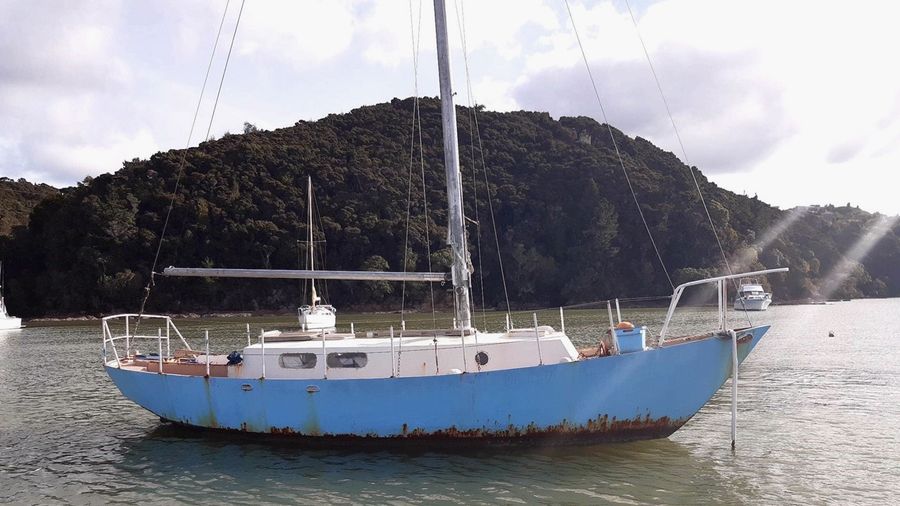
Backyard boatbuilding reached its high-water mark during the Muldoon years. On any given suburban street it was entirely unremarkable to find two or three Pelins taking shape beneath army surplus tarpaulins and improvised shed roofs, with the odd ferro-cement yacht rising nearby. Neighbours would wander over on a Saturday afternoon and somehow never quite manage to leave. That era belongs to a different New Zealand, but the boats it produced have endured. Sound hulls still surface on worn trailers in boatyards, inside farm sheds, and tucked into chook houses from Northland to Southland. They carry little monetary value in their current state, yet they are quietly acquiring classic status. With patience and the right expertise, they can be returned to active family use for a fraction of what a comparable new boat would cost.
Richard Edlin understands that equation better than most. The Empress that arrived at Matakohe came with an owner whose assessment of its condition had been, to put it charitably, optimistic. Minor repairs revealed themselves as major repairs. The owner was satisfied to leave the boat with Edlin and recover his outlay, and Edlin found himself committed to a restoration that would stretch across three full years.
Working from a designer's perspective, Edlin's central problem was how to bring the Empress's interior and transom thoroughly up to date without disturbing the hull's distinctive classic lines. He concluded quickly that a 24-foot boat simply did not offer enough space to deliver the level of comfort he was after, and that something more ambitious than cosmetic improvement was needed.
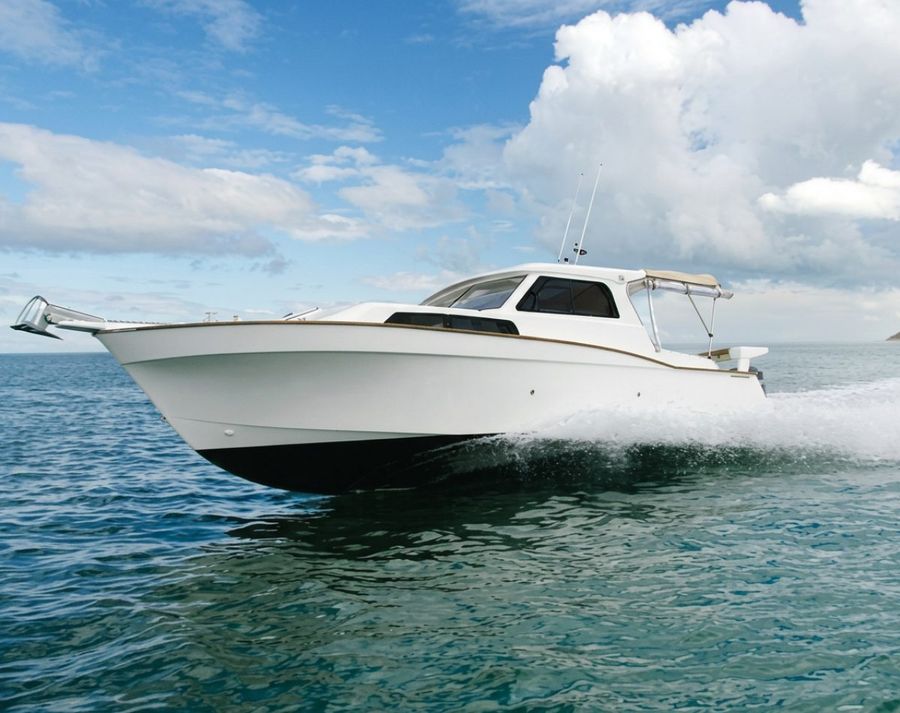
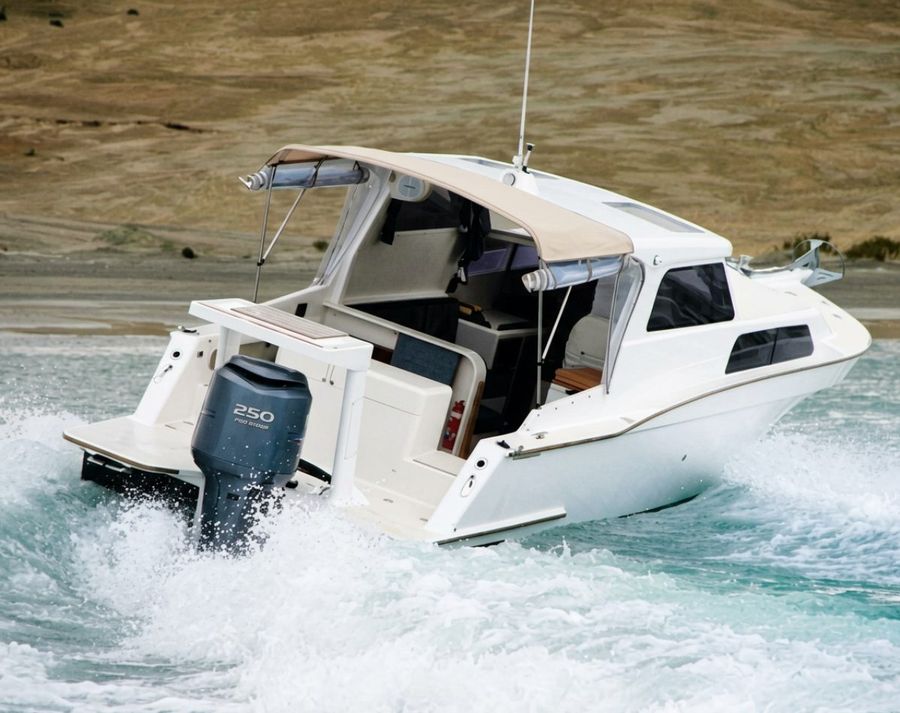
His answer was to cut away the transom and add four feet to the hull's length. A patch of rot discovered well aft made this an easier decision to justify. The extended transom produced a generous boarding platform in an island-style walk-through arrangement, with new transom lockers accommodating a barbecue and a live-bait tank, and a solid permanent bait board completing a fishing-friendly layout. Mindful of both the hull's proportions and the Kaipara's well-known appetite for rough conditions, Edlin also raised the topsides by incorporating a variable bulwark running forward to the cockpit. The change works as a practical seagoing improvement and as a visual one, giving the hull a pronounced classic sheer that sits naturally with the boat's heritage.
A new self-draining anchor locker replaced the original at the bow. The original drained directly into the bilge, a design flaw Edlin considers responsible for the premature ruin of many otherwise sound Pelins. While working on the deck, he reshaped the cabin trunk, increasing its aft rake to align with a new windscreen and a stylish cabin-top eyebrow.
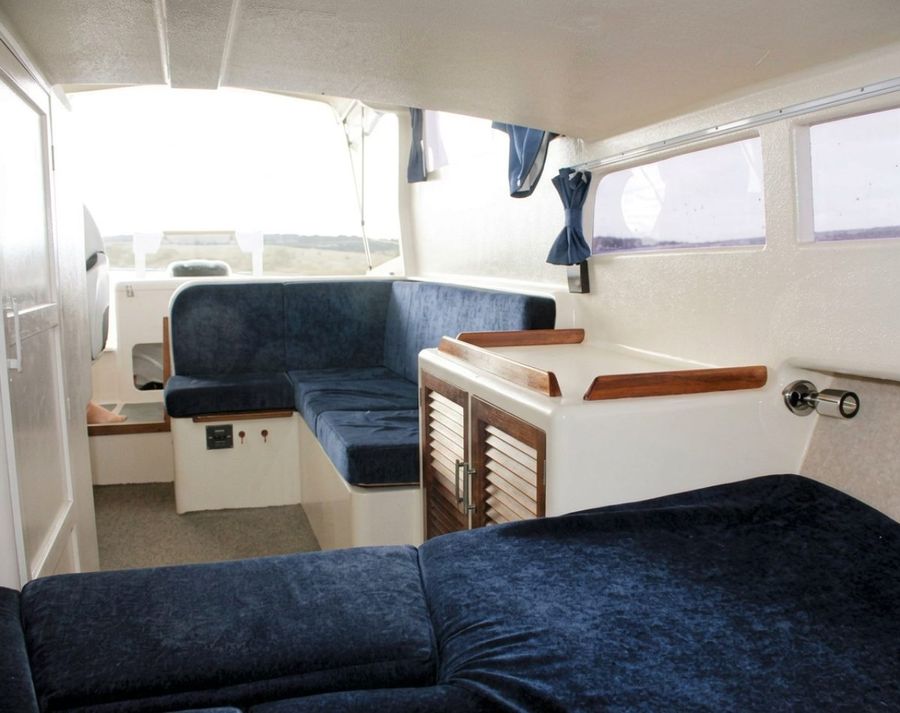
Ninety percent of the interior was gutted to allow full access to the forward bilge, which was substantially strengthened with a GRP foam core sandwich laid between the existing stringers and frames. With the cabin cleared, Edlin built moulds for a new GRP and ply underfloor fuel and water tank and fitted a 120-litre holding tank beneath the forward V-berth. That last item required raising the forward bunk height by 200mm, with the practical bonus of a worthwhile gain in bunk width. Edlin went further still by removing the cabin bulkhead frame entirely, opening the full length of the cabin and creating a generous double berth.
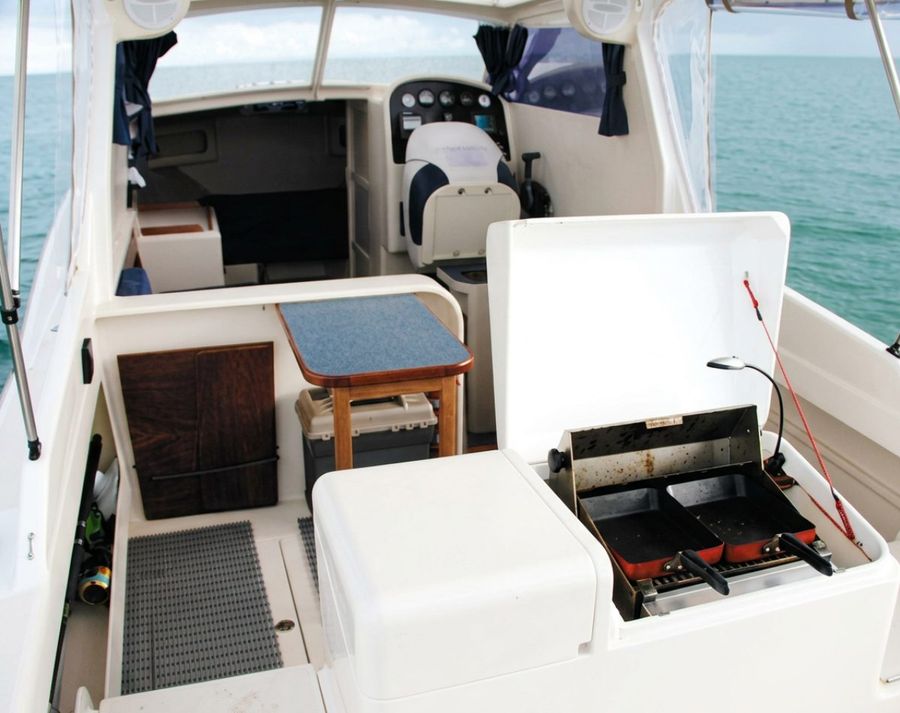
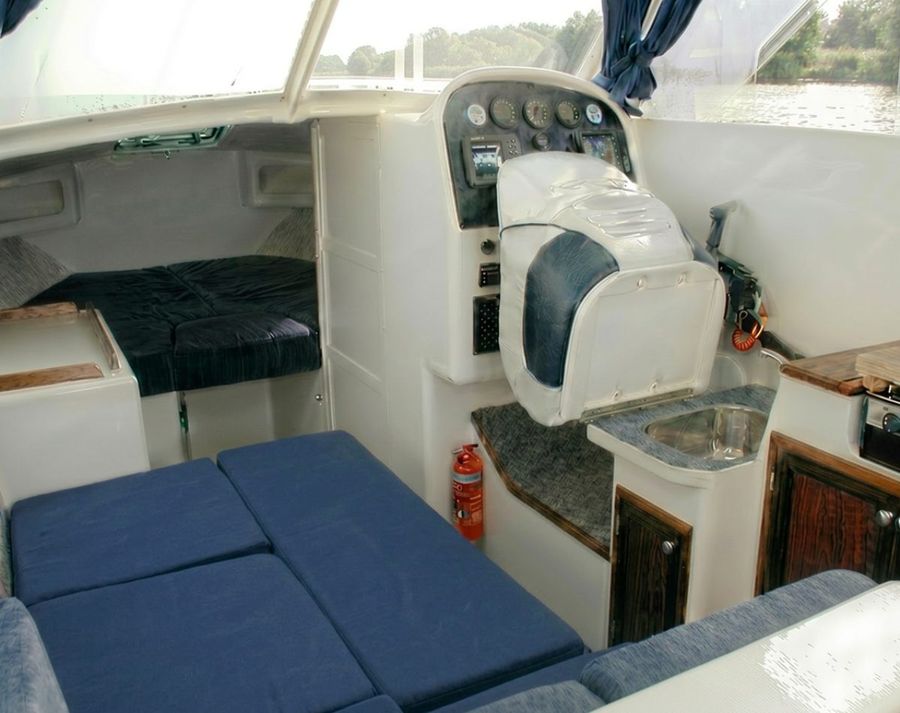
The helm station was stripped and replaced with a custom-built ply and GRP unit featuring an inset carbon-fibre fascia to house a new electronics suite. A replacement V6 250hp four-stroke Yamaha was mounted on the new transom to complete the mechanical overhaul.
The case for buying old
Edlin's total investment, covering his time, the replacement Yamaha, an upgraded secondhand Hosking trailer, the original purchase price, new electronics, canvas covers and clears, new squabs throughout, and various sundries, is a figure that rewards close inspection. A significant portion of that went into making moulds for the new tanks and the various aesthetic refinements that, as he freely admits, contribute little to raw practicality or performance.
"There are no regrets on my side," he says. "Sure, the boat took on a life of its own but I have no problem justifying this, to the extent that we're committed to owning and using it as our family boat for the next five years. It does everything we want it to do and it does it well. I feel reasonably comfortable that we're still on the right side of the ledger when I see what people are paying for similar-sized new trailer boats."
The renovation was completed in stages, as funds allowed, and Edlin identifies this incremental approach as one of the genuine advantages of refitting over buying new.
"If you're financing a new boat, the ticket price is not a true reflection of cost. Finance comes at a price, and if that new boat has to be sold, depreciation losses have to be factored in. Buying secondhand and refitting as you can afford is less likely to cause financial stress, and if managed properly, it shouldn't stop you getting on the water in summer while you refit through winter," he explains.
Edlin is open to working with owners who want to take that path. "Custom wooden boatbuilding in New Zealand is in a tough place and boatbuilders have had to diversify. I've progressively set my business up for refit work and I encourage owners to be part of that process." He is also extending his workshop to include basic accommodation so that owners can stay on site and work alongside him. His facilities allow boats up to around 45 feet to be launched and retrieved directly from the Kaipara Harbour.
One firm caveat: timber boats demand careful assessment before any refit commitment is made. Edlin is emphatic that a proper invasive survey by an experienced surveyor is non-negotiable. "It's not enough to get your boatbuilder mate to check it out. As boatbuilders, we know how to repair rot but a surveyor worth his salt knows where to find it. Cutting corners for the sake of a surveyor's fee is false economy."
The tour
The value of the extended transom platform is apparent the moment you step aboard. Boarding is easy, the cockpit gains meaningful volume, and the boat's credentials as a fishing platform are transformed. Edlin has held back from fitting a game chair and reserved most locker space for general family stowage, though a wash-down facility is in place and one of the aft lockers can be converted to a live-bait tank when the fishing is on. The open transom suits diving and swimming well, with a sliding hatch board providing security at sea when children are on board.
Moving forward to starboard, a compact galley offers a two-burner hob and grill, with an LPG water heater supplying hot water on demand to the sink beneath the helmsman's seat and a handheld shower in the cockpit. Opposite sits an L-shaped settee that converts readily to a double berth. Further forward, the enclosed head is to starboard with cupboard storage opposite, and the V-berth can be configured as two singles or one large double.
The interior is light and airy, with twin overhead opening hatches in the hardtop and generous windscreen and cabin windows. A canvas bimini and clears allow full enclosure without consuming usable space. With 540 litres of fuel and 210 litres of water aboard, the boat is well set up for overnight stays and extended weekend cruising. The layout is practical and the finish is sharp.
Edlin, his partner Trudy, and their two-and-a-half-year-old daughter Alysha spent a week cruising the Northland coast over Christmas, comfortably and without incident across a range of conditions.
On the water
The transom extension and the foam-filled bilge both add hull weight, but the Empress comes in at around 2,300kg on the trailer, a figure comparable to an equivalent alloy boat and lighter than a solid GRP hull of similar size. The additional length calls for more power, and the 250hp Yamaha four-stroke more than covers the requirement, lifting the boat onto the plane quickly and cleanly. Trimmed out at wide-open throttle, the Empress pulls 34 knots, settles into a comfortable cruise at 25 knots with the tachometer at 4,500rpm, and returns a respectable one litre per 1.3km.
Launched from Tinopai and heading toward Pouto Point and the Kaipara Heads, conditions ranged from flat-water running to a short wind-against-tide chop. The foam-filled bilge has measurably reduced slap on the timber hull, and the Empress handled everything without complaint. Pelin hulls have long carried a reputation as capable all-rounders, and this one does nothing to undermine it.
Visibility from the passenger side is limited unless you move alongside the helm, though the driver enjoys excellent sight lines and the option of putting their head through the overhead hatch. As a cruising platform the boat flows well, with easy movement between cockpit and saloon. Bow rails are planned, which will improve access to the forward deck.
Edlin is candid about the original design's one acknowledged limitation, relatively low bow freeboard that could become a concern when punching into a serious sea. The raised bulwarks address this effectively, and the new self-draining anchor locker has added genuine structural strength to the foredeck.
"No boat is infallible in the wrong hands," he says, "but with good seamanship the Empress will cope with most conditions. We've seen plenty of action on the Kaipara and we've always got home without incident."
What Edlin has produced is a 1970s vintage hull transformed into a contemporary weekend cruiser, modern in every practical respect yet faithful to the character Frank Pelin gave it. The case he makes, through the work itself as much as through his words, is that the refit path is not a compromise born of necessity. Properly pursued, it is a genuine alternative that deserves to be taken seriously.