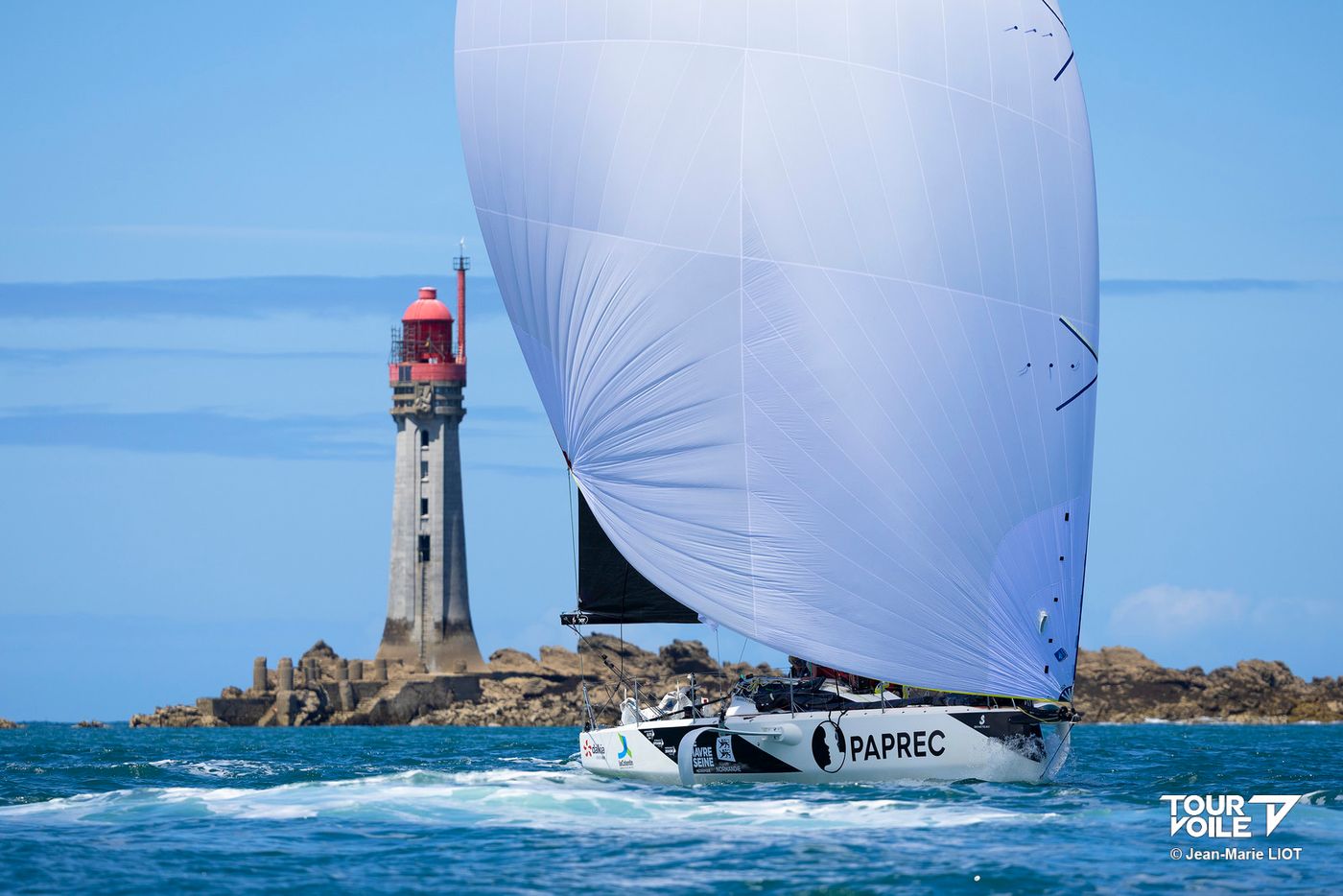
Twenty hours of racing over two full Channel crossings, battling gusts of 25 to 30 knots and the relentless tidal rhythms of one of Europe's most unforgiving stretches of water, and still nine Figaro Beneteau 3 crews arrived at Saint-Malo having barely separated. For most of the opening stage of the 47th Tour Voile, run from Cherbourg-en-Cotentin, the fleet moved in lockstep, positions trading hands without any single crew finding a move the others couldn't answer. The decisive break, when it finally came, was swift and surgical: a narrow corridor off the Cotentin peninsula, one crew willing to press east while the rest held the conventional line, and a gap of roughly three nautical miles that appeared almost before anyone could respond. That crew was PAPREC by Normandy Inshore Program, and the advantage they built in that one moment carried them comfortably to the finish.
The win immediately reshuffled the overall standings and made an already tight competition tighter still. What had felt like a two-team contest at the top going into the stage emerged as something more complicated, with three crews now close enough that a single strong result could rearrange everything.
Nothing in the opening exchanges suggested the race would hinge on a single commitment at a single point on the course. Both Channel crossings demanded pinpoint navigation, and the English coast added further complexity for crews already managing demanding conditions. Dunkerque–Kiloutou cycled through the lead repeatedly, with Région Bretagne–CMB Espoir tracking every shift they made. PAPREC hovered nearby in third or fourth, trading places with APCC Centre de Formation but unable to open any meaningful gap. The fleet resisted separation entirely, each crew absorbing whatever advantage the next attempted to create.
Paul Loiseau of Dunkerque–Kiloutou described the mood with precision. "It was a race from start to finish," he said. "Everybody was going at nearly the same speed. There weren't many tactical moves to make. The difference came down to very fine positioning, especially with the currents."
Arthur Meurisse had kept his crew near the front through much of the stage and watched the defining moment unfold without being able to answer it cleanly. "We held our rhythm for a good portion of the race," he said. "Then the Normans chose to try something. At that moment, we wanted to control, but when the fleet starts to split, it's never simple. We stuck to our core strategy. Was that a mistake on our part, or a brilliant move on theirs? Probably a bit of both."
The pivot arrived as the fleet rounded the Raz Blanchard and turned for the French coast. PAPREC's Paul Cousin had read the current differently from everyone around him and trusted that reading enough to act on it. "All the lights were green," Cousin recounted. "We were in contact with the leaders and we felt it was the right moment to try something. While we committed, we weren't entirely calm. We had some doubts. But within minutes, our intuition was confirmed."
Cousin was direct about what separated his crew from the rest. "Currents remain crucial in this zone, even with modest tidal coefficients. Figaro Beneteau 3s are very sensitive to that. It's really what made the difference today."
With PAPREC now firmly in contention, Région Bretagne–CMB Espoir holds the overall lead by the narrowest of margins from Dunkerque–Kiloutou. Loiseau took the new challenge in his stride. "Congratulations to them. They've pulled off a very good move," he said. "We remain in the lead, and that's really what matters. This race is exactly what we expected: everyone sailing at nearly the same speed. You have to be good at the right moment."
One stage into Tour Voile 2026 and the contest has already taken its shape. Outright boat speed will not settle it. What will matter, again and again through the stages ahead, is the capacity to read water that offers no visible clues, to commit to a diverging course when every instinct says cover the fleet, and to be right at the precise moment it counts.