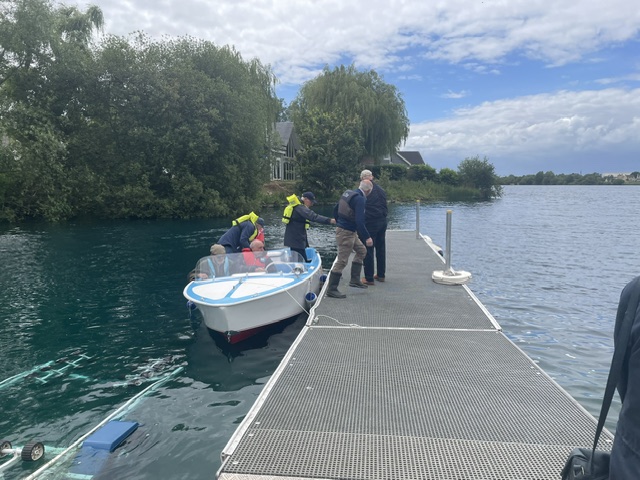
A 1950s speedboat carrying New Zealand engineering at its heart has returned to the Gloucestershire lake where it first seized the public's attention, more than 65 years after Donald Campbell transformed a sandbank crossing into an indelible piece of motorsport theatre.
The craft in question is a Dowty Turbocraft known as Rowdy Dowty, which powered away from Lake 16 at South Cerney on 5 June 2026. That particular stretch of water is the very place where Campbell had put the Turbocraft through its paces during trials in the late 1950s, and the return carried real weight for those who know its history.
The story behind the Turbocraft begins with a cross-Pacific collaboration that was unusual for its era. Fred Cooper, a British designer, was responsible for the hull and mould, while the water-jet propulsion system came from New Zealand inventor Sir William Hamilton. Hamilton's motivation was entirely practical: the shallow, gravel-riddled rivers near his Irishman Creek Station in Central Otago made conventional propellers useless. He developed the jet-drive concept out of necessity, and while his early prototypes were modest performers, they proved the underlying principle was sound.
The Turbocraft made its public debut at the 1959 London Boat Show, and Campbell's presence guaranteed the launch drew serious attention. The Dowty Group, a manufacturer far more associated with aircraft components than pleasure craft, found itself in unfamiliar territory. As Dowty Heritage recounted in their event summary, Campbell made headlines at the press launch by driving a Turbocraft flat out across a sandbank separating two of the South Cerney lakes, going fully airborne before landing safely on the other side. Jackie Heywood, daughter of former Dowty CEO Sir Robert Hunt, spoke to the BBC about the incident, noting that her sister had witnessed the stunt in person. "She always remembered it," Heywood said, describing Campbell as "a very wild character."
Old Speed Boats describe the Turbocraft's specifications as impressive for the period: a 14-foot-6-inch hull driven by a marinised Ford Zephyr straight-six, fitted with a two-stage Hamilton Chinook jet unit, capable of 35mph, and able to seat five people. Bringing one of these boats back to working order is no modest undertaking.
Production figures remain unclear, though the total built is believed to be fewer than 3,000. Each boat cost around £790 new, a sum equivalent to roughly £23,000 today. The business ceased trading in 1966, though surviving examples do appear at auction periodically, with auctioneers Brightwells among those known to have listed them.
The gathering at South Cerney was a quiet reminder that certain engineering ideas can outlast the companies that created them. A propulsion system conceived to navigate the rivers of Central Otago eventually found its way onto British waterways, and the fact that Rowdy Dowty could still draw a crowd to a Gloucestershire lakeside in 2026 speaks to the quality of thinking that produced it.