Modern cruising boats carry more solar panels, greater battery capacity, and higher expectations of self-sufficiency than ever before. What hasn't always kept pace is the way onboard systems are designed to actually use that power.
Watermakers illustrate the problem well. Every watermaker on the market works from the same fundamental process: seawater is filtered, pressurised, and driven through a reverse osmosis membrane, which rejects salt and impurities while collecting fresh water on the other side. What varies considerably is how much effort, and how much power, it takes to reach that outcome.
Conventional systems typically rely on a pair of pumps working in sequence. A small 12-volt pump delivers seawater to the unit, while a second high-pressure pump, frequently running on 220 volts, carries out the desalination work. That arrangement functions well, but its appetite for power is substantial. In practice, most skippers end up running a generator or the main engine to support it, which means water production ends up planned around power generation rather than daily needs. Fuel gets burned, heat builds up, hours accumulate on the engine, and the whole exercise becomes a scheduled chore rather than a natural part of life aboard.
Solving exactly that problem is the mission behind Oceanflo, a Kiwi company that designs and builds its watermakers entirely in-house. Built by people with a genuine understanding of how boats are lived in and operated, the range was developed with one clear aim: to produce fresh water without turning the exercise into a reason to run the engine.
A closer look at Oceanflow watermakers
Oceanflo addresses the high-pressure challenge through a highly efficient proprietary DC-powered pump with an innovative energy recovery system, removing the need for AC power entirely. Both 12V and 24V versions are available, and the electrical demand is modest enough that watermaking from solar alone becomes genuinely practical on many boats. A boat generating 300 watts of solar can meet the power overhead comfortably.
Fewer components also translate directly into less to maintain. The system is quieter and simpler to live with day to day, which matters when you are at anchor for weeks at a stretch.
Three models sit within the Oceanflo range, built around two output levels.
OF70M manual
The OF70M delivers 70 litres of fresh water per hour and is the most straightforward unit in the lineup. Although the high-pressure pump is inherently automatically pressure regulated, water is initially diverted overboard until quality reaches an acceptable level, at which point it is directed to the tanks. The weekly freshwater flush is performed manually. This model suits owners who prefer to operate systems directly and want a solid, well-built solution without additional electronics.
OF70A automated
The OF70A shares its desalination hardware with the manual model but adds a layer of automated control.
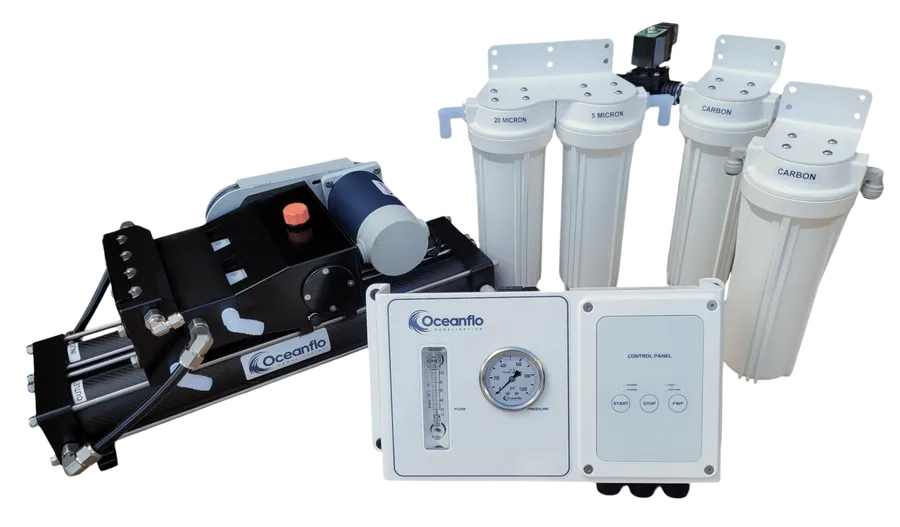
A local control panel displays flow and pressure readings, while the system manages its own start and stop functions and automatically diverts water overboard until salinity falls within acceptable limits. Once quality is confirmed, water flows to the tanks without any input from the crew. Freshwater flushing is handled automatically as well. A second control panel mounted in the saloon means the unit can be started or stopped without a trip to the machinery space. For short-handed crews, this removes most of the routine involvement watermaking would otherwise demand.
OF150A high-volume automated
For boats with larger crews or higher daily water requirements, the OF150A steps output up to 150 litres per hour. It retains the same innovative high-pressure pump design and automated control features as the OF70A, paired with a larger brushless DC motor. That higher output is delivered without pushing owners back towards dependence on a generator.
Oceanflo, designed to fit real boats
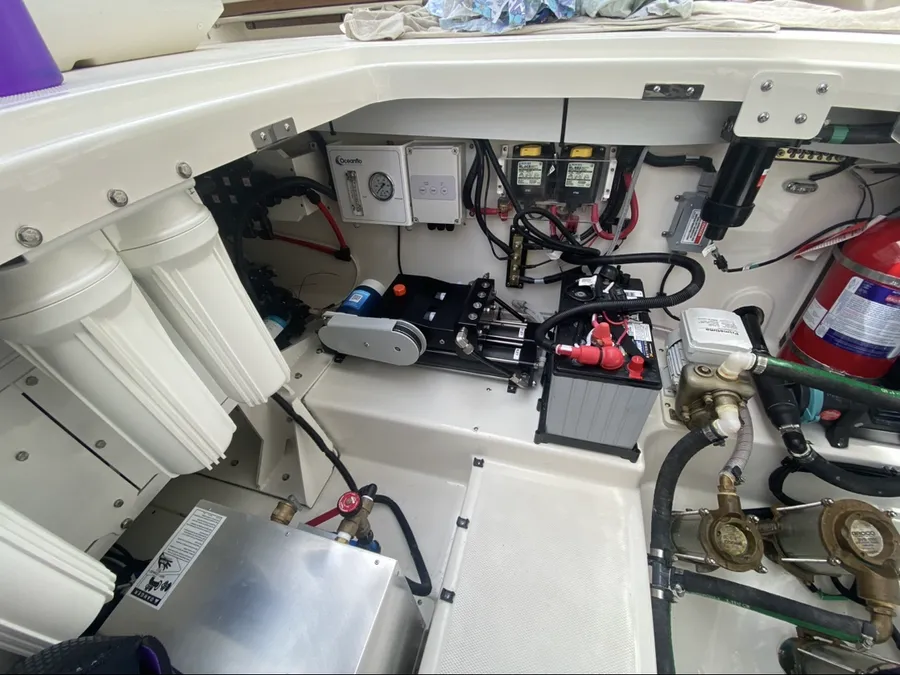
Space is frequently the deciding factor when fitting a watermaker, and Oceanflo has been designed with that reality firmly in mind. The system supports shorter reverse osmosis membranes, typically around 50 centimetres in length, which are far easier to position in engine compartments, lockers, or under floors than the one-metre membranes that were standard in earlier systems.
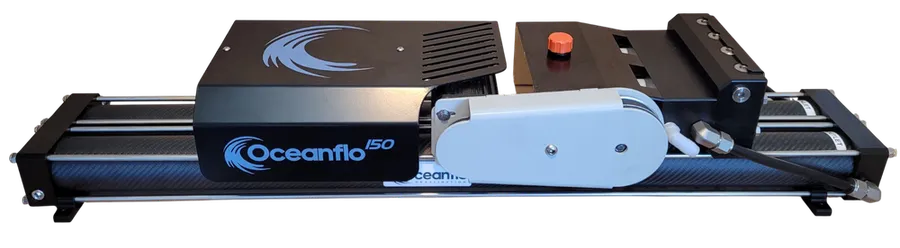
The main unit is compact and logically laid out. It fits neatly under floors, within the engine room, or beneath a built-in saloon seat, and installation doesn't require major compromises to achieve a tidy result.
Noise, vibration, and finish
Quality DC motors running at relatively low RPM keep noise and vibration to a minimum throughout operation. Component quality is high across the board, with fittings, housings, and overall layout reflecting equipment designed to be used regularly rather than installed and forgotten. Because Oceanflo manufactures in-house, feedback from real-world use feeds directly back into design decisions. In the tech world, this kind of seamless, ready-to-run integration is what people mean when they talk about plug and play.
Cost, value, and practicality
Oceanflo watermakers enter the market at around the $10,000 mark, making them financially accessible by the standards of the category. Few watermakers exist at a lower price point, and from my own personal experience, I can tell you that cheaper systems are often highly manual, kit-style builds. Those systems can be useful for learning how watermakers work, but they tend to be complex to install and demanding to operate.
Oceanflo takes a different path. Even the most basic model, the OF70M, arrives as a complete, cohesive system that is straightforward to install and clear to operate. The automated models go further, delivering features that are usually associated with systems costing considerably more.
https://youtu.be/jzpF9Exk3gY
Automatic salinity control, automated flushing, and remote operation from the saloon are capabilities that typically command a significant price premium. Here, they are included without adding fragility or unnecessary complexity. The result is a watermaker that feels genuinely finished and affordable, without having been stripped back to get there.
Making water without the engine running
Oceanflo isn't attempting to reinvent the science of desalination. The focus is on reducing what it costs to carry out that process, both in upfront costs and in what might be called power cost per litre. By lowering the energy required to produce each litre of fresh water, the system turns watermaking into a background activity rather than a planned event. Water gets made when the sun is up, without needing to start an engine or generator.
For owners who value simplicity, want fewer engine hours, and are looking to make better use of the solar and battery capacity already onboard, Oceanflo watermakers offer a solution that reflects the way boats are actually sailed and lived in.
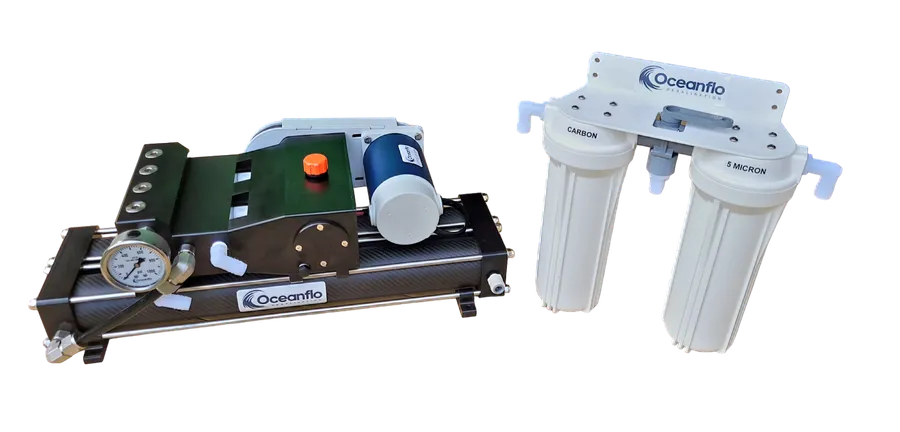
A New Zealand-built answer to something most cruisers deal with every day at sea. Making fresh water, without making a meal of it.