New Zealand's 15,134 kilometres of sea coastline, combined with 3,166 square kilometres of inland lakes and waterways, make the country's boating culture self-evident to anyone near a boat ramp on a summer weekend. Less obvious is the commercial weight of the industry operating behind that culture. Data from the NZ Marine Industry Association's Autumn 2026 News, drawing on the 2025 ICOMIA (International Council of Marine Industry Associations) Yearbook, reveals a sector that is larger, more export-oriented and more structurally complex than most people would expect.
1,104 companies. 5,451 jobs. One coastline.
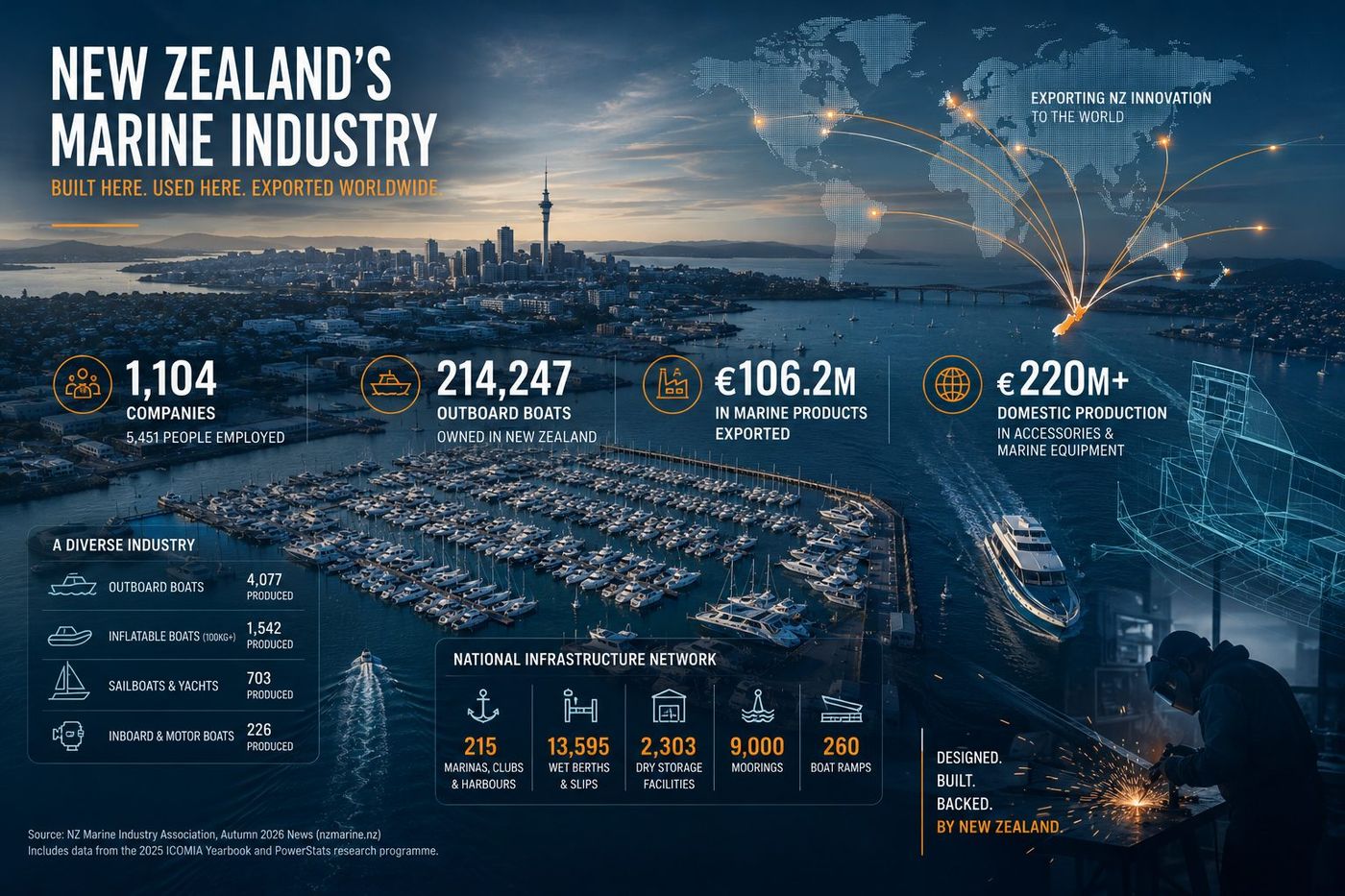
The 2025 ICOMIA Yearbook puts New Zealand's marine sector at 1,104 companies employing 5,451 people across the full supply chain. Breaking those numbers down gives a clearer sense of the industry's shape.
Of the total workforce, 2,202 jobs sit within the 149 boat-building companies, an average of nearly 15 employees per business. These are not cottage operations. They are companies with dedicated production facilities, skilled tradespeople and substantial capital investment. A further 987 jobs belong to 113 boat accessory and marine equipment manufacturers. The largest segment by company count is service providers: 842 businesses accounting for 2,262 jobs. This category takes in marinas, repair yards, chandleries and surveyors, and it is arguably the most structurally resilient of the three. Owners keep boats in the water through soft sales markets as readily as through strong ones, and the antifouling, refitting and repair work that generates flows on regardless.
Supporting all of this is a physical infrastructure network with genuine national reach: 215 yacht harbours, clubs and marinas, 13,595 wet berths and slips, 2,303 dry storage facilities, 9,000 moorings and 260 boat ramps.
Who actually builds boats in New Zealand
The ICOMIA production figures reveal a manufacturing base more varied than the lifestyle image of New Zealand boating might suggest. Outboard boats are the largest category by unit volume, with 4,077 produced domestically at a value of €111.3 million. Inflatable boats of 100 kilograms or more account for 1,542 units worth €30.7 million, sailboats and yachts 703 units worth €30.2 million, and inboard, sterndrive and motor boats 226 units worth €61.3 million. That last figure deserves attention: the smallest category by unit count carries by far the highest per-unit value, reflecting the large, complex and often custom vessels New Zealand has built its international standing around in this space.
Running alongside complete vessel production is a substantial accessories and marine equipment manufacturing sector. Total domestic output reached €220 million, with €106.2 million of that exported. That export figure alone challenges any assumption that New Zealand's marine manufacturing is primarily about finished boats.
The full production picture spans volume outboard hull manufacturing at one end, high-value custom inboard builds at the other, meaningful inflatable production in between, and a large equipment and accessories sector operating across all of it.
The fleet: 214,000 outboard boats and a lot of PWCs
The ICOMIA Yearbook's owned fleet data makes the dominance of outboard boats in New Zealand unmistakeable. There are 214,247 registered outboard boats in the country. Against a national population of roughly five million, that works out to approximately one outboard boat for every 23 people. No other category comes close. Personal watercraft are second at 96,268 units, a figure that reflects both their accessibility and the growth the segment has seen over the past decade. Inflatables of 100 kilograms and over account for 34,970 units, sailboats and yachts 30,375, and inboard and sterndrive motor boats 13,189.
That inboard fleet warrants a closer look. At 13,189 vessels, it represents an ongoing market of real scale for berthing, parts, professional servicing and refitting. Within that number, 6,622 owned boats fall in the 12-to-24-metre range, pointing to a meaningful cohort of serious cruising and commercially adjacent vessels. A catch-all "other boats" category of 1,196,546 units captures smaller craft such as kayaks, tinnies and rowing boats. As a commercial metric its value is limited, but as an indicator of how thoroughly on-water activity is embedded in New Zealand life, it reinforces the breadth of culture the industry is built on.
Exporting to the world from the bottom of it
The export data is where the conventional image of New Zealand as primarily a consumer of imported marine product gives way most decisively. Of the 4,077 outboard boats produced domestically, 1,673 were exported at a value of €42.5 million. That represents roughly 41 percent of total outboard production leaving the country, a striking orientation for a category most people associate with the local recreational runabout market.
The inflatable boat figures are more pointed still. Of 1,542 units produced, 1,157 were exported against just 483 sold domestically. New Zealand exports more than twice as many inflatable boats as it keeps for the home market. These are not entry-level products. The 100-kilogram-and-over threshold in the data covers substantial craft, including the RHIBs and commercial tenders for which New Zealand has earned genuine international recognition.
Inboard and motor boats tell a consistent story at the high-value end. Of 226 units produced, 83 were exported at a value of €59.3 million, a figure that approaches the €61.3 million total production value for the entire category. In engines, 269 outboard engines were exported from New Zealand, and the accessories and equipment sector contributed a further €106.2 million in exports. Across multiple segments, the industry is competing internationally rather than simply absorbing imported product.
Where the market sits today
Bar chart data in the Autumn 2026 publication, drawn from the PowerStats programme run on behalf of NZ Marine, tracks outboard retail sales and total imports from 2016 through to 2025. The pattern is consistent with the wider economy's experience: a pronounced COVID-era demand surge with retail outboard unit sales peaking at approximately 8,000 to 9,000 units annually around 2021 to 2022, followed by a correction back toward pre-pandemic levels. By 2025, retail outboard sales had settled to approximately 6,000 to 6,500 units annually.
The import data adds another dimension to that correction. Total outboard imports peaked at approximately 13,000 units around 2021 to 2022, well ahead of retail volumes for the same period. By 2025, imports had dropped to approximately 6,000 to 7,000 units, consistent with distributors having spent much of 2023 to 2025 drawing down excess inventory rather than replenishing it. One detail within the pullback is notable: the over-90 horsepower segment appears to have held its market share better than smaller horsepower bands through the downturn. Buyers who are still purchasing are skewing toward higher-powered, higher-value product, with implications for margins across the distribution chain.
Trailer boat registrations by region follow the same general arc. Auckland leads consistently, with Waikato, Bay of Plenty and Canterbury behind it, and Northland a smaller but stable contributor. The 2020 to 2022 peak is visible across virtually all regions, and the subsequent softening is equally broad-based, confirming that the correction is a national condition rather than a problem concentrated in any one market.
The diesel engine segment, tracked over a longer period stretching back to 2003, presents a different and more settled picture. Sales in 2025 sit at around 300 units, consistent with the prior several years and well below the mid-2000s peak of approximately 500 units. It is a smaller, more specialised market, and it behaves with corresponding stability.
None of this points to an industry in structural decline. The owned fleet is large and durable, export performance across several categories is strong, and the service and infrastructure base is substantial enough to carry the sector through cycles in new-vessel demand. What the data does reflect is the natural consequence of a demand spike that no one engineered and no one could fully anticipate: an overhang of imported stock, a buyer market catching its breath, and a gradual return to the steadier conditions that characterised the years before 2020.
For an industry that produced more than €220 million in accessories and equipment domestically, exports inflatable boats at a ratio exceeding two-to-one against domestic sales, and has more than 214,000 outboard boats in the water, catching its breath looks like a reasonably comfortable position to be in.