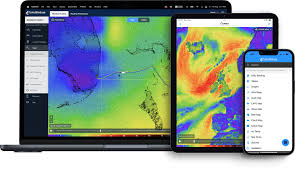
PredictWind has released three new global weather models, and for anyone who spends time on New Zealand waters, the implications reach well beyond a software update. PWAi, AIFS and ICON each bring distinct capabilities to marine forecasting, and together they represent a meaningful shift in what recreational and offshore sailors can expect from their planning tools.
The headline addition is PWAi, PredictWind's own proprietary AI model. Rather than standing alone, it draws on the combined strengths of several of the world's leading forecast systems, blending data from the European Centre for Medium-Range Weather Forecasts (ECMWF), AIFS, GraphCast and Fengwu. For sailors focused on the near-term picture, one of its most useful features is 1-hour time-step coverage across the first three days of a forecast. That finer temporal resolution gives a clearer picture of exactly when a wind shift or frontal passage is likely to arrive, not simply that it will.
The second addition, AIFS, is ECMWF's next-generation AI-driven model. Its strength lies in medium-to-long-range forecasting, helping sailors identify broader patterns and developing storm systems out beyond the usual three-day horizon, with coverage extending to 15 days. For those planning offshore passages or extended voyages, that longer window is genuinely useful when sizing up departure options and initial routing decisions.
Rounding out the trio is ICON, the global model produced by the German Weather Service (DWD). Built on an icosahedral grid that distributes coverage more evenly across the globe, ICON has recently been extended from its European focus to full worldwide availability. Its physics-based approach adds a different kind of rigour to the model suite, particularly in regions where high-resolution local models may not be available.
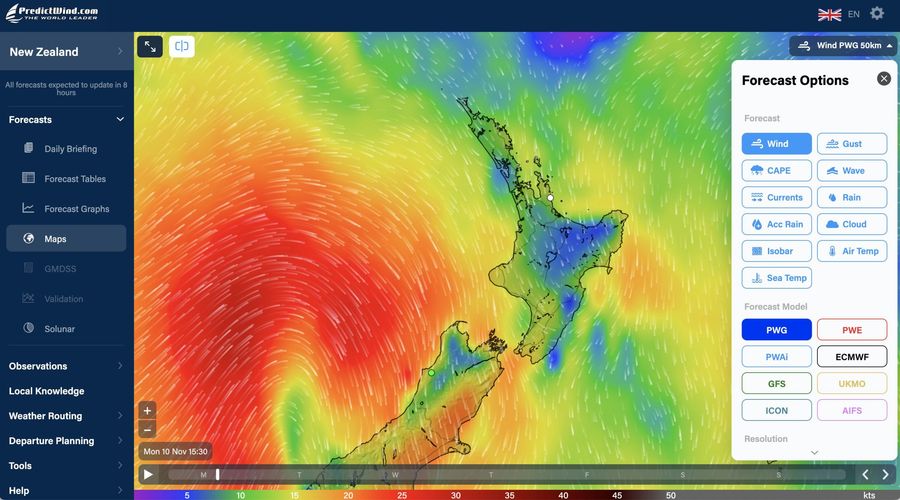
Between them, the three models address different parts of the forecasting challenge. PWAi delivers fine-grained short-range detail, AIFS extends reliable performance further into the medium range, and ICON provides consistent global coverage grounded in established atmospheric physics. No single model does everything equally well, which is precisely why having all three available matters.
For New Zealand boaters, the country's coastal geography makes this kind of model depth especially valuable. Sounds, fjords, offshore islands and complex peninsulas all create conditions where winds can funnel, squalls can develop quickly and local terrain effects diverge sharply from broader regional patterns. A forecast suite that combines higher resolution with greater update frequency improves the chances of detecting those locally driven events before they become a problem.
The practical value of multiple models lies in comparison. When PWAi, AIFS and ICON all point to similar conditions, a sailor can approach a passage or departure window with considerably more confidence. When one model diverges from the others, that disagreement is itself useful information, a prompt to look more closely before committing to a plan. PredictWind's existing model range already encouraged this kind of cross-checking, and the new additions strengthen it further.
In terms of how to use the suite, the first 72 hours of a PWAi forecast are worth close attention when timing a coastal leg or choosing a departure window. The 1-hour stepping is most relevant here, particularly for passages where a wind shift or sea breeze transition could significantly affect conditions. For planning at the four-to-ten-day range, AIFS and ICON become the more useful reference points for identifying larger system changes, with PWAi and regional models providing the fine-tuning as the window approaches. On tricky harbour entrances or narrow passages, the models can also help assess how local terrain is likely to modify the winds and seas predicted at a broader scale.
The addition of PWAi, AIFS and ICON to PredictWind's forecasting suite gives New Zealand sailors sharper short-range timing, a longer reliable outlook and a sounder basis for comparing model outputs. In waters where weather windows can close quickly and conditions can change within a single tide, the difference between a precise forecast and a vague one carries real weight.