Crewless fishing vessels controlled from shore have shifted from theoretical concept to active development, with a Nelson-based startup aiming to put prototype craft on the water within five years.
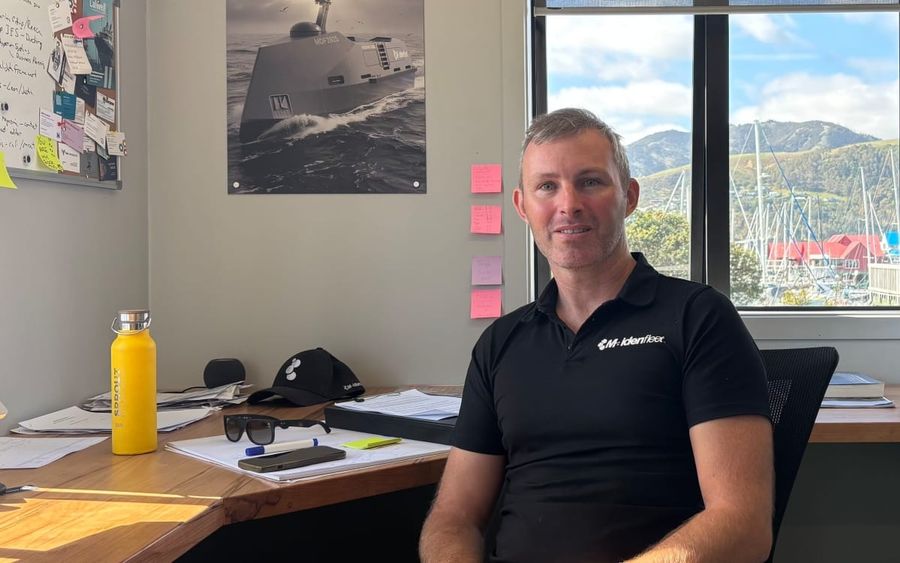
Dan Burrows, chief executive of Maidenfleet, is building fishing boats designed to operate without anyone aboard, guided remotely from land. Autonomous vessels already traverse the world's oceans on research and surveillance missions, yet commercial fishing remains entirely untouched by the technology. Burrows sees that absence as a genuine opening, describing his vision as a new and ambitious reimagining of inshore fishing that could relieve several of the pressures the industry currently faces.
His route to this point was far from conventional. Growing up in South Canterbury, he watched the America's Cup and was captivated. He trained as a boat builder, worked on superyachts in the Middle East, and later moved into high-performance racing at SailGP Technologies. The idea that would eventually become Maidenfleet took shape during the Covid-19 pandemic, while Burrows and his family were living in Auckland, the heart of New Zealand's boat-building scene, where he had been working in the composites industry. Having spent time on the edges of the fishing industry, he spotted room for significant efficiency gains, and his response was to begin redesigning the traditional fishing vessel from the ground up, automating core harvesting and vessel functions to reduce the need for crew to be physically present at sea.
"Our technology is designed to reduce the industry's dependence on crew by automating a number of harvesting and vessel functions that are becoming increasingly difficult to staff," he said.
Burrows is careful to frame Maidenfleet as something considerably more than a project about taking people off boats. His stated aims cover broader ground: improving safety, tackling labour shortages, strengthening fisheries data collection and reporting, reducing environmental impacts, and building a more sustainable commercial fishing model overall.
One of his more concrete arguments concerns space. On a conventional fishing vessel, as much as half the available room is devoted to facilities serving the people who live and work aboard. Remove the requirement for crew, and that calculation shifts considerably.
"When you take someone off a vessel you can eliminate all of that so you can use 100 percent of that internal space for storage or working equipment areas and in doing so you can reduce the size of that vessel. So you've got less capital outlay, less vessels out there doing the same job," he said.
The question of job losses is one he fields regularly, and his answer is direct.
"I just tell people, when was the last time technology ever removed any jobs? It might take two jobs off a boat, but we're going to create five on shore, so it's that old chestnut," he said.
The prototype vessels under development bear little resemblance to any conventional fishing boat. When reaching for a comparison, Burrows lands on something unexpected.
"If you think sort of stealth military technology, think F-35 fighters but on the water, it kind of looks like that," he said.
Development has been accelerated by drawing on technology already proven in other sectors. "What's really sped up our development is there's a lot of existing technology from other industries that we can cherry pick, we're not reinventing the wheel in most cases. It's applying existing technology, boxing up and putting it into the fishing industry," he said.
Burrows has self-funded the project and, to support that work, established a marine maintenance business in Nelson called Shipwright Services, handling marine carpentry, composite repairs, structural work, interior fit-outs and finishing. He estimates several years of research and development lie ahead, placing the timeline for vessels entering the water at three to five years, though he notes that could shorten if investment becomes available.
Uncrewed vessels are already operating in New Zealand waters, though not for fishing. Obsidian Systems, a robotics company whose research and development arm trades as X-craft, has been building and trialling autonomous boats and aircraft for some years. Chief executive Philip Solaris says X-craft has tested its uncrewed vessels in detecting illegal fishing, supporting search and rescue operations by deploying life rafts, and assessing cyclone damage to remote islands by launching aerial drones from the water.
Solaris is candid about the demands the marine environment places on any technology required to work reliably within it over time, noting that the sea is often described as more demanding than outer space.
"It is an incredibly aggressive, difficult environment to work in and what I mean by that is that it's fine if you just want to pop a boat into the water for a couple of days but to get it reliably operating over a long period of time with anybody on board is quite a challenge," he said.
X-craft has also developed software allowing multiple unmanned vessels to operate together as a coordinated group. "We're talking about collaborative robots, boats working with each other and then humans being there on call to make overall decisions if needed," Solaris said.
Broader uptake of the technology, he believes, will require sustained investment and thorough trials to prove these systems can operate safely at scale. On the specific question of autonomous fishing, he declines to close the door entirely, saying he would "never say never in the robotic realm".
"I would have to say that when we look at autonomous systems, we want to ask the question, is this doing something better than humans can do and is there value in doing that rather than just removing people out of the economic equation?" he said.
Obsidian Systems maintains a firm policy on humanitarian and environmental matters, and Solaris says that shapes which projects the company will pursue. He recounts being approached about developing systems to strip more fish from the sea, a proposal he rejected rather fiercely. The pitch that would interest him sounds quite different.
"If they were to come to me and say, 'well actually we want to improve the quality and the reliability and lower the impact on maritime operations', then that would be highly desirable for us," he said.
On the scientific side, autonomous vessels have already found a place in fisheries research. Richard O'Driscoll, wild fisheries chief scientist at Earth Sciences New Zealand and a specialist in counting and measuring fish, worked with X-craft to develop two autonomous boats fitted with fish-finder equipment for estimating fish abundance, trialling them in the Hauraki Gulf and Cook Strait in 2020 and 2022.
"What we were trying to do is test the viability of using those autonomous vessels instead of a research vessel to go up and down and count fish," he said.
The approach proved more cost-effective for gathering certain kinds of data, though O'Driscoll is clear about its limits. The vessels cannot capture fish to provide biological samples, for instance. He frames the technology not as a replacement for crewed research vessels but as a complement, one that allows greater coverage across geography and time at a lower cost per survey.
"The advantage of those sort of platforms is not to replace what we do from crewed vessels or research vessels but to basically augment what we do by allowing greater coverage in space and time by having a cheaper option to put into your survey programme," he said.
Automated ocean monitoring is, in any case, already routine. O'Driscoll points out that drifting, moored and mobile platforms collect data from the world's oceans every day. "We have automated glider systems that we use to measure oceanography, self-propelled gliders that go up and down in the ocean measuring things like temperature and salinity. We also have autonomous oceanographic floats that go up and down in the water column, collecting information on water properties and then transmitting that information via satellite back to a receiving station," he said.
Seafood NZ has welcomed the general direction of this work, with fishers consistently seeking ways to improve catch efficiencies and support marine health. A spokesperson for the industry body pointed to the regulatory environment as something that can slow the pace of innovation, while noting that rule changes had already been made to enable initiatives such as FloMo, which has brought meaningful improvements to the quality of fish caught. The organisation acknowledged that some of the most significant advances, particularly around bycatch, had come from people responding and adapting as conditions changed, and confirmed it is running an innovation programme aimed at continuing to find ways to improve fishing practices.