
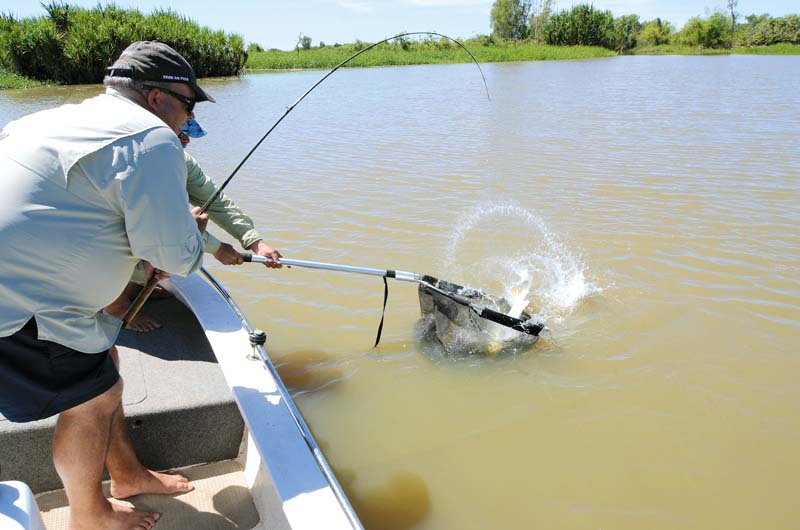
Tales of the fish that got away are woven into angling folklore, and a surprising number of those heartbreaking losses happen in the final few seconds, when the catch is tantalisingly close to the boat or the bank. A large proportion of these near-misses come down to poor use of a landing net, a tool that should, in theory, make the whole business straightforward.
Bringing a fish to hand with a landing net ought to be simple enough, yet the heat of the moment has a way of undoing even experienced anglers. When a trophy fish finally surfaces after a long fight, the impulse to haul it clear of the water as fast as possible is completely understandable. Acting on that impulse, however, is usually where things fall apart.
The landing net is by far the most widely used tool for finishing the job, yet the netting process goes wrong with astonishing regularity. The same overly eager net-wielder who frees one fish from the hook will almost certainly do it again, because the mistake is instinctive rather than careless.
The single most important thing to understand about using a landing net is that it has absolutely nothing in common with catching butterflies. Swooshing, swooping, dipping, and scooping at a flailing fish will not work. Instead, there are three straightforward steps to follow every single time.
First, place the net in the water so that the front of the hoop is well submerged and the back of the hoop, where the handle connects, sits roughly flush with the surface. Second, use the rod and line to bring the hooked fish to the net and guide it in headfirst. If you are fishing alone, you will need to manage both the rod and the net handle yourself, and if more line needs to be reeled in during this process, tuck the net handle under your arm to free up a hand. Third, and this is the step most often skipped, as soon as the fish's head and at least half its body mass are over the front of the hoop and above the mesh, relax the pressure on the line before you begin lifting the net from the water. This easing of tension typically encourages the fish to dive deeper into the net and also takes the strain off the rod at the most critical point of the whole encounter.
Those steps are worth repeating plainly: submerge the net, bring the fish to the net and swim it in headfirst, reduce the pressure on the line, then smoothly lift the net clear.
Two things you should never do are chase a swimming fish with a net or attempt to net a fish tail-first. Any fish can swim considerably faster than you can push a submerged net through the water, so pursuit almost always ends badly. Modern fish-friendly knotless and mesh nets, including the popular Environets and their various clones, create particular resistance when moved through the water quickly, making the problem even worse. Fish chased from behind by a net will nearly always escape, and they frequently break the line or throw the hook in the process.
As a general rule, a larger net with a wider hoop is easier to use and more effective than a smaller one, at least up to a point. Once you are dealing with fish above roughly 18 to 20 kilograms, even a generously sized net starts to reach its limits. Most anglers will never regularly encounter fish that large, but for those who remain optimistic, which is to say most anglers, carrying a gaff provides an option when something truly enormous comes alongside. We'll look at gaffing next time.
When choosing a net, look for solid construction and a sturdy handle. Sizing up is a sensible policy, and the newer knotless varieties are worth considering seriously. They are considerably gentler on fish, which matters greatly for anyone practising catch and release, and they are also far less prone to tangling with loose hooks. A quality landing net represents a real investment, but one that will repay itself many times over across many seasons, provided it is used correctly.