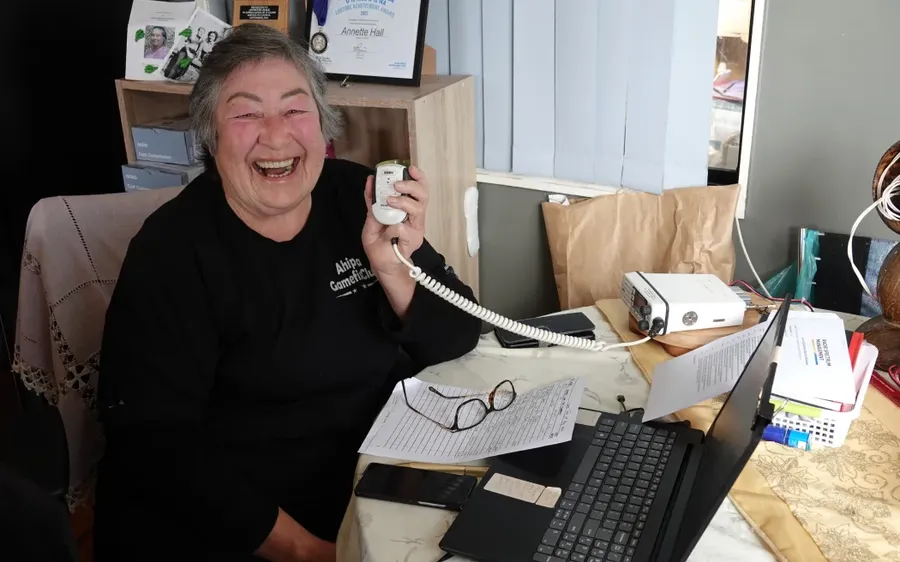
For two decades, Annette Hall was the steady, familiar presence that commercial fishers, sailors, and charter skippers trusted to keep watch over them. Twice daily, without exception, she made contact with vessels across a vast stretch of northern New Zealand waters, confirmed they had returned safely to port, relayed weather forecasts, and when emergencies erupted in the middle of the night, she reached for the radio and co-ordinated rescues from her living room. She did all of this without pay, from a modest cottage overlooking Doubtless Bay. At 6pm on Wednesday she made her final transmission, and with it, a service stretching back to at least 1947 came to an end.
Her route into maritime radio was an unlikely one. Before she ever sat behind a microphone, Hall had been pulling pints at well-known hotels in Ōpua, Kaitāia, and Mangōnui. She had no seafaring background to speak of, only a love of fishing, and her involvement began entirely by chance. She happened to live next door to Far North Radio and Sea Rescue stalwarts Malcolm and Maureen MacMillan, known to everyone as Mac and Mo, and it all started with a few evening shifts so her neighbours could take a break.
"One afternoon, Maureen said to me, 'You're very good at talking a lot. Let me show you the radio'. And I said, 'Okay, how hard could it be?'"
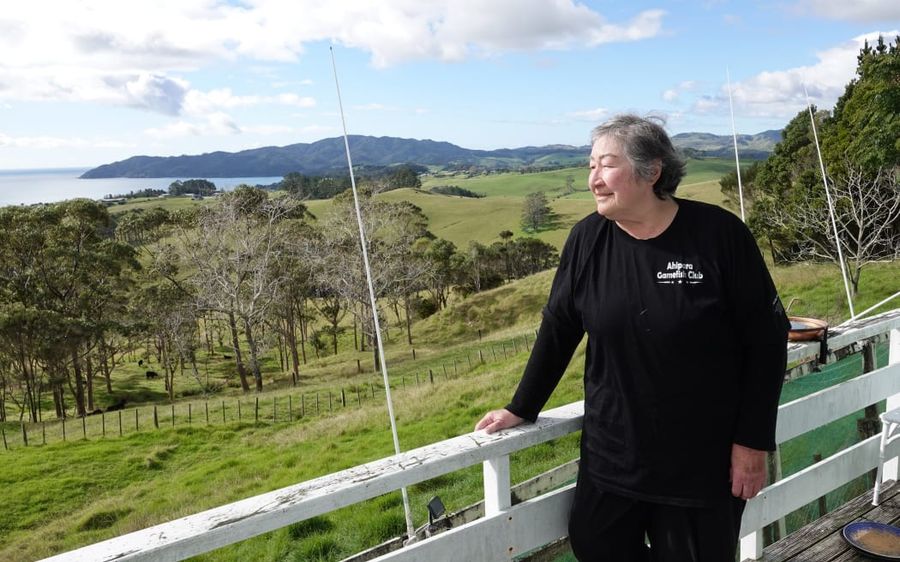
When Maureen MacMillan died of motor neurone disease, Hall agreed to help out while her husband sorted things out. What unfolded next she still recounts with gentle amusement.
"I came home from work, and there was all their radio equipment on my dining table. So I said, 'Okay, let's just do it for a few months, and we'll take it from there'."
That was 20 years ago.
"It's longer than four months. Way longer. But it's been fun, you know? It's a community thing, and very family-oriented."
Far North Radio and Sea Rescue ran a VHF marine radio service covering waters from Whangaroa Harbour on the east coast all the way north to the Three Kings Islands, and down the west coast to the Hokianga Harbour. It also operated a single-sideband (SSB) radio service with an almost unlimited range. Until a few weeks ago, the organisation also ran a rescue boat named Lily Walker. An earlier vessel, Good as Gold, had taken its name from Maureen MacMillan's favourite expression.
The service was a lifeline for commercial and recreational fishers, for blue water sailors making passages between New Zealand and the Pacific Islands, and for the many fishing contests held in those northern waters. As senior operator, Hall handled the morning and evening radio calls herself, while other volunteers covered day shifts so she could continue working at the local veterinary clinic. On weekends and public holidays she monitored the airwaves, and she kept a radio beside her bed so that any overnight emergency could rouse her immediately.
To those who depended on her, the connection was deeply personal. Doubtless Bay-based commercial fisherman Nat Davey described her contribution as simply "amazing".
"Over the last good 20 years, Annette's been like a mum to the fishermen out there," he said. "She's kept a great eye on us, and if for some reason we haven't called up in the evenings and she knows we're out there, she'll always check in to make sure we're all fine. It's pretty selfless, really. She just gets in there and does it."
Ethan Bryant, skipper of fishing charter boat Te Ariki Nui, spoke to RNZ by satellite from the Three Kings Islands, roughly 30 nautical miles north of Cape Reinga.
"We look at her as our guardian angel," he said. "She's one of the only people that looks out for us out here. Between 7.30 and 8 o'clock every single morning without fail you hear that sweet voice come on the radio, no matter how rough or rainy or sunny or whatever it is, you always feel comfortable. That little 30 second chat every morning and every afternoon, it means a lot."
Bryant said Hall would be greatly missed by those who venture far offshore, beyond the range that Coastguard covers. "She knows exactly where everybody is. If she doesn't hear from you or you forget to do your afternoon call, she'll make sure she gets hold of you before the end of the day. If she can't, then she knows something's up," he said. "I know she looks at us as her boys that she looks after. It's definitely a big help knowing that somebody's looking over you and knows exactly where your nearest help is."
For all the warmth and community spirit that defined the role, Hall spoke candidly about its harder moments. The most serious incidents she dealt with included the sinking of Enchanter in 2022, in which five people died, and the Karikari Peninsula fire of 2011, when a helicopter on a rescue mission came down in the sea.
Over the years she developed her own method for steadying herself when an emergency call pulled her from bed in the small hours.
"When something happens, you get up, and put the jug on first," she said. "One of the really big ones I had was the Karikari fire, when we lost two people in the helicopter. That was a real tragedy."
Hall turns 75 later this month, and she cited several reasons for stepping back. Her daughter has recently moved up from the South Island, and she is looking forward to spending time with her. There is also, she noted, quite a lot of cricket to catch up on, and she is finally hoping to get out and do some fishing herself.
"It's just natural attrition, really. You know, we've all got older, and you need to go on and do other things. And also, I'm actually quite old, believe it or not."
The question of what fills the gap she leaves behind remains unresolved. Coastguard New Zealand has confirmed it is in discussions with Far North Radio and Sea Rescue about future VHF radio coverage for the region, though no decision has yet been made. Coastguard has indicated it wants to ensure boaties in the Far North retain access to safe and reliable radio coverage. In the meantime, VHF channel 16 remains available for trip reports and requests for assistance, with calls passed on to Coastguard as required.
Hall's two decades of service have not gone unrecognised. In 2025 she was named a Local Hero medallist in the New Zealander of the Year Awards and received a Te Tohu Tutuki/Lifetime Achievement Award from the Far North District Council. Far North Radio and Sea Rescue receives no direct government funding, relying instead on member subscriptions, sponsorship, and fundraising to keep operating.