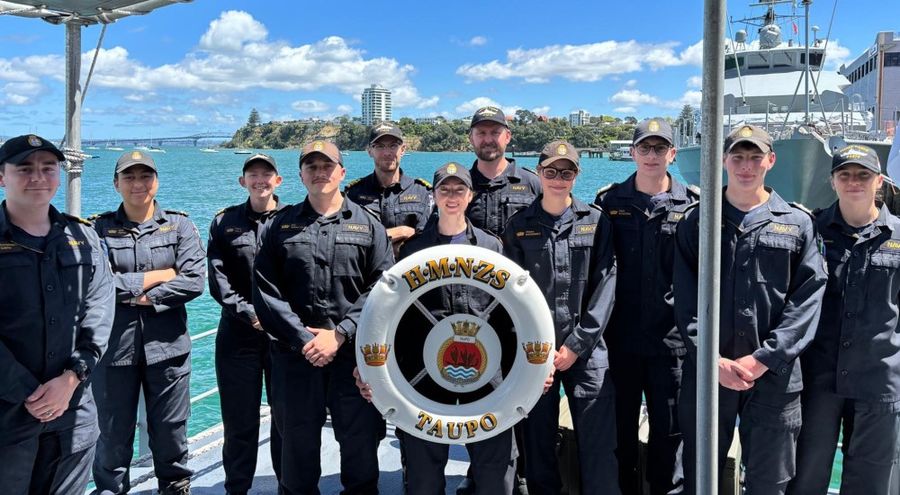
Confidence isn't handed to anyone. It accumulates through exposure, through decisions made under pressure, and through moments when the sea stops cooperating and a crew has to respond. The trainee watchkeepers aboard HMNZS Taupo collected a significant amount of that currency during their most recent Bravos sea phase.
The Bravos programme is where textbooks give way to tidal streams. Officers-in-training step onto a working bridge and begin translating classroom theory into real decisions, with coastal navigation, pilotage, and shiphandling forming the core of what they practise. The plan for this rotation was straightforward enough until Cook Strait delivered conditions that Wellington locals would describe, without much drama, as fairly typical.
Gusts reached 50 knots. The harbour entrance produced the kind of stacked chop that draws the eye of even experienced skippers. Yet aboard HMNZS Taupo, the bridge stayed composed. Lieutenant Commander Toby Mara, the ship's Commanding Officer, credited both the vessel's capability and his team's familiarity with conditions like these.
"The conditions were exciting for the students, but the experienced members of the team were confident the ship could handle it," he said.
For the trainees, that moment was the lesson itself. Wind, tide, sea state and hull response had all featured in lectures and written assessments, but now every one of those variables was pressing directly against the ship. No simulation produces that particular combination of sensory information and real consequence.
The rough weather extended Taupo's time in port beyond the original schedule, but the delay didn't slow the programme. Wellington Harbour has its own demands, with gusts tumbling off the surrounding hills and sweeping unpredictably across the water. The trainees worked through turns, approaches, and station-keeping in conditions that rewarded patience and precision far more than boldness. Seamanship in a blustery enclosed harbour is its own discipline, and the trainees got a thorough introduction to it.
[gallery td_select_gallery_slide="slide" ids="158645,158646,158644"]
Earlier in the month, Taupo had operated alongside ROKS Hansando, a Republic of Korea Navy training vessel on a visit to Auckland. The two ships conducted an escort evolution out of harbour together, and while the manoeuvre itself was uncomplicated, the value was in what surrounded it. Radio calls moved between two languages, shiphandling coordination happened across different naval traditions, and the whole evolution held together through shared professional standards.
Mara reflected on what that kind of interaction offers. "It's such a great opportunity to work with another nation… our communications methods still stand up and we can conduct manoeuvres together," he said. For trainee watchkeepers, watching seamanship operate across a language barrier reinforced something worth knowing early: the fundamentals travel well.
Over the course of the year, Taupo has threaded through an impressive range of New Zealand coastal environments. The busy approaches of the Waitematā, the island-dotted terrain of the Motukawao Group, the open stretches of the Hauraki Gulf, Northland's northern reaches, and exercises conducted alongside HMNZS Canterbury have all contributed to the trainees' developing picture of this coastline.
The passage back from Wellington provided some of the most demanding conditions of the rotation. Taupo departed into Sea State 5, with heavy swell running hard on the beam and the ship working a zig-zag course up the east coast to manage the motion. The crew sheltered in Hawke Bay when conditions called for it, found easier water in Anaura Bay, and then pressed on around East Cape before continuing north. Each of those decisions, to seek shelter, to alter the heading, to read what the sea was actually doing rather than what the passage plan assumed it would do, gave the trainees direct experience of adaptive seamanship.
HMNZS Taupo holds the distinction of being the smallest vessel in the Royal New Zealand Navy fleet, yet her contribution to officer development is considerable. The Bravos sea phase is built around the understanding that certain things cannot be absorbed from a printed page or a computer screen: how to weigh risk against conditions, how to keep mental pace with a changing situation rather than fall behind it, and how to move a vessel responsibly through coastal waters that don't stay the same from one hour to the next.
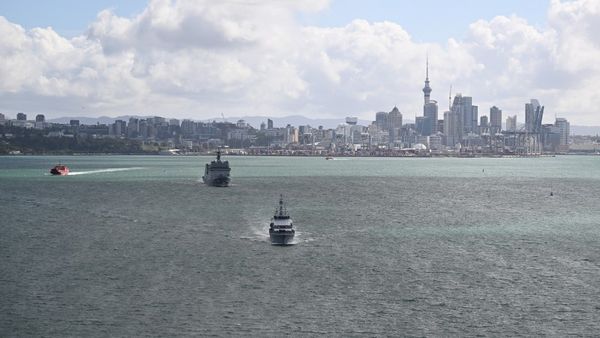
By the time this rotation concluded, the trainees had encountered more variety than many recreational skippers accumulate across an entire season. Gale-force harbour approaches, confused coastal swell, confined-water shiphandling, multinational operations, and the repeated need to revise plans mid-execution had all featured in the same programme. Each experience added something that formal assessment alone cannot measure.
For the Navy, that is precisely what the Bravos phase is designed to produce. For anyone who spends time on the water in any capacity, it points to something worth remembering: genuine seamanship isn't built through dramatic moments alone. It accrues steadily, through the kind of ordinary-extraordinary days that stay with a person long after the vessel is back alongside.