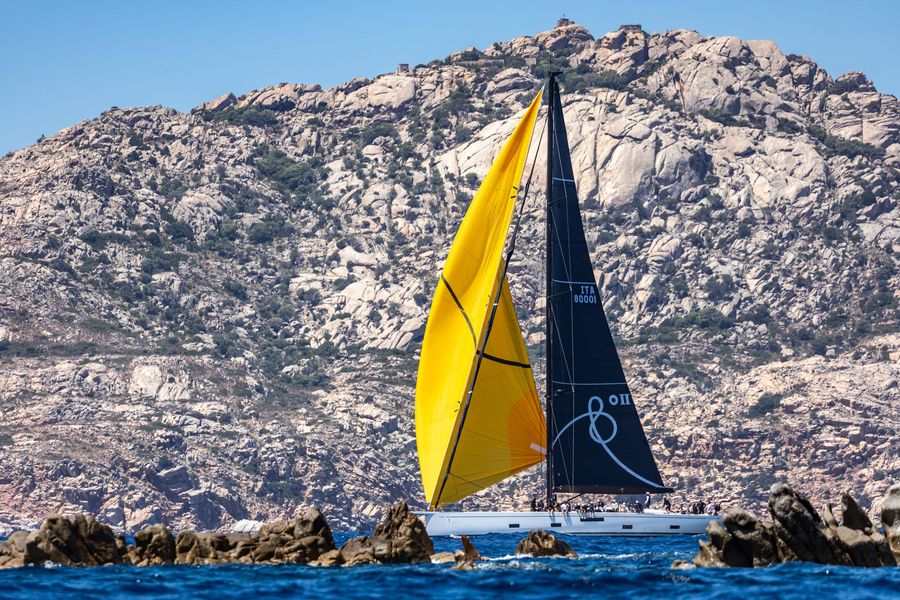
Cantiere del Pardo has been quietly at work at its Forlì yard, and the Grand Soleil Plus 80 Long Cruise is the result. At 26.20 metres, this sailing yacht is unambiguous in its ambitions: ocean crossings in comfort, confidence in heavy weather, and a genuinely liveable space once the anchor is down.
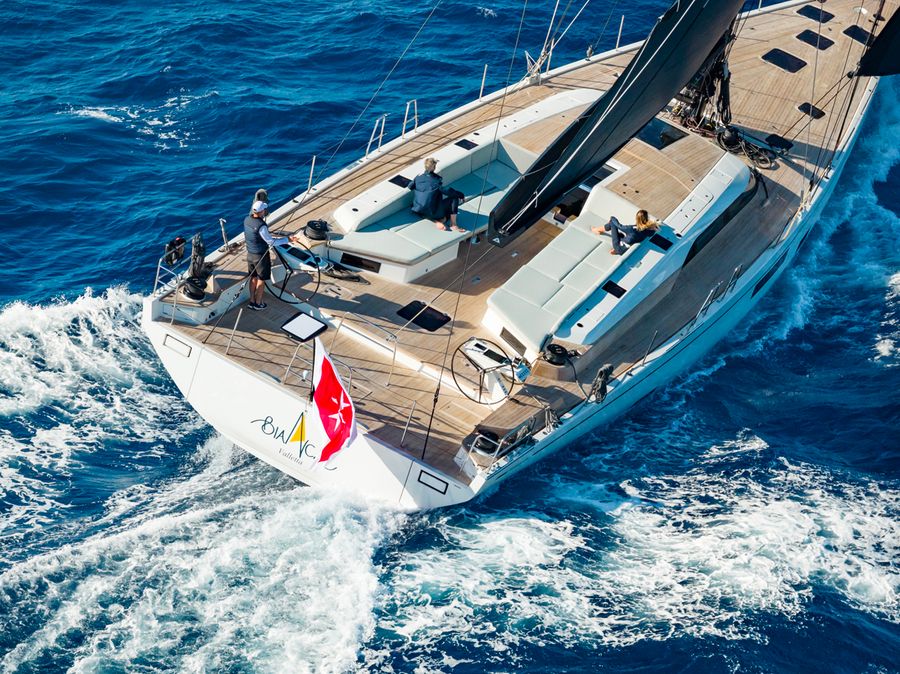
Bianca II, the first hull, made its initial appearance at the Grand Soleil Cup 2026 in a private capacity before a wider public showing at the Cannes Yachting Festival in September. The largest model to emerge from the Plus line, which now stretches from 65 feet upward, its arrival makes clear that the Italian yard has no intention of following much of the superyacht market in shifting its focus toward motor vessels.
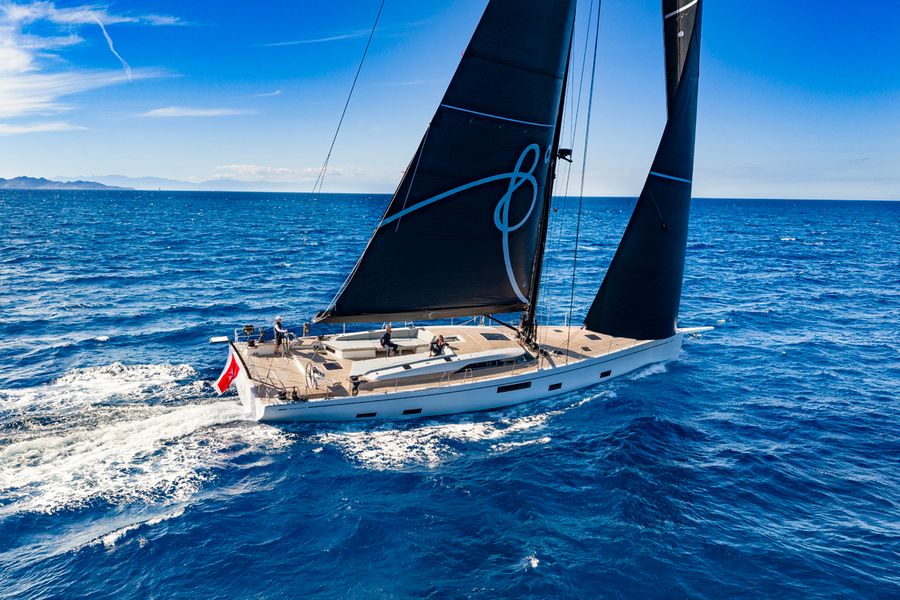
Size alone does not explain what makes the Plus 80 LC worth attention. The more telling story is how the design team managed to scale up without surrendering the handling character that smaller Grand Soleil models are known for. Naval architect Matteo Polli, a consistent presence across the Plus range, gave the hull narrow bow sections that part a chop cleanly rather than batter through it. The sections widen progressively toward the stern, a deliberate decision that keeps offshore motion manageable while recovering the interior volume that a fine entry inevitably gives away.
The underwater configuration reflects serious offshore priorities. Bianca II carries twin rudders paired with a telescopic keel offering variable draft between 2.90 and 4.40 metres, a combination that preserves steering authority even when the boat is well heeled. Owners who prefer a more conventional arrangement can opt for a single-rudder setup with fixed keel options ranging from 2.40 metres to deeper profiles. That flexibility counts on a yacht likely to be threading through the Mediterranean one season and crossing the Pacific the next.
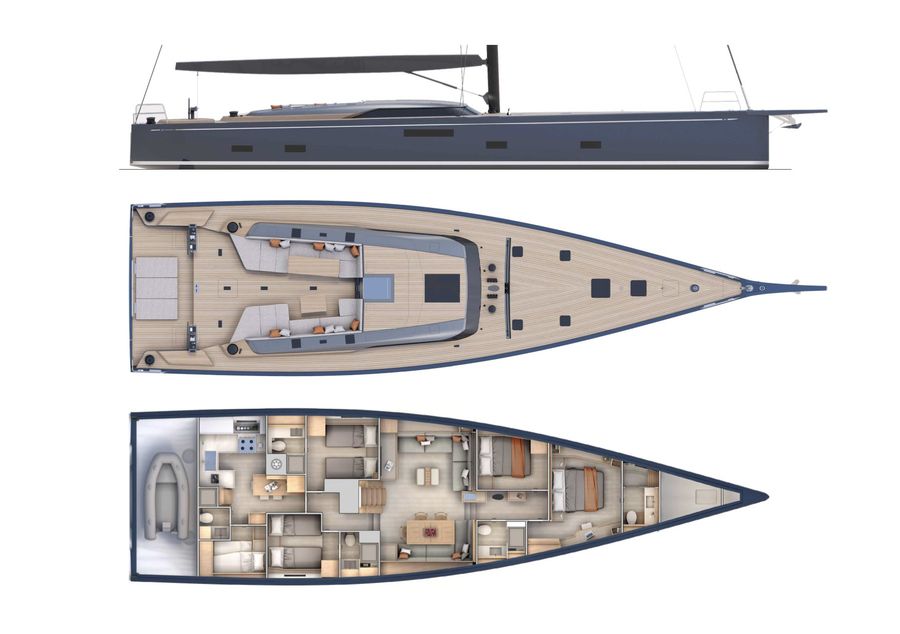
The rig centres on a carbon mast and boom, with rod standing rigging chosen for durability on extended passages. A fixed bowsprit accommodates two gennaker configurations: a traditional nylon sail for light-air work and a furling gennaker on an anti-torsion cable suited to short-handed crews. An inner forestay is available as an option for a storm jib when conditions deteriorate. All running rigging leads aft to twin helm stations, keeping the central cockpit clear for crew movement and maintaining a sensible separation between working and social areas. Mainsail handling is assisted by the V-boom, and the total sail plan measures 400 square metres.
Construction follows Cantiere del Pardo's established in-house process: composite sandwich lamination using epoxy-based vinylester resin, vacuum infusion, and carbon reinforcement concentrated at high-load points. On Bianca II, the bulkheads incorporate carbon conduit for cable runs, cutting wiring clutter and making systems easier to trace when attention is needed. Project manager Franco Corazza notes that the entire build, from first lamination through to launch, was completed on site, which is notable at a scale where subcontracting commonly becomes the norm.
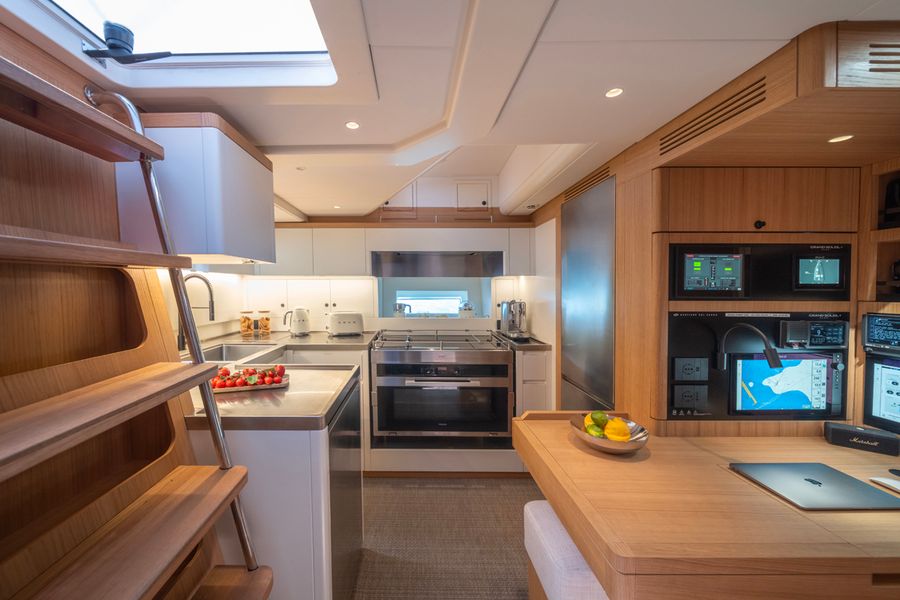
Power management is built around a Torqeedo hybrid platform combining electric propulsion with hotel load management. Two 40 kWh battery packs deliver a combined 80 kWh of storage, with the long-range configuration adding a pair of 45 kW generators. A dedicated buffer pack keeps essential systems running regardless of propulsion or generator status. Rather than fitting individual electric drives to each piece of deck machinery, the yard has connected the winches, telescopic keel mechanism, and mast systems to a single centralised hydraulic circuit, reducing weight and limiting the number of independent systems requiring maintenance.
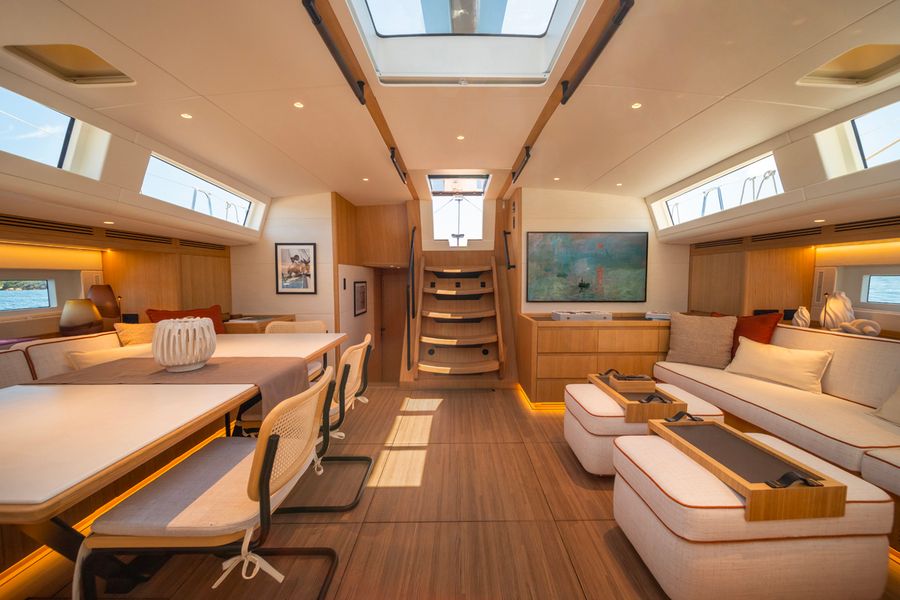
The raised coachroof that visually defines the Plus line carries real consequences below decks. The elevated saloon sole it produces opens up a usable technical void where electrical and mechanical components are housed, leaving cabin and stowage space above unaffected. The coachroof glazing wraps through 270 degrees, ensuring the saloon draws genuine natural light at sea rather than only when the boat is sitting alongside a dock.
Nauta, the Milan studio responsible for exterior styling and interior design across the Plus range, configured Bianca II with four guest cabins and two crew cabins, with a three-plus-two layout also available. The master cabin sits forward with a walk-around bed and its own ensuite. Guest cabins can be arranged as doubles or as convertible twins with Pullman-style upper berths for additional capacity. Crew quarters and the galley occupy the aft section, served by their own access route that keeps working areas clear of guest spaces. Bianca II forgoes a tender garage, directing that volume instead toward owner-specified equipment such as a freezer or laundry fitout.
Below decks, Bianca II pairs warm oak joinery with textile-covered bulkheads, moving away from both painted surfaces and conventional timber panelling. Nauta says the approach improves acoustics and adds a greater sense of warmth to the spaces below.
Nauta CEO and co-founder Massimo Gino framed the underlying challenge directly: an 80-foot yacht must deliver what buyers shopping in the 95 to 100-foot bracket have come to expect. The Plus 80 LC makes a credible case that it can.
Specifications
Overall length 26.20 m / Hull length 23.99 m / Waterline length 22 m / Beam 6.60 m / Standard draft 3.95 m / Displacement (light ship) 42.5 t / Sail area 400 m² / Fuel 2,000 L / Fresh water 1,300 L / Engine Yanmar 4LV250 250 hp / Layout 5+5 / Naval architecture Matteo Polli / Design and interiors Nauta / Builder Cantiere del Pardo