From backcountry rivers to sprawling estuaries, the watercraft you arrive in can determine the quality of your entire game bird season. Across New Zealand, a growing number of hunters are investing in purpose-built boats to reach better water, find better birds, and make the most of every day afield.
Game bird season has a habit of sneaking up on you. One weekend the lakes and estuaries sit glassy and undisturbed, the next, opening morning has arrived and shots are echoing off estuary banks and lake margins in the half-light.
For those hunting from a boat, everything that happens before that first shot counts.
A well-prepared boat does far more than transport you from the ramp to your shooting position. It keeps you safe when the weather turns, keeps you mobile when the birds do what birds inevitably do, and gives you a kind of freedom that a fixed maimai simply cannot provide. The birds will move. Count on it.
Early in the season, ducks spread widely across open harbours, lakes, and estuaries. As hunting pressure accumulates over the following weeks, they pull back into tighter, more sheltered water. Rivers and backwaters grow in value as the weeks pass. A boat that can handle those conditions means you can stay on the birds no matter where they end up.
Pre-season boat checks
Getting through the fundamentals before the season opens is time well spent.
Safety gear tops the list. Throughout most of New Zealand, wearing a lifejacket is compulsory when hunting from a boat under six metres. The best options balance real protection with enough freedom of movement to hunt comfortably. Low-profile inflatable vests suit long days on open water well, while more durable foam vests hold up better for higher-motion situations such as kayak hunting. Whatever style you settle on, look for low-visibility or camouflaged colours. Every lifejacket should be in good condition, less than ten years old, and immediately accessible. Cold water and winter conditions raise the stakes fast if you end up in the water.
Give your hull a thorough inspection as well. Look for cracks, loose fittings, and any sign of corrosion, with particular attention paid to alloy construction. A small issue that seems trivial at the ramp has a way of becoming genuinely serious when you are operating in remote water with no simple way out.
If your boat has an engine, run through a proper pre-season check. Fuel lines, batteries, and reliable starting are what matter most on a dark winter morning in an isolated location. Outboard motors deserve the same level of attention.
There will also come a point when the motor goes quiet and the oars come out. New Zealand's game bird regulations place firm restrictions on the use of powered vessels, which means at some stage you will need to row into position rather than motor there. Check your oars, rowlocks, and mounting points before the season opens, not on the morning you actually need them. Discovering a failed rowlock mid-hunt is a frustrating and entirely avoidable problem.
Lighting rounds out the checklist. Many hunters are on the water well before first light, which means navigation lights and torches need to be reliable and ready before you leave the ramp.
Choosing a boat for hunting conditions
Not every hull is suited to game bird hunting. The setups that perform consistently well favour access and stability over outright speed.
Flat-bottom hulls remain the most popular choice for most hunters, and the reasons are straightforward. Their shallow draft allows them to push into water that deeper-keeled boats cannot reach, while a wide footprint delivers a stable shooting platform even when things get lively. Brands including Huntercraft and FatCat build specifically for these environments, producing boats that handle estuaries and wetlands well and carry decoys, dogs, and hunting gear without trouble.
Pontoon-style boats from New Zealand manufacturers such as Stabicraft, Senator, and Osprey Boats offer another strong option, particularly for hunters going out in groups or running larger decoy spreads. The buoyancy and stability these platforms provide is hard to match.
For those targeting rivers as the season progresses, shallow-draft rigs or jet boats open up stretches of water that most setups cannot reach at all. That kind of access becomes more valuable as pressure pushes birds into quieter, harder-to-reach country.
Setting up your boat as a floating maimai
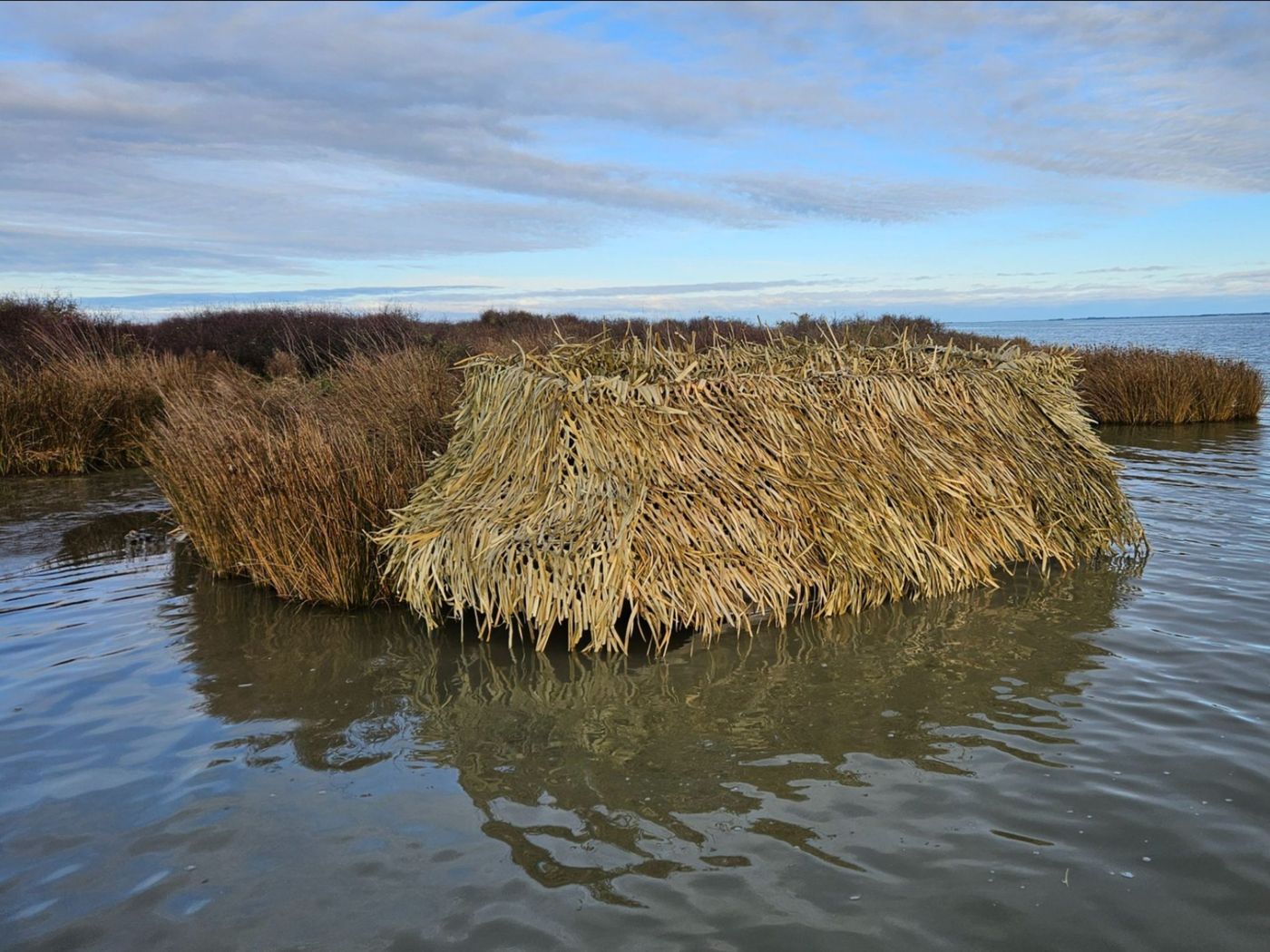
An exposed boat sitting on open water will cost you birds. Ducks have sharp eyes and react quickly to anything that looks out of place, and a bare hull in the open will register immediately. A well-built boat blind changes that entirely.
Breaking up your boat's outline and blending it into the surrounding cover lets you hunt effectively in places where no natural shelter exists. A floating blind also keeps you mobile, which matters enormously. When the wind changes direction or a flight line shifts, you can reposition, something a fixed maimai will never allow. That adaptability is one of the biggest advantages boat hunting has to offer.
Keep the setup functional and uncluttered. Stow loose gear securely, position your decoys where approaching birds will pick them up, and confirm that your shooting lanes are clear before the action starts.
Protecting waterways while you hunt
Hunting from a boat comes with responsibilities beyond the hunt itself. Aquatic pests are a serious and growing problem in New Zealand's waterways, and hunters moving between locations can unwittingly carry them from one place to another.
The guiding principle is simple. Check, clean, dry.
Before leaving any location, inspect your boat along with your decoys, boots, and dogs. Remove all plant material and drain every drop of water. Wash the boat down at the takeout point where you can. Once home, give everything a careful going-over and allow all gear to dry completely before your next trip out. It takes very little time, and it protects the very waterways that make this style of hunting worth doing.
Ready for opening morning
Hunters who produce results consistently across a season tend to have one thing in common: they have done the preparation before that first shot is ever fired.
A reliable boat, properly rigged and ready, gives you genuine options throughout the season. It lets you follow the birds as conditions change and as pressure builds week by week.
Get the boat right, and much of the rest has a way of taking care of itself.
New Fish & Game free online knowledge hub
New Zealand Council for Fish & Game has launched a free online knowledge hub carrying resources for game bird hunters at every level of experience, from first-timers to seasoned regulars. Well worth exploring before the season gets underway.