Electrical systems aboard boats were once straightforward. A battery bank, an alternator and a shore charger covered most needs.
That simplicity is largely a thing of the past.
Today's boats are frequently loaded with equipment that places a continuous electrical demand on the system throughout the day. Refrigeration never stops. Navigation electronics stay live throughout a passage. Lighting, entertainment and galley appliances all add to the draw. For cruising boats spending extended time away from a marina, the parallel with a small home is hard to avoid.
That shift in how boats are actually used has driven owners toward more sophisticated electrical setups.
"Victron is very strong in the marine market," says Morgan Brodie from Lusty & Blundell. "The foundations of the business actually came out of the Netherlands, with boats operating in canals. That's where their early chargers and power equipment were developed."
The company now supplies a wide range of electrical products across cruising yachts, motorboats and off-grid installations.
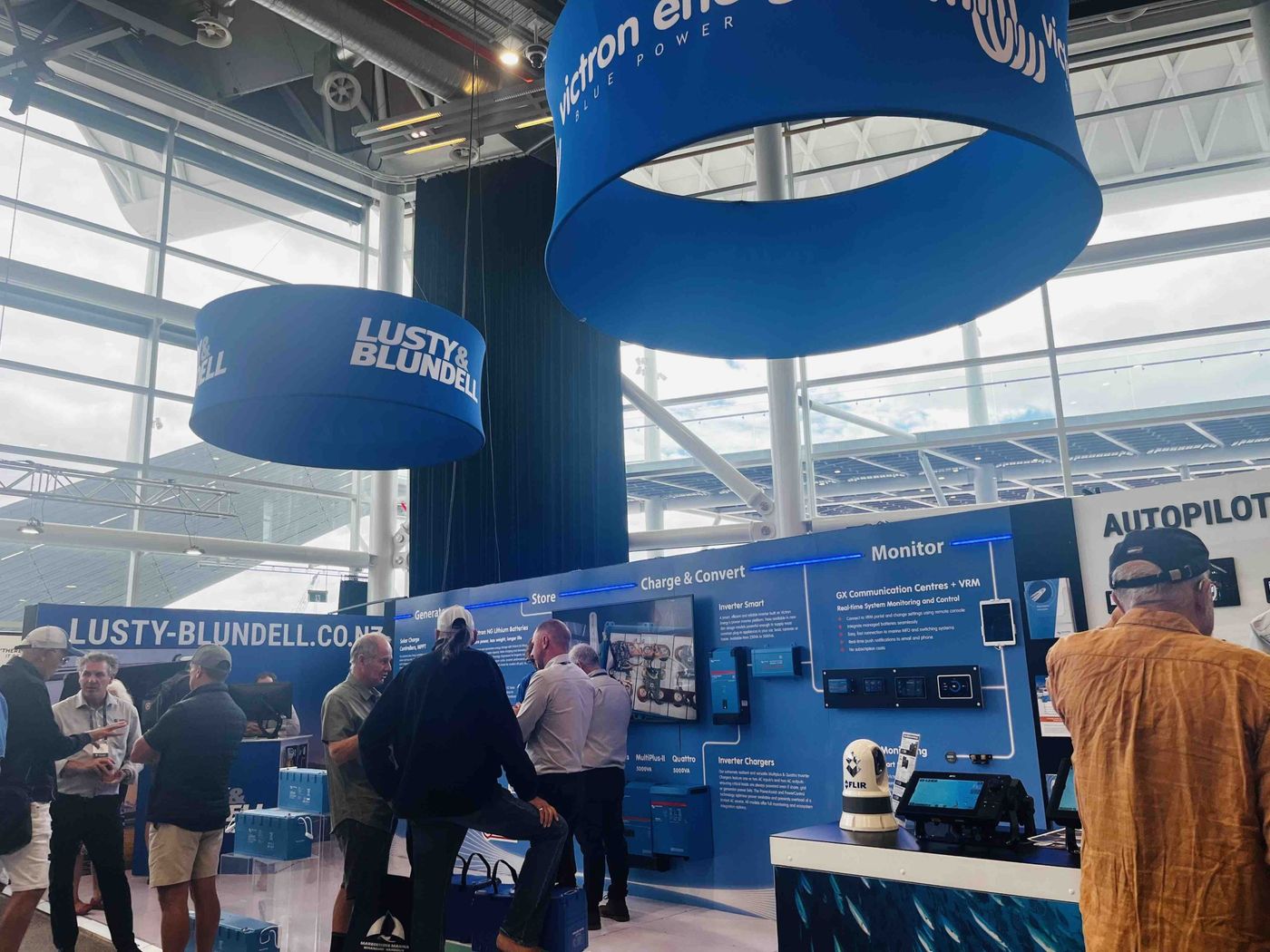
Brodie frames the Victron approach around four straightforward concepts, each describing a stage in the journey electricity makes through a modern vessel: generate, store, convert, monitor.
Generation is where everything begins. Most contemporary boats draw from several sources at once, with alternators feeding the system while the engine is running, solar panels contributing through the day, and shore power or a generator available when conditions allow. Each source adds electricity, but coordinating multiple inputs without conflict is where things can quickly become complicated.
Storage comes next. Lithium battery banks have become the standard for modern installations, offering deeper discharge capability and faster charging than the lead-acid banks they have replaced. Within the Victron ecosystem, a battery management system sits at the heart of the network, governing how energy flows in and out.
"The battery system communicates out to the whole network and tells the system what it wants in regards to charge and what it's allowed to do with discharge," Brodie explains.
The battery bank becomes the reference point the entire system defers to, rather than a passive reservoir.
Conversion addresses the gap between how electricity is stored and how it is used. Battery banks hold energy as direct current, yet most household appliances require alternating current to operate. Inverters handle that translation in one direction, while chargers reverse the process when power arrives from shore or a generator. Where individual devices operate in isolation, they can inadvertently work against each other, with one charging source ramping up while another backs off in response to a conflicting voltage signal. Integrated systems allow these components to communicate, so that charging and load management work together rather than competing.
Monitoring ties the whole system together. Owners want a clear, current picture of battery state, charging rate and what is consuming power at any given moment. Victron consolidates all of that information through onboard displays and a remote monitoring platform called VRM.
"If you connect your system to WiFi you can access it from anywhere in the world," Brodie says. "You've got full access and full control of what's happening with the system."
That connectivity also opens the door to remote technical support, allowing problems to be diagnosed without anyone needing to step aboard.
"We can dial in and see what's going on. Sometimes it's just a user setting and we can point that out straight away."
Plenty of boats already carry some of these components individually, whether a solar controller or a standalone inverter. Brodie's point is that the genuine benefit comes when those pieces are brought together into a single, communicating ecosystem. When generation, storage, conversion and monitoring all operate within the same network, the system becomes adaptive. Charging sources adjust in response to real conditions. Batteries receive what they need. Owners gain a clearer picture of what is happening onboard.
For vessels that now depend heavily on electricity, that level of coordination matters more than ever.