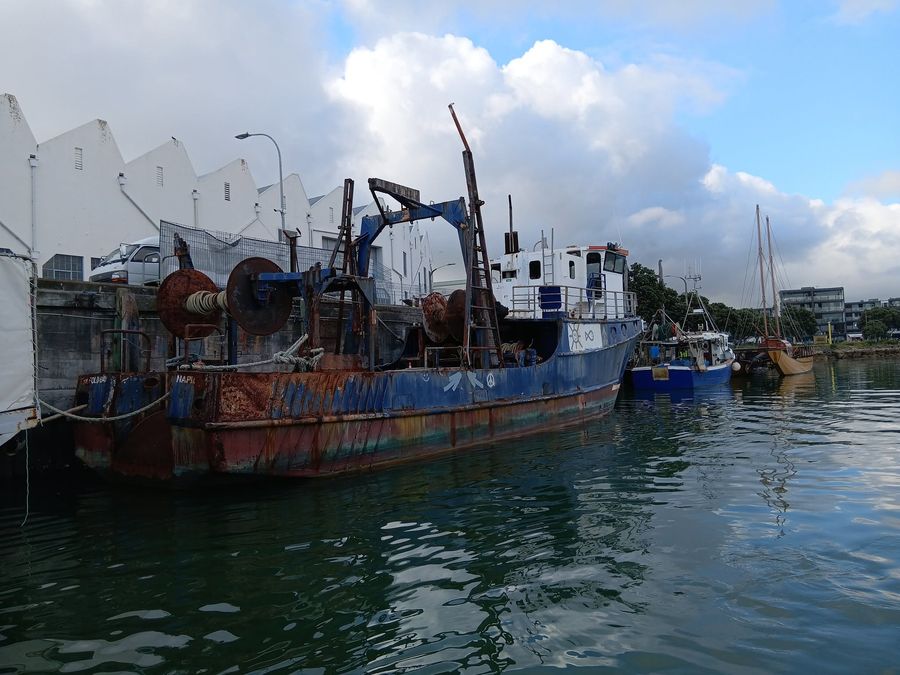
Few landmarks along the Ahuriri waterfront in Napier became as familiar, or as quietly forlorn, as Twofold Bay. For three years the 23-metre steel-hulled trawler sat moored on the far side of the narrow road from the restaurants and cafés lining West Quay, going nowhere. Maritime safety regulations had made her unfit for sea, and her condition deterred any prospective buyer. She simply stayed put, a rusting fixture of the harbour. Built in Australia in 1966, she had spent decades working New Zealand waters before the rules finally caught up with her and the dock became her permanent address.
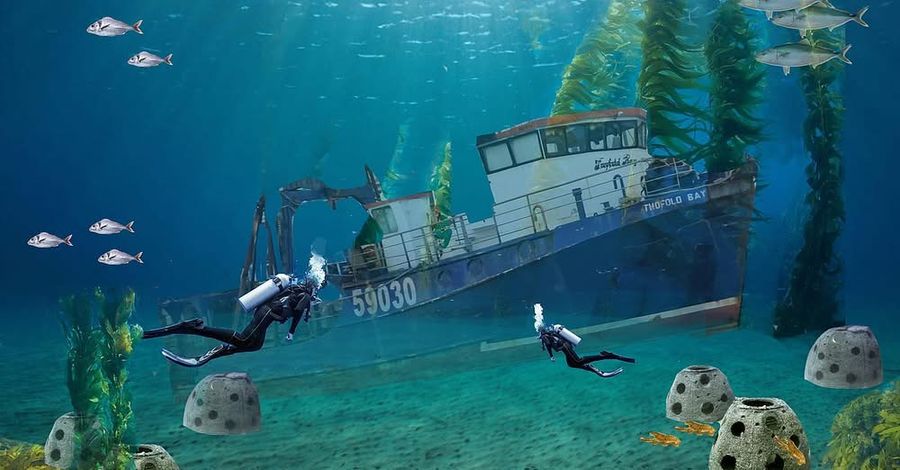
She might easily have stayed there until the hull gave way and nothing remained worth saving. She did not. Today she sits upright on the sandy seafloor, 17 metres down, and the argument could be made that her most productive years are only now beginning.
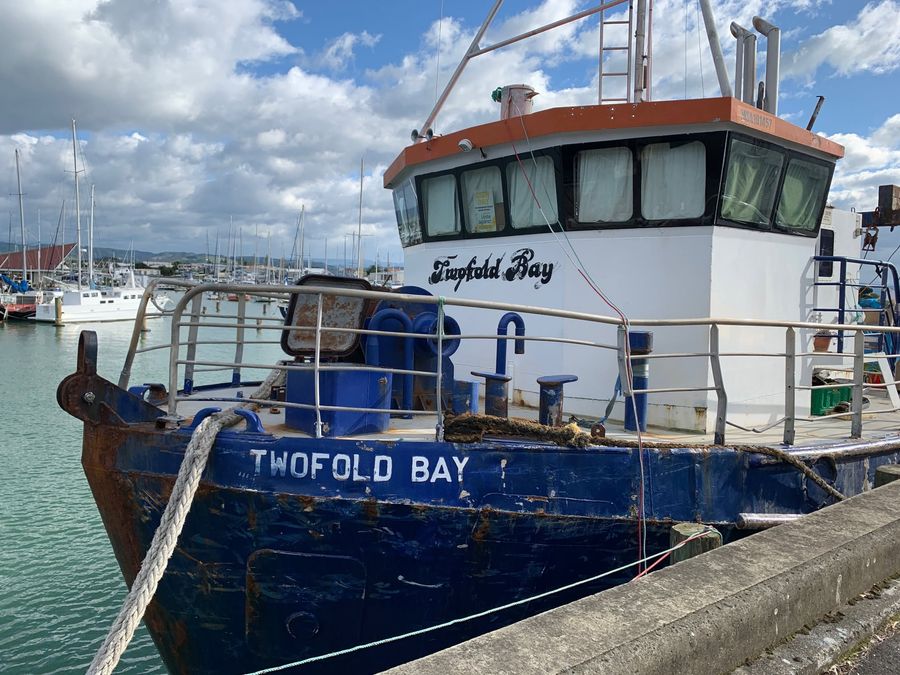
Shortly after 7am on the morning of the sinking, Twofold Bay moved through the Ahuriri channel for the last time, under tow, while a karanga rang out from the rocks at Te Karaka, the point that older charts still record as Perfume Point. By mid-morning she was moored to pre-laid buoys offshore, sitting quietly in the June light with Mahia faint on the horizon. At around 1:17pm, seawater claimed her. Horns sounded from the boats gathered around her as she went down, a last farewell from the water she had worked for most of her life.
The logic behind the project was not complicated. Hawke's Bay's inshore seabed is, for the most part, a flat and featureless muddy plain, offering little to the species that recreational anglers and divers most want to find. Crayfish, kingfish, snapper, and gurnard all rely on structure: something to shelter under, to hunt around, to colonise. As LegaSea Hawke's Bay put it, "It's a bit hard for crayfish to fly up to the surface." Rather than watch a redundant trawler slowly deteriorate on a dock, a determined group of people began working out how to give her a better ending.
The vessel was donated for the purpose by Napier businessman Rodney Green, and from that starting point the Twofold Bay Charitable Trust was formed, operating in partnership with LegaSea Hawke's Bay and alongside tangata kaitiaki Mana Ahuriri and Ngāti Parau Trust. What followed was the better part of three years, taken up by resource consenting, environmental assessment, careful planning, and a considerable volume of unglamorous volunteer work.
Volunteers worked through the hull methodically, removing engines, hydraulic lines, glass, hatches, and every other component that might pose a hazard to divers or cause harm to the marine environment, following the London Protocol for contaminant removal at every stage. More than 500 hours of volunteer labour went into preparing Twofold Bay for her new role, with organiser Alex Smith keeping the work moving forward week after week. In May, six cubic metres of concrete ballast were pumped into the hull, and the engines were lifted out through a section of cut deck by crane as the final major step. One working bee brought out a former skipper and a former deckhand, who came to watch and swap stories about Twofold Bay's working days, a few of which had probably improved in the telling.
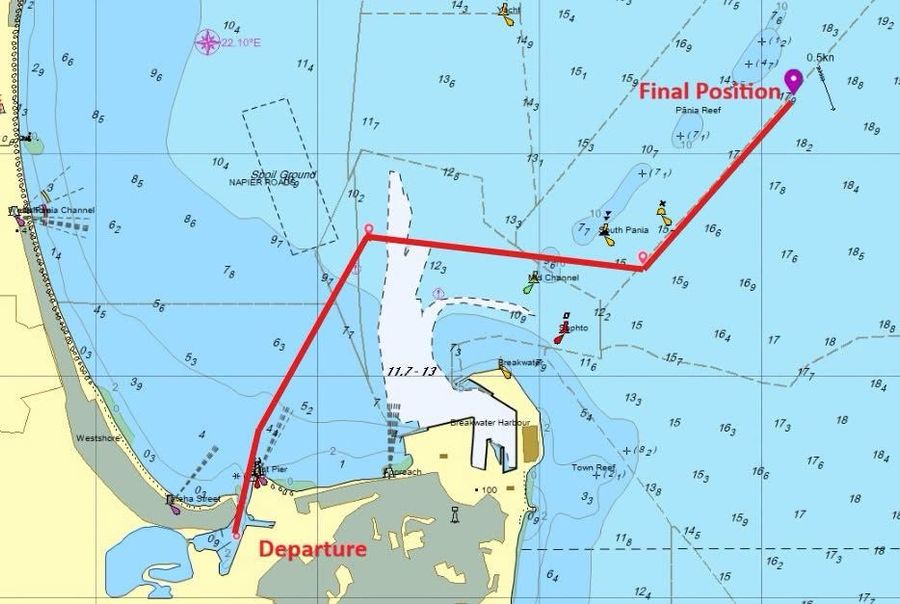
The chosen resting place lies three nautical miles from Napier Inner Harbour, approximately 400 metres east of Pania Reef. That location connects Twofold Bay to two other reef structures already established along the same stretch of coastline: a limestone boulder reef to the north, constructed from revetment wall material removed during the Te Whiti wharf development in 2021, and Pania Reef itself. Three linked reef systems across the same coastal strip will together sustain a far richer marine environment than any single structure could support on its own.
No explosives were used in the sinking. With Twofold Bay secured to her mooring buoys on site, seawater was pumped into the hull and she descended under her own weight, settling upright on the sandy bottom in 17 metres of water. That depth puts her within reach of recreational divers and boat fishers alike. A 100-metre exclusion zone was maintained around the site throughout the operation, keeping spectator craft clear, with the harbour master overseeing proceedings on the water.
In the coming months, up to 50 concrete reef cones will be placed across the seabed surrounding the wreck. Each pyramid-shaped structure weighs 1.2 tonnes, and together they will help stabilise Twofold Bay on the bottom while extending the footprint of the new habitat. Over time, algae and invertebrates will colonise the additional surface, drawing in baitfish and, in turn, the larger predators that follow them.
A rāhui currently covers the site while the wreck settles and divers carry out their safety assessments. Once that is lifted, Twofold Bay will be open for exploration, a new dive site and fishing ground for Hawke's Bay, built from a vessel that appeared to have exhausted every last thing she had to offer, right up until it became clear she had not.