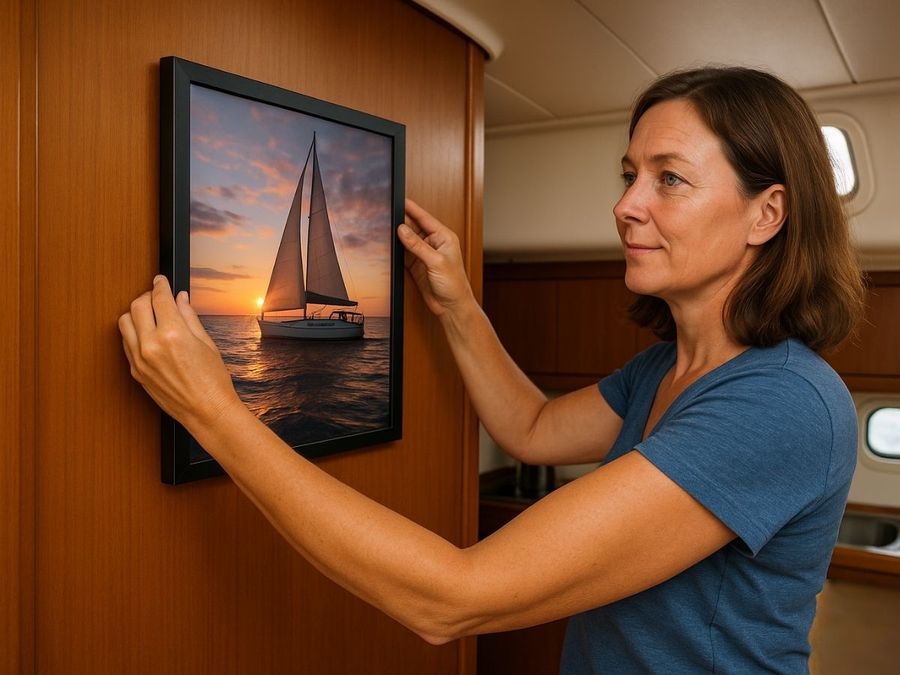
A boat is never just a possession. For the people who spend time aboard, whether that means a long weekend or several months of continuous cruising, it becomes something lived in, breathed in, and genuinely inhabited. Motor yacht owners, long-range cruiser sailors, and bluewater liveaboards all share the same instinct: make it yours. Personalising an interior is how that begins.
Soft furnishings are usually where it starts. Cushion covers, throws, and bed linen come first, and they do a lot of the work. But art is where a space stops feeling like a showroom and starts feeling like a home. More than any other element, it turns a floating interior into something with genuine character.
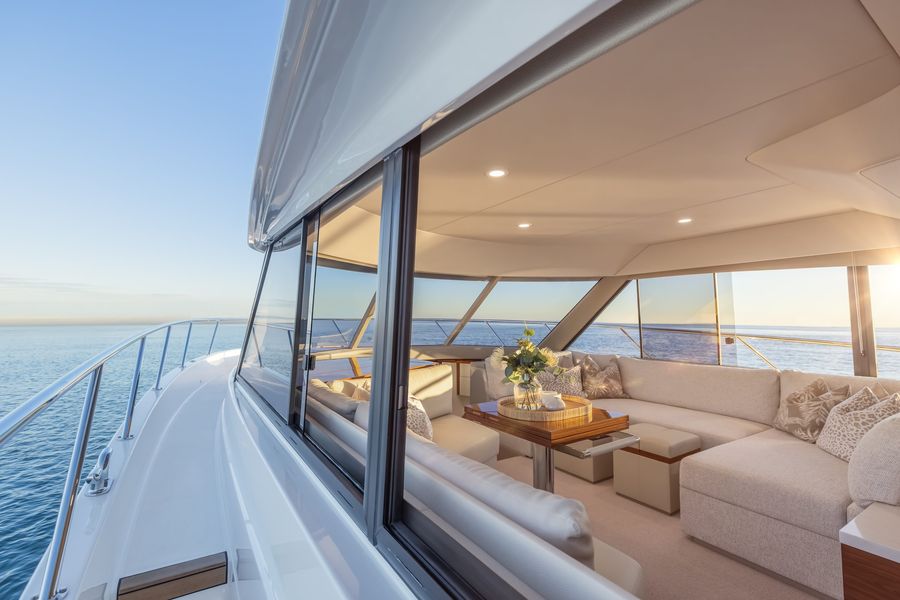
The catch is that a yacht moves. Hanging art aboard is a fundamentally different challenge from hanging it in a house, but it is far from impossible, and it does not require a specialist art handler or a megayacht budget to get right. Drawing on insights from Niamh Brennan and Sonya Romeo, co-directors of The Textile & Design Studio and the creative team behind Maritimo's luxury interiors, what follows is a practical and considered guide to sourcing and displaying art onboard.
Brennan and Romeo describe their philosophy plainly: "Artwork is the final layer that gives a yacht its soul." Having shaped the interiors of some of Australia's most admired motor yachts, they see art not as decoration applied after the fact, but as identity expressed in physical form. That thinking applies just as much to a smartly fitted $400,000 coastal explorer as it does to a $4 million cruiser. A boat should feel unmistakably like the person who owns it, and the right artwork is one of the most direct ways to achieve that.
“We use it to echo the owner’s story—whether that’s a single statement piece in the saloon or a quiet series in the staterooms—so every space feels personal rather than showroom-perfect.”
Mount it properly, or don't mount it at all
On land, a framed print faces very little in the way of physical threat. At sea, the situation is entirely different. Swell, vibration, slamming, and even the gentlest constant rocking can dislodge anything that is not properly secured. A framed photograph that comes off a wall underway is not just a broken piece of art; it is a potential hazard.
For small, lightweight frames, self-adhesive Velcro strips offer a surprisingly effective solution. One strip on the bulkhead, one on the back of the frame, and most canvas prints, photos, and lighter artworks stay put without leaving serious marks on your interior surfaces.
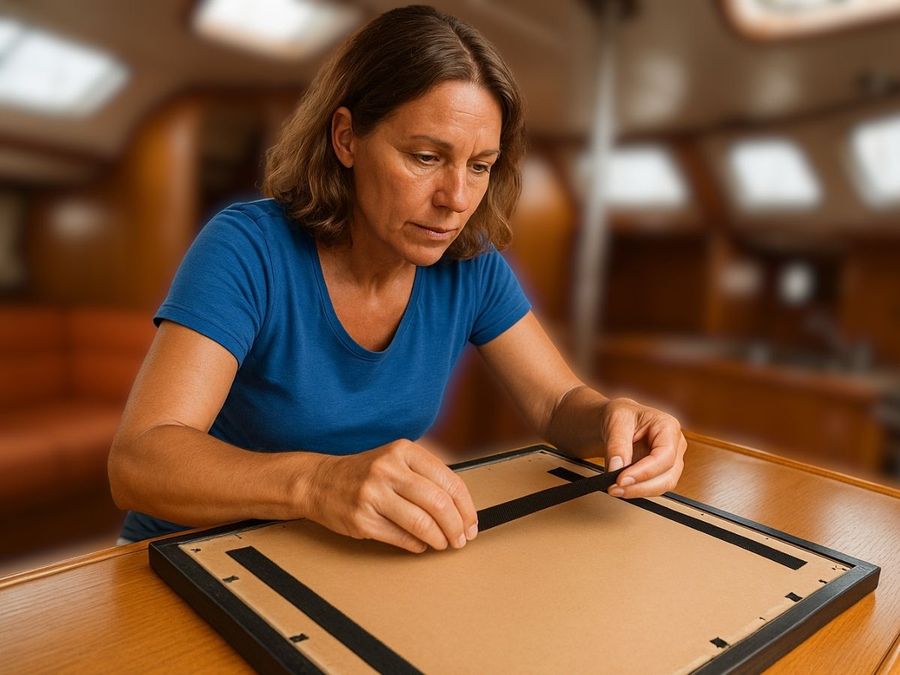
Heavier pieces, including substantial artwork and mirrors, need to be screwed directly into the bulkhead. One approach that balances security with flexibility is a top-hinged frame with Velcro at its base. The hinge holds the top firmly while the Velcro keeps the bottom from swinging, and the whole piece can be removed without tools when you want to change things around.
Brennan and Romeo consistently favour solutions built with life at sea in mind rather than adapted from onshore practice.
“The marine environment demands pragmatism: we favour lightweight substrates, non-glare glazing and vibration-proof framing systems that lock into place yet allow easy removal for service.”
Their reasoning comes down to three things: safety, longevity, and the freedom to refresh the space when the mood changes.
Think past the frame
Framed paintings and prints are not the only option, and on a boat they are not always the most practical one. Yacht designers are increasingly reaching for softer and more sculptural pieces that bring visual interest and texture without introducing the risk of shattered glass or damaged corners.
“We’re seeing more sculptural textiles—hand-woven wall pieces, fibre art and even acoustic fabric panels—because they add depth without the fragility of glass or ceramics.”
Fibre art, constructed from natural or synthetic materials including yarn, fabric, and thread, is one of the most compelling alternatives. It adds genuine texture to a surface, absorbs sound in a way that hard materials cannot, and travels far better in any kind of sea state than anything with a glass front. The visual impact can be just as striking, and the result often feels considerably more personal.
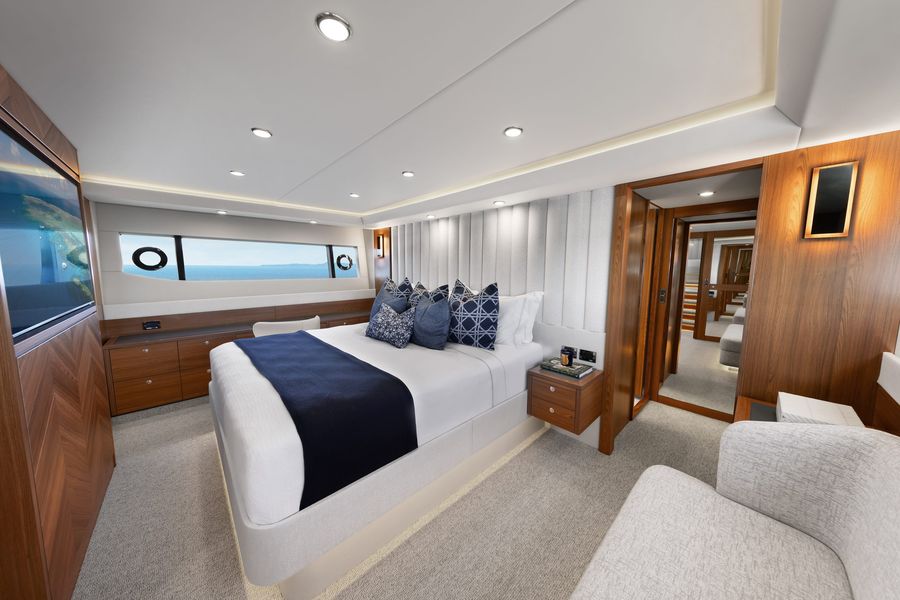
Artistic expression can also be worked into the boat itself. Panelling, cabinetry design, and even ceiling treatments offer opportunities to embed creative elements that are boat-safe by nature. A refit or a new build is the ideal moment to explore these possibilities, since they become part of the structure rather than something attached to it.
Getting the lighting right
Lighting art well is not purely an aesthetic exercise. UV exposure, heat, and direct glare can cause lasting damage to many types of artwork over time, with watercolours and photographic prints being particularly vulnerable.
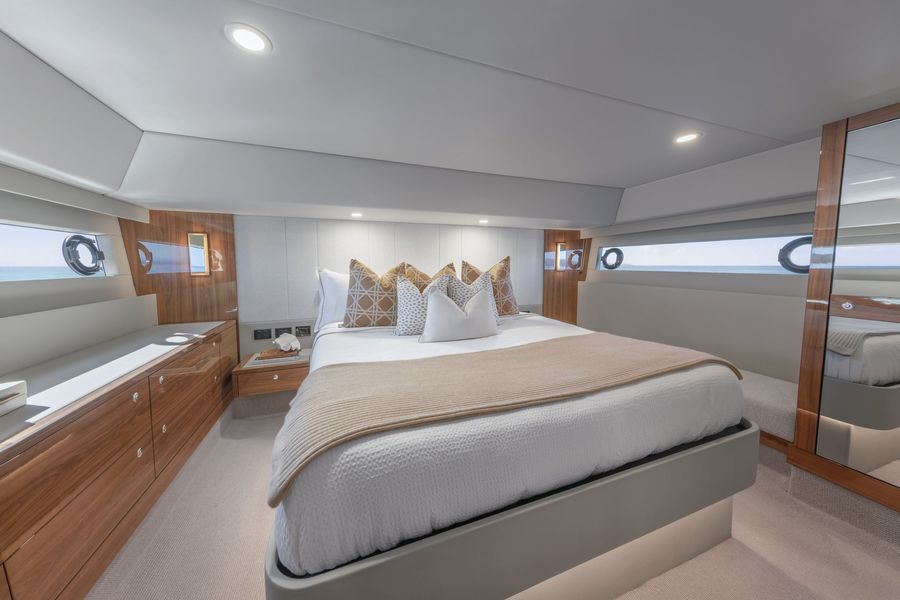
Brennan and Romeo address this from the very beginning of any interior project rather than treating it as an afterthought.
“Warm LED strips or track lighting give art the warmth it deserves while keeping heat off canvases. When integrated into overhead pelmets, it also avoids clutter on already compact ceilings.”
Whether you are adding a single piece to an existing interior or planning a complete fitout, think carefully about how light falls on your artwork. That means the natural light coming through hatches and windows at different times of day, as well as the artificial lighting you can control. A subtle, well-placed light source can transform how a piece reads in a space.
Protecting what you bring aboard
Museum-grade climate control is not a realistic expectation on a boat, and it is not necessary. A small number of thoughtful decisions, however, can protect artwork meaningfully, whether it is a $200 print or a family heirloom with no price attached.
Non-glare glazing is worth specifying wherever possible. It reduces reflections that make work hard to see, and it provides a degree of UV filtering that standard glass does not. Avoid mounting artwork near vents or hatches, where moist air and sudden temperature changes can warp frames and encourage mould. Heavier frames should be installed professionally, using corrosion-resistant fittings throughout. Photograph and document everything of value, particularly pieces that are part of your insurance cover. And if you use removable mounts, you retain the option to rotate pieces between seasons, which keeps the interior feeling fresh without significant effort or expense.
"It has to inspire."
Space is limited on any boat, which means every single detail registers. The things you see every morning when you come up from the cabin, and every evening when you sit down in the saloon, accumulate into the overall feeling of being onboard. A piece of art that makes you stop and look, that brings back a memory or simply makes you feel something, has done exactly what it should.
That is the standard Brennan and Romeo bring to their work on yacht interiors. Placement is never purely about filling a wall or balancing a colour palette. It is about meaning, and about making the experience of being aboard something more than comfortable. Whether you are working with an interior design team from the keel up, or simply thinking about what to add to a saloon that has always felt slightly unfinished, find something that genuinely speaks to you, and then hang it properly.