
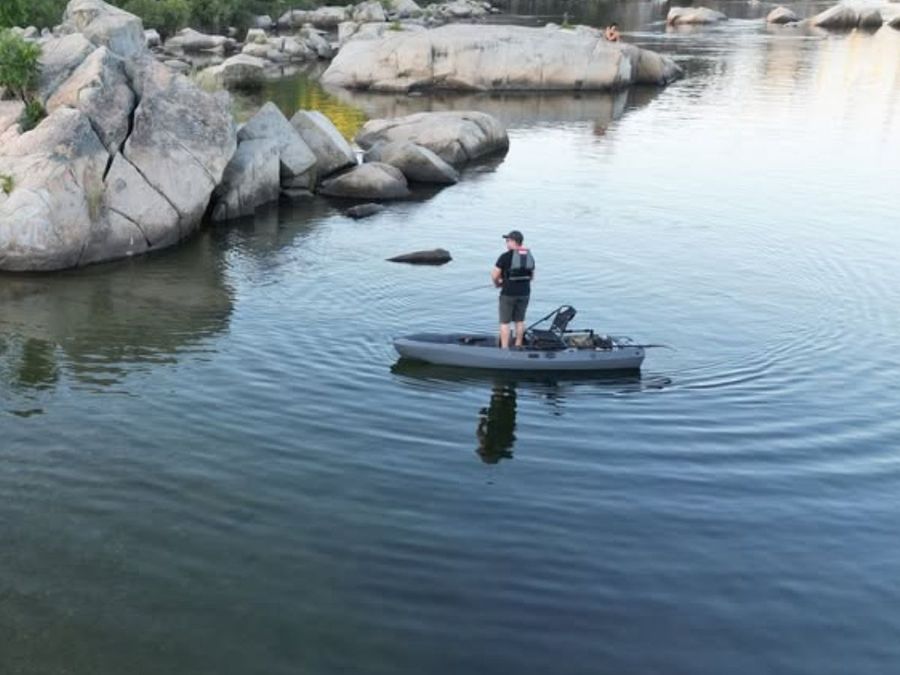
Among more than 800 products vying for attention at ICAST 2025 in Orlando, the world's largest fishing trade show, the standout winner was neither a rod nor a reel. It was a kayak. Specifically, it was the FluxJet Kayak, the world's first electric jet-powered fishing kayak, which claimed both Best of Show and Best Boat or Watercraft in the New Product Showcase. The quietest machine on the floor turned out to make the biggest noise.
The FluxJet Kayak was developed in California by the same team behind the Kymera Board. Its defining feature is a patented FluxJet propulsion system that sits flush within the hull. The entire drive unit weighs under 5 pounds (2.3 kg) and contains no propellers, driveshafts, or exposed moving parts. Instead, a direct-drive ring motor encircles the impeller, producing a system that is whisper-quiet, clog-resistant, and free of any rudder or external motor. For anyone fishing in weed-choked backwaters, that last point matters considerably.
CEO Jason Woods, a veteran of the marine propulsion sector, has described the project as ten years in the making.
“We started with a blank slate,” Woods explains. “Every part had to justify its existence. If there was a way to do it without seals, shafts, or bearings — we took it.”
The minimalist engineering delivers more than simplicity. Because the impeller and its surrounding ring rotate together, the gap where sand or grit might otherwise jam the blades is virtually eliminated. The arrangement also allows more water to pass through the system, increasing thrust while keeping acoustic output to a minimum. For anglers who rely on stealth, that combination is a genuine advantage.
The production FluxJet Kayak carries a price of US$2,999. It measures 132 inches (3.35 m) in length, 35 inches across, and weighs just 88 pounds (40 kg). Standard Group 31 batteries are compatible, and the system accepts voltages anywhere from 12V to 60V. The motor produces 1,000 watts of continuous output, enough to push the kayak beyond 6 mph (10 km/h). Battery choice also determines range: paddlers can expect up to 16 hours of runtime, which comfortably covers a full day on the water.
The deck has been fitted out with anglers firmly in mind. Transducer-ready construction, modular accessory rails, a recessed throttle switch, navigation and deck lights, built-in USB charging, adjustable foot pegs for steering, and generous storage fore and aft are all standard. Steering is managed through foot-controlled vectored thrust, doing away with a rudder entirely.
“It’s a clean, simple kayak that works straight out of the box,” says Woods. “And it gets into ridiculously shallow water.”
Claiming Best of Show at ICAST is no small achievement at any time, and for a first-time exhibitor the double win carries real weight. FluxJet's low-profile, high-performance approach won over voters drawn from both the retail and media sectors.
“My biggest fear was that people wouldn’t realise what they were looking at,” says Woods. “Because it’s so integrated, they might walk by without understanding what the drive system really does. But they got it.”
More than 12,000 attendees from 78 countries passed through the show, and FluxJet's double win has been widely read as a signal of shifting expectations in small watercraft propulsion.
Although the FluxJet Kayak was purpose-built for fishing, the underlying technology was always conceived with wider uses in mind. The drive unit has already been tested in body boards and small inflatables, and future applications could include tenders, ultralight runabouts, and electric surfcraft. With a weight as low as 4 pounds and scalable output ranging from 5 kW to 25 kW, the modular power unit carries real potential to stimulate innovation across the light-electric marine sector, particularly where silence, shallow-water access, and portability are the priorities.
Preorders for the FluxJet Kayak open on 1 August 2025, with production models expected to ship early the following year. Early interest is strong, and the reaction at ICAST helps explain why. What took home the awards in Orlando is not simply a kayak fitted with a motor, but a considered rethinking of what powered paddling can look like.