Chris Newman spent the night at Mercury Cove on the Coromandel, and by all accounts he chose his spot well. Acting on advice from the New Zealand sailing crew, he rode out the storm without incident, the water inside the cove holding surprisingly flat despite an easterly blowing at 25 knots and gusting to 30. When he checked in, the barometer was reading 1005 hectopascals and still dropping, with the eye of the storm due to pass through late morning and bring a brief break in conditions. His report was composed and matter-of-fact, the kind that comes from someone who has picked their anchorage carefully.
His 11am update, sent from within the eye of the storm:
Conditions beyond that sheltered cove told a different story. RNZ reported gusts reaching 130 kilometres per hour in the outer Hauraki Gulf and around Coromandel through the night, with trees coming down across power lines and more than 600 homes losing power in the Coromandel Forest Park area between Te Kouma and Te Mata. PowerCo's outage map listed landslip as the cause of some individual outages.
Northland bore the worst of it. The entire region is under a state of emergency, with gusts of 120km/h recorded at Cape Reinga and Tutukaka Harbour overnight. More than 100mm of rain fell across parts of Northland in 24 hours, with the Whangarei CBD recording 122.5mm. Around 1,000 homes between Waimamaku and Whirinaki in the Far North lost power, though some have since been reconnected. In central Kerikeri, six households were evacuated over concerns about a nearby stand of redwood trees.
Three state highways remain closed. SH2 through Waioweka Gorge, SH1 through Mangamuka Gorge, and SH35 between Te Araroa and Hicks Bay were all shut as a precaution. Emergency Management Minister Mark Mitchell urged people off the roads and out of the weather, issuing a direct warning not to wait for official alerts before acting. "If you see flood waters rising or suspect that a landslide is about to occur, get away immediately."
Fire and Emergency responded to twelve incidents overnight, none life-threatening, with most callouts involving fallen trees and roofs lifting in the wind. Rescue teams remain on standby in Whangarei, Auckland, Rotorua, Tairawhiti and Coromandel.
The main concern through today is Tauranga. Civil Defence has flagged a potential threat to life around this afternoon's 2.30pm high tide, when the centre of the cyclone is expected to sit directly over the city. Coastal and low-lying residents have been urged to self-evacuate now, with centres open at Whakamarama Hall, Baypark and Matua Bowling Club.
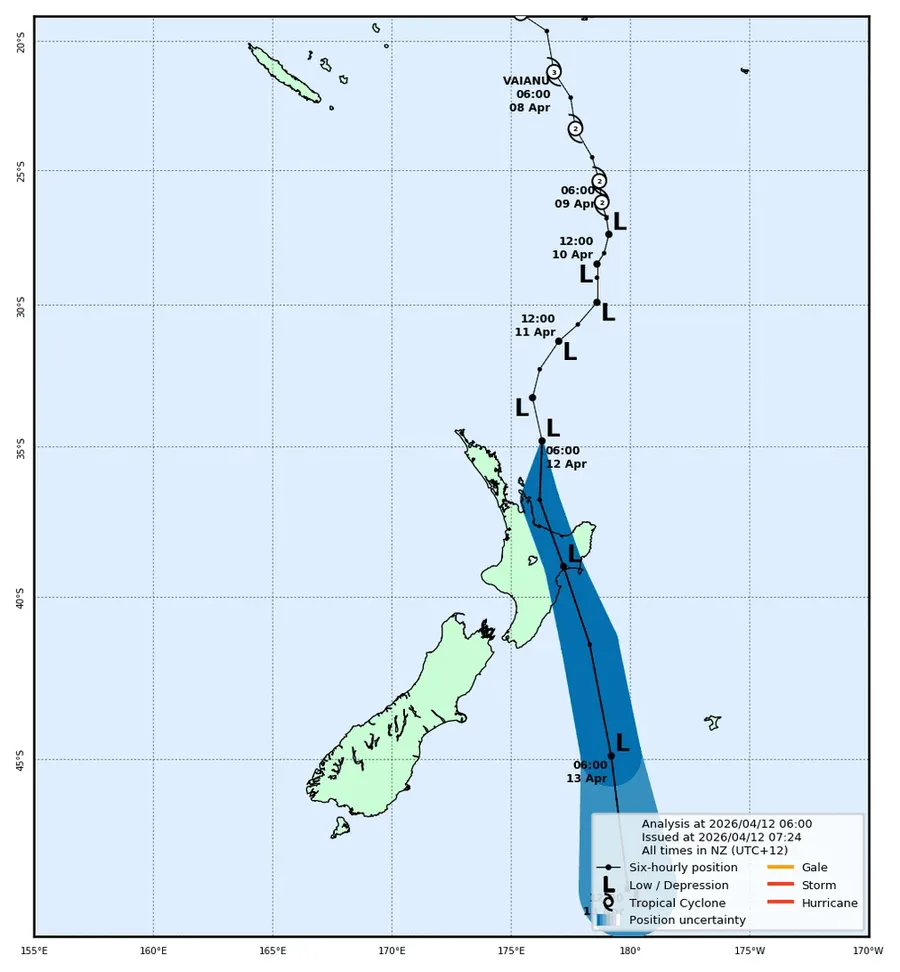
At 7.46am, the centre of Cyclone Vaianu was positioned 160km northeast of Great Barrier Island and still tracking southeast. MetService warnings for Northland remain in place, with a review scheduled around 10am. Rain has largely stopped in the Far North but continues in Whangarei and Kaipara.
The morning has gone better than many feared. What the afternoon brings around Tauranga is another question.