Few production yachts carry half a century of history, and fewer still can claim to have reinvented themselves so thoroughly three times over. With 2027 marking the 50th anniversary of the Beneteau First 30, it is worth tracing exactly how different each generation of that boat has been from the last, and what those differences reveal about how sailing itself has changed.
Three versions of the First 30 have appeared across five decades. Each one was shaped by the performance thinking of its moment, from an IOR rule-chasing cruiser racer to a hard-chined offshore weapon, and now a lightweight planing cruiser built for a generation that grew up on sport boats. The name has remained constant. Almost nothing else has.
*1977 to 1982: born from Half Ton ambition*
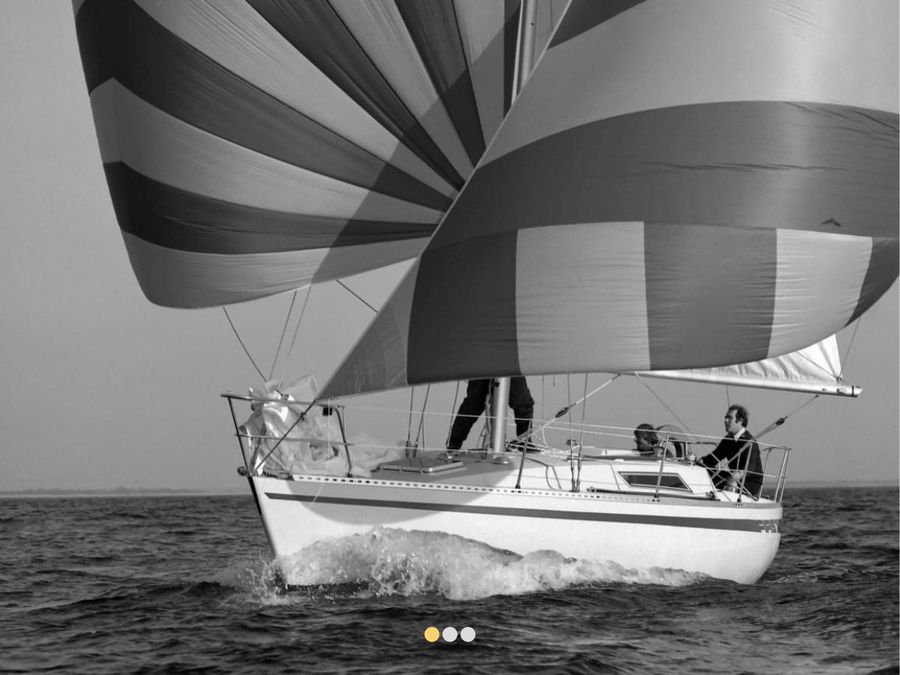
The story begins in 1977, when the original First 30 became the founding model of Beneteau's First range. Its strong commercial reception and competitive record gave Beneteau the confidence to extend the concept across a family of sizes, eventually producing the First 22, First 25 and First 28 alongside it. Between them, these boats opened up production performance sailing to a much wider audience.
André Mauric drew the design, and he drew it directly from his Half Ton race boat experience. The Half Ton Cup was run under the International Offshore Rule, a complex measurement formula that grouped boats into rating bands expressed in tons. Designers who wanted to win within a given band learned quickly how to sculpt hull sections, manage measured girths, and tune keels and rigs to optimise a rating number. The results were often powerful, purposeful boats with strong upwind ability and distinctive stern shapes.
Mauric's starting point for the First 30 was Impensable, his Half Ton Cup winner from 1973. For production, he extended the coachroof, softened the pure race hull, and added a cruising interior. The outcome was a genuine dual-purpose boat, competitive on the racecourse and comfortable enough for a weekend away.
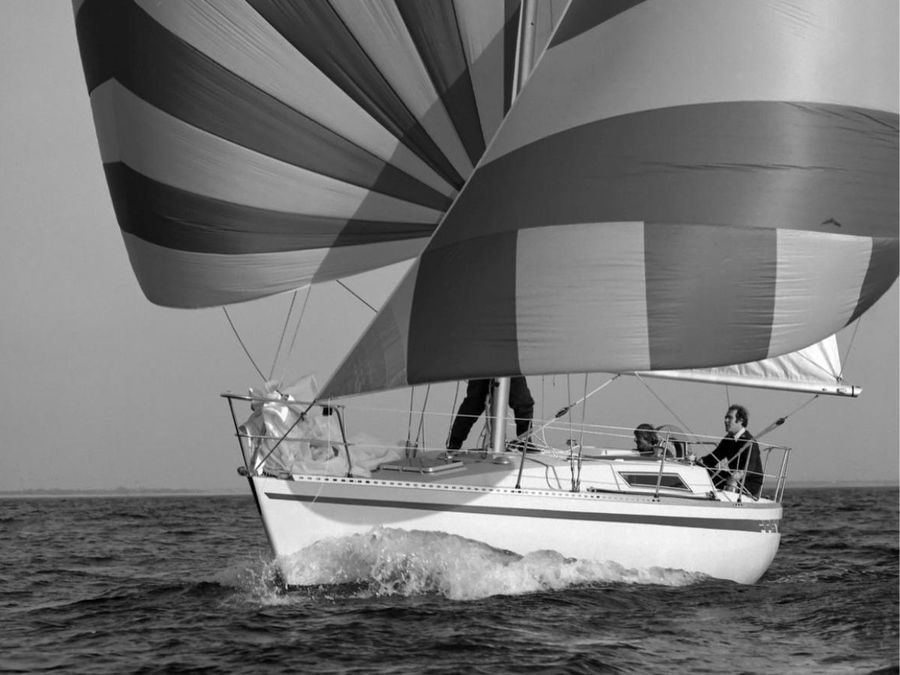
The hull carried a relatively deep fin keel and a single spade rudder, with displacement in the range of 3,500 to 3,600 kg depending on configuration. That ballast ratio and mass gave the boat real drive upwind in a blow, without sacrificing responsiveness at the helm.
The connection to top-level Half Ton racing only deepened in the years that followed. In 1980, Mauric's First Lady won the Half Ton Cup outright. The following year, King One, another Mauric design, took the title with Paul Elvstrøm on board. Those were purpose-built custom race machines rather than showroom boats, but the hull forms and technical refinements they developed fed directly into the First 30 Evolution variant. That lineage gave the production boat genuine racing credibility rather than borrowed prestige.
Production figures reflected its popularity. Eight hundred and twenty-four First 30s were built within the first five years, with estimates suggesting more than 1,000 hulls were produced across the standard model, the Evolution, and related variants. For many sailors of that era, owning a First 30 was their entry point into serious cruiser racer sailing, and the boat remains a respected IOR-era classic today.
*2010 to 2015: Juan K and the offshore reset*
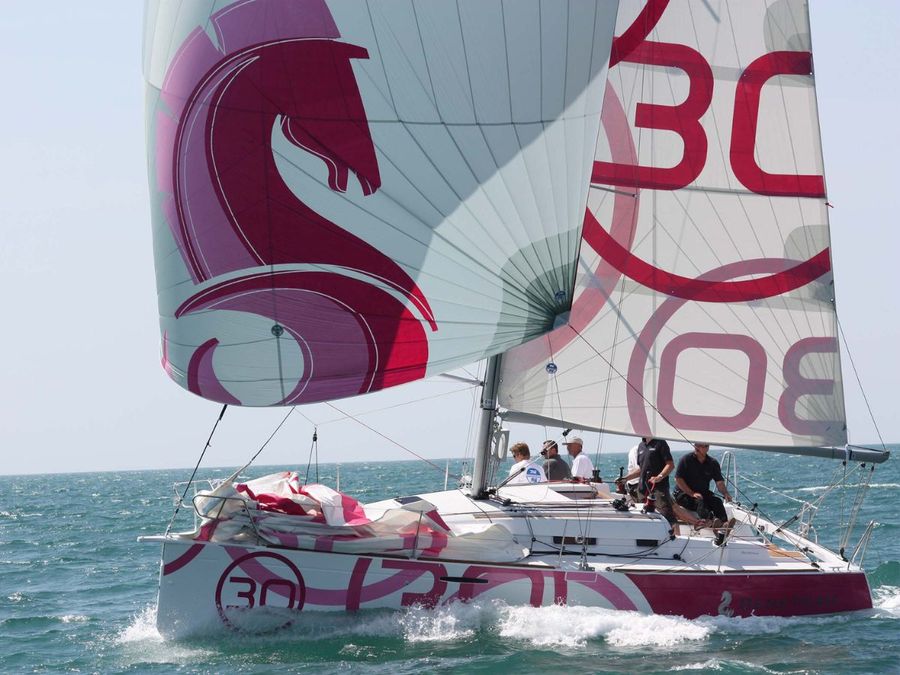
Beneteau revived the First 30 name in 2010 after a long absence, and the contrast with the original could scarcely have been greater. The new boat, known as the First 30 JK, was designed by Juan Kouyoumdjian with input from Vendée Globe winner Michel Desjoyeaux. Its debut at Cowes Week, wearing a vivid pink hull, announced its intentions before anyone had seen the sail plan.
Technically, it represented a thorough embrace of modern offshore race thinking. Twin rudders replaced the original single spade. Hard chines ran aft along the hull to increase form stability. A T-shaped keel with a lead bulb pushed the centre of gravity lower. The rig moved away from overlapping headsails and running backstays, favouring a cleaner, more manageable sail plan suited to short-handed sailing offshore.
Measuring 9.8 metres overall with a displacement of around 3,750 kg, the JK was heavier than its sharp lines implied. Reviewers found it delivered well on its promises, praising its control and stability when driven hard, particularly on a reach or in offshore conditions. It was a direct, physical boat that rewarded confident sailing.
Below, the interior offered approximately 1.85 metres of headroom and a functional contemporary layout. Comfort was considered, but this was clearly a boat built for sailors who prioritised going fast and sailing properly offshore rather than cruising in luxury.
The JK never accumulated production volumes to match the original First 30. What it did do was reinforce the idea that the First name stood for genuine innovation rather than sentiment about past glories.
*2025 onwards: lighter, faster, built for planing*
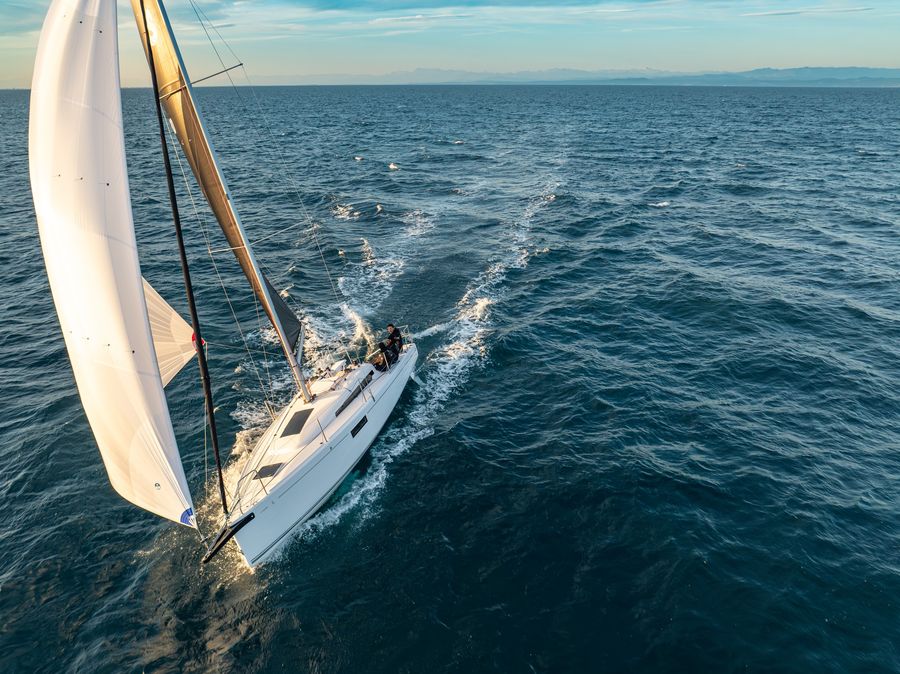
The third generation First 30 was unveiled at boot Düsseldorf in January 2025. Beneteau brought in the Seascape team for this project, working with designer Samuel Manuard, and the direction taken was different again from either predecessor.
Where the JK was shaped by offshore race culture, the new boat is focused on light displacement performance and the ability to plane. At 10.33 metres overall, it is longer than the JK, yet at approximately 3,150 kg it is around 600 kg lighter. Vacuum infused construction and a fully cored structure are central to achieving that weight reduction.
The hull form is shaped to reduce wetted surface and encourage dynamic lift as boat speed builds. A higher sail area to displacement ratio than the 2010 model means the boat is designed to move beyond pure displacement sailing and into semi-planing and planing modes in moderate breeze, especially on a reach or broad angle downwind. Twin rudders maintain grip and control as heel increases, keeping the leeward blade working effectively when the boat is pressed hard.
This is performance expressed through acceleration and sensation rather than handicap numbers. It reflects a generation of sailors whose frame of reference is sport boats and short-handed offshore racing, where light weight and lively handling carry more value than rating optimisation.
Two configurations are available. The Cruising version keeps the cockpit straightforward, with oversized winches and simple control layouts. The Racing version adds a mainsail traveller and more adjustable sail controls for crews who want to extract the last bit of trim from the rig. Electric propulsion is offered as an option alongside the standard diesel installation.
Below decks, the interior includes two cabins and around 1.85 metres of headroom. Sustainable material choices feature alongside lightweight solutions, with cork flooring, textile lockers, and magnetic closures all contributing to the overall brief of keeping weight down without sacrificing practicality.
*Three boats, one name, fifty years*
Place the three versions of the First 30 side by side and what emerges is three very different answers to the same underlying question: what does performance sailing look like for committed but practical sailors?
The 1977 original established the First range and gave Beneteau its performance identity at a time when IOR ruled the racing world. The 2010 JK took offshore race thinking seriously, signalling its ambitions with hard chines, twin rudders, and a pink hull that nobody forgot. The 2025 model chases planing speed and light-air responsiveness, shaped by modern sailing culture rather than any measurement band.
What runs through all three is a consistent intent: to build real sailing performance into a manageable, production package that keen sailors can actually afford and sail. Across half a century, the First 30 name has never settled for standing still, and that willingness to keep changing may be exactly what has kept it relevant.