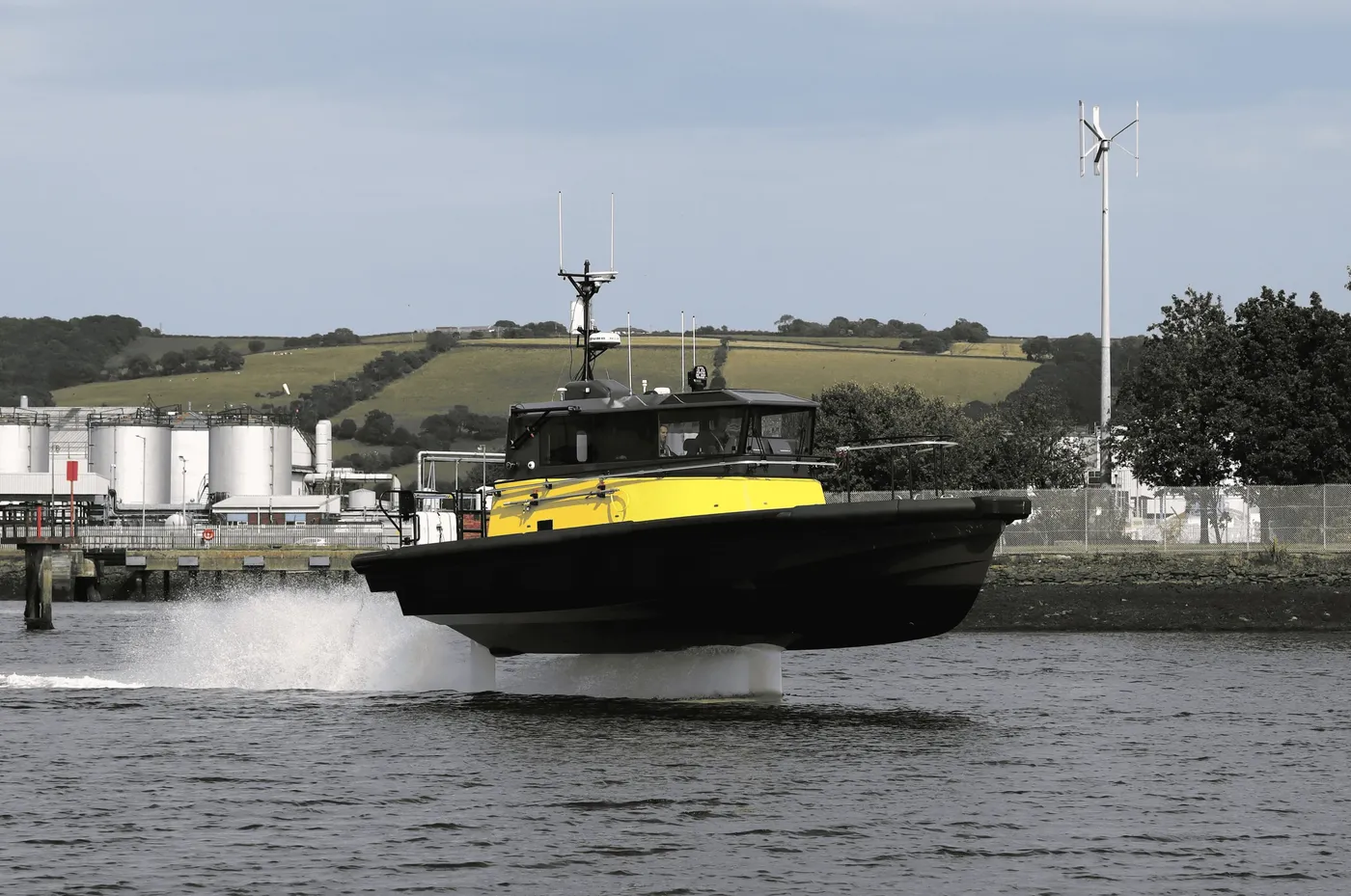
Artemis Technologies, based in Belfast, has put the world's first fully electric hydrofoil pilot boat into the water. The EF-12 Pilot has completed sea trials and is now ready for commercial deployment.
Pilot boats represent one of the more persistent emissions challenges in port operations. Running around the clock to shuttle licensed harbour pilots to and from arriving and departing vessels, these workhorses almost never shut their engines down. A conventional diesel-powered pilot boat burns between 450 and 800 litres of fuel daily, producing as much as 1,200 tonnes of CO2e per vessel each year. They also operate in precisely the kinds of sensitive coastal and harbour environments where diesel exhaust, engine noise, and the wash thrown up by fast-moving hulls each carry their own layer of impact. The EF-12 Pilot has been engineered to address all three.
The foundation of the design is Artemis's eFoiler system, which makes fully electric propulsion viable at the speeds pilot boats demand. Rather than forcing a heavy displacement hull through the water, the eFoiler deploys carbon-fibre hydrofoils that lift the entire vessel above the surface once it reaches operating speed. Removing the hull from the water cuts hydrodynamic drag significantly, and that reduction in drag is what makes a practical electric range possible. Pushing a conventional hull through the water at 25-plus knots demands far more energy than flying above it, and that gap has defeated most previous electric workboat projects when they have tried to deliver speed and range together. The foils change that fundamental equation.
Keeping a foiling hull stable under real working conditions calls for more than foils alone. An autonomous flight control system monitors and adjusts ride height, roll, and pitch continuously, maintaining a steady deck through turns, choppy water, and the pressure waves that large vessels generate. When the EF-12 Pilot slows to displacement mode for close-quarters manoeuvring alongside a ship, wake is eliminated entirely, a quality that matters both for crew safety during pilot transfers and for avoiding wash damage to other harbour traffic nearby.
Two propulsion configurations are available. The dual 540 kW variant achieves a top speed of 32 knots with a foiling range of 45 nautical miles, while the single 270 kW version reaches 30 knots with a range of 47 NM. Both variants cruise at 25 knots and can be recharged fully in under an hour via ultra-fast DC charging. Without fuel systems, oil changes, or exhaust installations to service, ongoing maintenance requirements are also considerably lower than those of a comparable diesel vessel.
The environmental benefits reach further than simply cutting tailpipe emissions. Because the hull flies above the water at speed, the EF-12 Pilot produces none of the wash that displacement hulls create at equivalent speeds, reducing shoreline erosion, protecting harbour-floor ecology, and lowering underwater noise levels. For port authorities operating under environmental regulation, those gains sit alongside the headline carbon figures as meaningful advantages.
Sea trials were conducted at Cork Harbour, where the EF-12 Pilot completed 15 ship contacts across four vessel types ranging from 90 to 158 metres in length. The wheelhouse has been configured with pilot transfer operations in mind, featuring large wrap-around windows and a custom 8-inch HMI display that presents battery status and vessel performance data in both day and night modes.
CEO Dr Iain Percy described the vessel's purpose in practical terms: "Pilotage places very specific demands on a vessel. The Artemis EF-12 Pilot applies proven foiling technology to meet those demands, delivering an efficient, fully electric solution that supports pilots, crews and port operations globally."
Among the first confirmed customers are Brabo in Belgium, the Swedish Maritime Administration, Noatum Maritime in Abu Dhabi, and the Port of Tyne in the United Kingdom. The EF-12 Pilot builds on more than four years of operational experience with the eFoiler platform, which also forms the technical basis for Artemis Technologies' crew transfer vessels and passenger ferry designs.