Autonomous boating technology has been building quietly in the background for years. If you've spent any time watching the self-driving car industry develop, you've probably started wondering when something comparable would show up on the water. That moment has either already arrived or is close enough that it warrants your attention.
Start with the reassuring part: nobody is about to make the helm redundant. The systems actually reaching the market are far more practical than the science-fiction version of this story would suggest. Nobody is proposing you crack open a cold one while your boat threads its own way through the Hauraki Gulf unaided. These technologies target very specific problems, and the right way to think about them is as tools that assist the skipper rather than replace one.
The industry term that has coalesced around this middle ground is situational autonomy. The spectrum itself will feel familiar to most Kiwi boaties, who are already somewhere on it. An autopilot locked onto a heading, a chartplotter following a planned route, these are low-end members of the same technology family. At the far opposite end sits a vessel capable of operating with no human input whatsoever, which remains far more concept than product. What's actually reaching consumers falls between those two poles.
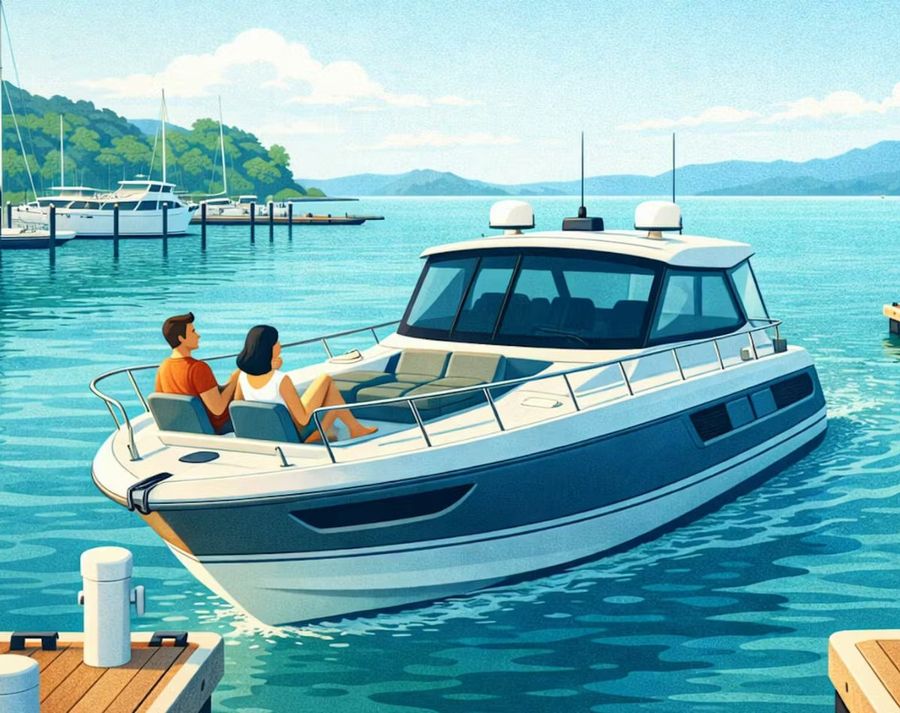
The goal of these emerging systems is not to strip away the pleasure of handling a boat. It's to take over the moments most skippers find genuinely stressful: squeezing into a tight marina berth, approaching a dock at an awkward angle, or holding position while a gusty wind tries to push you sideways into someone else's pride and joy. Those are precisely the scenarios these systems are engineered for.
Getting reliable autonomous technology to work on the water has proven considerably harder than on land. Roads come with lanes, markings, and predictable surfaces. The marine environment offers none of that. Wind, current, tidal flow, and wave action shift constantly and affect how a vessel handles in real time. That layered complexity goes a long way towards explaining why this space has matured more slowly than its road-based equivalent.
The most significant product to emerge recently is Simrad's AutoCaptain system, launched in late 2025. Developed in collaboration with Mercury Marine and initially available on Boston Whaler models, it uses a network of six cameras to provide 360-degree situational awareness around the vessel. Through a touchscreen interface, the system handles docking, undocking, and short-range manoeuvring autonomously. It doesn't depend on pre-mapped marina locations, meaning it functions anywhere rather than only in places it has already been taught to recognise.
A second system worth following is the Avikus Neuboat Control, backed by HD Hyundai. It takes a broadly comparable approach, combining an integrated sensor array to manage steering, throttle, and collision avoidance. Like AutoCaptain, it keeps the skipper informed and in command throughout. A useful shorthand for both systems is assisted parking for boats. True autonomy, in any meaningful sense, is not what either of them offers.
New Zealand is not simply watching from the sidelines while overseas developers push this technology forward. Earth Sciences New Zealand, formerly NIWA, has already been operating a six-metre autonomous trimaran in local waters, collecting fisheries acoustic data through a collaboration with NZ drone company X-Craft Enterprises. The work is research-focused rather than recreational, but it confirms that autonomous vessels are already being tested in genuine New Zealand sea conditions.
Closer to the everyday boating experience, NZ company Tectrax has developed a product called the Boat Launcher, an autonomous, GPS-guided amphibious trailer. Using onboard sensors and a remote control, it can drive itself to and from the water and be operated from up to 500 metres away. The system is aimed particularly at older boaties and those with mobility challenges, and it represents a practical, here-and-now example of autonomous technology solving a real problem for Kiwi boat owners.
On the regulatory side, Maritime NZ and MFAT have published guidance for operators of small autonomous surface vessels in New Zealand waters, though the current framework is directed primarily at commercial and research applications. Rules specific to recreational autonomous boating haven't caught up yet, which is consistent with the way most emerging technology moves through the regulatory process. As these systems shift from niche products to mainstream ones, the framework will follow.
The broader trajectory towards technology-assisted boating mirrors what has already played out with electric boats. The technology moves faster than the rulebook, and boaties have always tended to be early adopters.
For most Kiwi boaties right now, none of this demands immediate action. The available systems are expensive, currently tied to specific overseas brands, and not yet readily accessible in New Zealand. But the direction is clear, and development in this space has been moving quickly.
What won't shift, regardless of how capable the technology eventually becomes, is where responsibility sits. Maritime NZ is unambiguous on that point: the skipper is responsible for the vessel and for everyone aboard it. Knowing the rules, maintaining a proper lookout, and making sound decisions on the water remain non-negotiable, whatever assistance technology one day provides.
For now, the piling is probably the only party that might prefer a different arrangement.